
Some links on this page are affiliate links. If you book or buy through them, I earn a small commission — at no extra cost to you. How this site is funded →
You can see most of the region’s best Christmas markets using trains, local buses and seasonal shuttles alone. December is actually the easiest month to do it: extra services run, markets cluster around railway towns, and driving means dealing with closed town centres and full car parks anyway. This page shows which markets are genuinely reachable car-free, how to chain them, and where a car still wins.
In short
- Strasbourg and Colmar are fully car-free friendly. Both have main-line stations within a 10–15 minute walk of their markets.
- The easiest village markets to reach by public transport are Obernai, Sélestat, Barr, Ribeauvillé (bus from Colmar or Sélestat), Turckheim and Kaysersberg (bus from Colmar).
- Riquewihr and Eguisheim need a bus or a seasonal shuttle from Colmar; they are doable but need planning around return times.
- Base yourself in Colmar or Strasbourg, not in a village, if you have no car. Villages have limited evening services.
- Buy a regional day pass if you plan more than two trips in a day; it usually beats single tickets.
- The main constraint is the last bus home, not the first one out. Check return times before you commit to an evening market.
Why car-free works well in December
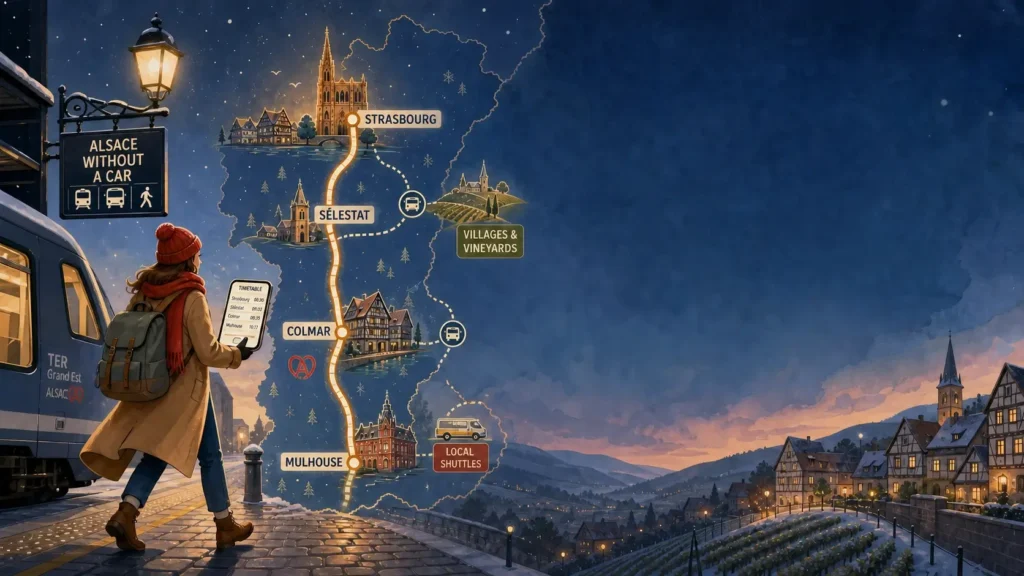
Alsace has a dense railway spine. The main line runs north to south along the plain, linking Strasbourg, Sélestat, Colmar and Mulhouse, with regional TER trains running frequently throughout the day. Most of the towns hosting large Christmas markets sit on or very near that line.
The vineyard villages sit a few kilometres west, on the slopes. They are not on the railway, but they are served by regional bus routes that connect back to Colmar and Sélestat, and several markets add seasonal shuttles during the market season.
There is a practical argument too. In December, town centres in Strasbourg, Colmar and the larger villages close to traffic or restrict access during market hours. Parking fills early, especially at weekends, and evening traffic on the approach roads to Colmar and Riquewihr can be slow. Arriving on foot from a station is often faster than arriving in a car and then finding somewhere to leave it.
For the wider picture on when markets open and how the season is structured, start with the complete guide to Alsace Christmas markets and the practical overview of Christmas market dates and opening times.
Which markets are realistically reachable without a car
| Market | How to get there | Practical difficulty |
|---|---|---|
| Strasbourg | Main-line station, walk to the centre | Very easy |
| Colmar | Main-line station, walk to the centre | Very easy |
| Mulhouse | Main-line station, walk to the centre | Very easy |
| Sélestat | Main-line station, short walk | Very easy |
| Obernai | Regional train from Strasbourg | Easy |
| Barr | Regional train from Strasbourg | Easy |
| Turckheim | Regional train from Colmar | Easy |
| Ribeauvillé | Bus from Colmar or Sélestat | Moderate |
| Kaysersberg | Bus from Colmar | Moderate |
| Riquewihr | Bus or seasonal shuttle from Colmar | Moderate |
| Eguisheim | Bus or seasonal shuttle from Colmar | Moderate |
Treat « moderate » as meaning: perfectly feasible, but check the return timetable before you leave, and do not assume a late-evening service exists.
Where to base yourself if you have no car
This is the single decision that shapes your whole trip. Two bases work; village bases mostly do not.
Colmar is the strongest choice for a car-free Christmas market trip. It hosts several markets of its own, sits on the main railway line, and is the departure point for the bus and shuttle routes serving the vineyard villages. Nearly every village market you want to see is a day trip or a half-day trip from here.
Strasbourg works if the large city market is your priority, or if you are arriving by TGV from Paris. It gives you the biggest market in the region, excellent onward rail links, and easy access to Obernai, Barr and Sélestat. Vineyard villages are further, so plan a full day or move to Colmar mid-trip.
A village base looks romantic and causes problems. Bus services thin out in the evening, Sundays are quiet, and you will end up either leaving markets early or paying for taxis. If you strongly want a village stay, do it with a car and read the wider comparison in where to base yourself in Alsace.
Accommodation near a station and near the market perimeter is the whole point when you have no car, and December is the tightest month of the year for rooms in both Colmar and Strasbourg. Properties within walking distance of the centres tend to be committed months ahead, so fix this before you fix anything else. Compare central options in where to stay in Colmar and Strasbourg accommodation areas, or look specifically at hotels near the Christmas markets.
Where to stay when you have no car
In Colmar, aim for the triangle between the station, Petite Venise and the old town. In Strasbourg, the Grande Île, the Krutenau and the station quarter all put you within walking distance of the markets.
See available stays in central Colmar – See available stays in central Strasbourg
Filter by distance from the centre rather than by price. Without a car, 3km out costs you a taxi fare every evening — and a walk you will not want to make in December drizzle.
Getting to Alsace without a car in the first place
Strasbourg is directly connected to Paris by high-speed train, and the journey is comfortably shorter than driving. From Paris, arriving by high-speed train and continuing by regional rail makes a car-free trip straightforward, especially if you base yourself in Strasbourg or Colmar.
If you are flying in, EuroAirport Basel-Mulhouse-Freiburg is the closest airport to the southern part of the region, with onward bus and rail connections towards Mulhouse and Colmar. Strasbourg Airport is connected to Strasbourg station by a TER shuttle train from Entzheim station; the airport terminal is linked to the railway platform by a covered pedestrian walkway. The comparison of options is set out in the guide to airports serving Alsace and in how to get to Alsace.
Rail fares in France are cheaper the earlier you book, and December is a high-demand period on the Paris–Strasbourg route, particularly on Friday evenings and Sunday returns. Fixing your long-distance legs early gives you the widest choice of times and the lowest fares.
Getting around: trains, buses and shuttles
Regional trains (TER)
Regional trains are the backbone. Services along the Strasbourg–Sélestat–Colmar–Mulhouse line run frequently through the day, and the Strasbourg–Obernai–Barr branch and the Colmar–Turckheim line open up two more market towns. Journey times are generally short: direct Strasbourg–Colmar trains usually take around 30 to 35 minutes, while Colmar–Turckheim takes roughly 10 to 15 minutes depending on the service.
Buy tickets at station machines, at counters, or through the regional rail app. Follow the validation instructions shown on your ticket and at the station; many TER tickets bought online or issued by SNCF no longer require traditional stamping, while some local or older paper tickets may still have specific conditions. Full detail on the network sits in travelling around Alsace by train.
Regional buses
Buses fill the gap between the railway line and the vineyard slopes. Routes radiate from Colmar towards Kaysersberg, Riquewihr and Eguisheim, and from Sélestat and Colmar towards Ribeauvillé. Fares are low and journeys are short, but frequency drops sharply in the evening and at weekends.
Two rules make bus travel painless: check the return time before you board the outbound bus, and confirm whether the route runs on Sundays and public holidays. Some do not.
Seasonal shuttles
During the market season, additional shuttle services are commonly laid on between Colmar and the nearby villages, and some markets organise their own park-and-ride or evening connections. These vary from year to year and are not permanent fixtures, so verify what is running for 2026 on the relevant tourist office pages before you build a plan around them.
Taxis and pre-booked transfers
For one awkward leg — a late return from Riquewihr, an early airport run, a village where the last bus goes before the market closes — a taxi or pre-booked transfer solves the problem cleanly. Village taxis are not plentiful in December and are rarely available on the spot at 9pm, so arrange them in advance rather than hoping.
Tickets and passes: what to buy
Single tickets are fine if you are making one return trip a day. If you plan to combine two or three towns, look at the regional day passes available on the Grand Est network, including group and weekend variants that can cut costs significantly for two or more travellers.
| Type of ticket | Best for | What to check |
|---|---|---|
| Single TER tickets | One return journey per day | Whether a return is cheaper than two singles |
| Regional or group day pass | Several TER or Fluo coach journeys in one day | Exact geographic validity, eligible Fluo services and any exclusions |
| Group or weekend pass | Couples and families, Saturday–Sunday travel | Minimum and maximum number of travellers |
| Bus tickets | Village routes from Colmar or Sélestat | Whether they are sold on board or only in advance |
Prices change, so treat any figure you find online as indicative and confirm at the ticket counter. Budget planning across the trip as a whole is covered in Alsace trip costs and budgeting.
Three car-free day plans
Plan A — Colmar plus one village (half day out, evening in town)
- Morning: explore the Colmar markets while they are quiet, before the afternoon crowds build.
- Early afternoon: take the bus or shuttle to Eguisheim or Turckheim.
- Late afternoon: village markets at dusk, when the lighting is at its best.
- Early evening: return to Colmar for dinner and the illuminated old town.
This is the highest-value car-free day in the region. Detail on the individual markets is in Colmar Christmas market and Eguisheim Christmas market.
Plan B — Strasbourg base, northern markets
- Morning: regional train from Strasbourg to Obernai, a compact market town on the rail branch.
- Midday: continue to Barr or return towards Sélestat.
- Afternoon: back to Strasbourg by train.
- Evening: the Strasbourg market at full illumination, which is when it is at its strongest.
Read the city market in detail in Strasbourg Christmas market, and pair the day with the wider city guide in things to do in Strasbourg.
Plan C — The village day: Ribeauvillé and Riquewihr
- Morning: bus from Colmar or train to Sélestat then bus to Ribeauvillé.
- Midday: Ribeauvillé’s medieval-themed market and lunch.
- Afternoon: continue to Riquewihr only if a suitable seasonal shuttle or bus is operating; otherwise, return via Colmar and allow enough time for the connection.
- Before dark: check the last return, then enjoy the village until you need to leave.
This is the most rewarding car-free day and the one most likely to go wrong on timing. Village market specifics are in Riquewihr Christmas market and Kaysersberg Christmas market.
When a guided tour makes more sense than public transport
Public transport handles two villages a day comfortably. It handles four badly. If you want to see several vineyard markets in one day, particularly in the evening when bus frequency collapses, an organised tour does the work that no timetable can.
The trade-off is control. A tour fixes your timings and your stops, but it removes the last-bus anxiety entirely, and it reaches villages that have no useful evening service at all. For couples on a short trip, or anyone visiting midweek in early December when services are thinner, it is often the sensible choice. Options and formats are compared in Christmas market tours in Alsace and in the broader guide to Alsace tours and day trips.
Small-group departures in December fill early, especially those running on Saturdays and in the final ten days before Christmas.
What you give up without a car
Being honest about this saves disappointment.
- The smallest markets. Some hamlet and one-weekend markets have no useful public transport at all.
- Spontaneity. You cannot decide at 4pm to add a village. You are on someone else’s timetable.
- Late evenings in villages. Village markets often stay lively after the last convenient bus.
- Combining markets with the countryside. Castles, forest walks and remote vineyard viewpoints stay largely out of reach.
If any of those matter to you, weigh up hiring a car for one or two days rather than the whole trip. The practicalities, including winter driving and December parking, are in car hire in Alsace.
Common mistakes to avoid
- Assuming buses run late. The last useful village bus often leaves well before the market closes. Photograph the timetable at the stop when you arrive.
- Planning a Sunday village hop. Sunday services are reduced on many regional bus routes. Use Sundays for Colmar, Strasbourg or Mulhouse instead.
- Booking accommodation on the outskirts because it is cheaper. Without a car, a hotel 3km from the centre costs you time and taxi fares every evening.
- Trying to fit three villages into one afternoon. Two is realistic. Three means you rush all of them and see none properly.
- Ignoring the walk from station to market. In Colmar and Strasbourg it is short and pleasant. In some smaller towns the station sits away from the historic core.
- Not checking whether a shuttle is running this season. Seasonal services change. Confirm before building a plan around one.
- Travelling with too much luggage. Regional trains and village buses are not designed for large suitcases at peak market times.
Practical tips for December travel
Dress for standing still outdoors in cold, damp air rather than for walking. Waiting for a bus in an Alsatian village at 6pm in December is colder than any amount of walking between stalls. Layers, waterproof footwear, gloves and a hat make the difference between an enjoyable evening and an early retreat. The full list is in what to pack for Alsace.
Download offline maps and timetables. Mobile coverage is generally good, but battery life drops fast in cold weather and you do not want to be hunting for a bus stop on 4% charge.
Eat before the evening rush. Winstubs in Colmar and Strasbourg fill from around 7pm in December, and walk-in tables become scarce. Book, or eat early. What to order is covered in traditional Alsatian dishes and in the guide to Christmas market food and drink.
Finally, build in slack. A car-free day with one buffer hour works. A car-free day timed to the minute does not.
FAQ
Can you visit Alsace Christmas markets without a car?
Yes, comfortably. Strasbourg, Colmar, Mulhouse and Sélestat all have main-line railway stations within walking distance of their markets, and regional buses plus seasonal shuttles connect Colmar to the vineyard villages. For a car-free itinerary, one or two village markets plus a market in your base town is the realistic target. Three markets may be possible when they are linked by a confirmed seasonal shuttle, but evening return services are often the limiting factor.
Which is the better car-free base, Colmar or Strasbourg?
Colmar, for most people. It hosts several markets, sits on the main railway line, and is the departure point for buses and shuttles to Eguisheim, Turckheim, Riquewihr and Kaysersberg. Choose Strasbourg if the large city market is your priority, if you are arriving by TGV from Paris, or if you want the northern towns of Obernai and Barr.
How do you get from Colmar to Riquewihr without a car?
By regional bus from Colmar, or by a seasonal shuttle when one is running during the market period. The journey is short, but frequency is limited and evening services are sparse. Check the return timetable before you set out, and consider a pre-booked taxi if you want to stay after dark.
Are the Alsace Christmas markets walkable from the train stations?
In Strasbourg and Colmar, yes: both stations are roughly 10–15 minutes on foot from the market areas, on flat, well-lit routes. Sélestat, Obernai and Turckheim are also walkable from their stations. In some smaller towns the station sits further from the historic centre, so check the walking distance in advance.
Do buses to the vineyard villages run on Sundays?
Some routes run a reduced Sunday and public holiday service, and some do not run at all. Do not plan a village-hopping Sunday around buses. Use Sundays for Colmar, Strasbourg or Mulhouse, where everything is within walking distance, and save the villages for weekdays or Saturdays.
Is a rail pass worth buying for Christmas market trips?
A regional day pass can be worthwhile when you combine several TER or Fluo coach journeys, particularly for groups travelling on Saturdays, Sundays or public holidays. For two short journeys, compare the pass price with individual tickets first, and check whether the specific bus service accepts it. For a single return trip a day, ordinary tickets are fine. Check whether buses are included before assuming a pass covers a village route.
Can you do a day trip from Paris to the Alsace Christmas markets?
It is possible to reach Strasbourg from Paris by high-speed train and return the same day, but it makes for a very long day with only a few hours at the market. Two nights is far better, and lets you add Colmar or a village. See the options for day trips from Paris to Alsace.
How many markets can you realistically see in one car-free day?
Two comfortably, three if they are close together and one of them is your base town. Trying for four means constant clock-watching and no time to actually enjoy any of them. A good pattern is one village in the afternoon and your base town in the evening, when the lighting is at its best.