Some links on this page are affiliate links. If you book or buy through them, I earn a small commission — at no extra cost to you. How this site is funded →
Alsace runs the densest cluster of Christmas markets in Europe, with dozens of towns and villages within an hour’s drive of each other. This guide tells you which ones are worth your time, when to go, how to combine several in a day, where to sleep, and what to eat once you’re there. It’s built for planning, not browsing.
In short
- Season: markets typically open in the last days of November and run to around Christmas Eve, with a few continuing into the New Year. Always confirm the current calendar before booking.
- Best base: Strasbourg for scale, transport links and evening atmosphere; Colmar for the villages and a shorter, denser circuit.
- Best combination: one city market plus two or three village markets. That contrast is what makes the trip.
- Busiest moments: the two weekends before Christmas, plus every Saturday afternoon. Weekday mornings and Sunday evenings are far calmer.
- You do not need a car, but you do need to plan train and bus times carefully in December.
- Book accommodation early. December is the single tightest period of the Alsatian year for hotel rooms.
What makes the Alsace Christmas markets different
Three things set Alsace apart from Germany, Austria or Paris.
First, density. You can visit a large city market and two half-timbered village markets in a single day without ever driving more than 30 minutes between them. Nowhere else in Europe offers that compression.
Second, age and continuity. Strasbourg’s Christkindelsmärik dates back to the sixteenth century, and the region’s Advent customs — the Christkindel figure, Advent calendars, the baking of bredele Christmas biscuits and the Advent wreath — are lived traditions rather than imported decoration. If that background interests you, the Alsatian Christmas customs and legends page covers the figures and rituals you’ll actually see on the stalls.
Third, wine. The Christmas season sits directly on top of the Alsace Wine Route, so the market circuit and the vineyard circuit are the same road. Many cellars stay open through December, which turns a market day into something more substantial.
The practical consequence: don’t plan Alsace like a single-city Christmas break. Plan it as a small circuit.
When to go: dates, weekends and crowd levels
Markets generally open in the final week of November and close on or just before Christmas Eve. A handful of city markets extend into the last days of December or early January, but most village markets shut earlier — and several village markets only operate on specific weekends rather than daily. That last point catches a lot of visitors out.
| Period | Atmosphere | Crowds | Our verdict |
|---|---|---|---|
| Opening weekend (late November) | Fresh, everything new | High | Good if you want the switch-on energy |
| Early December weekdays | Calm, relaxed browsing | Low | Best overall balance |
| First two December weekends | Full swing, lively | High | Fine if you avoid Saturday afternoons |
| Final week before Christmas | Peak intensity | Very high | Atmospheric but hard work |
| 24 December onwards | Most markets closing | Low | Not the trip to plan |
Weekday mornings are the quietest time in any market town. City markets peak between roughly 4pm and 8pm, when lighting, mulled wine and after-work crowds all arrive together. Village markets often peak earlier because many operate limited hours.
Because opening patterns shift year to year and vary from village to village, check the current schedule for each town on your list before you fix your dates. The Christmas market dates and opening times page explains the usual patterns and what to verify. For a wider view of Alsatian seasons beyond December, see the best time to visit Alsace.
Which Christmas markets should you actually visit?
There are far more markets than you can sensibly see. The realistic answer for most trips is one city, two or three villages.
The big city markets
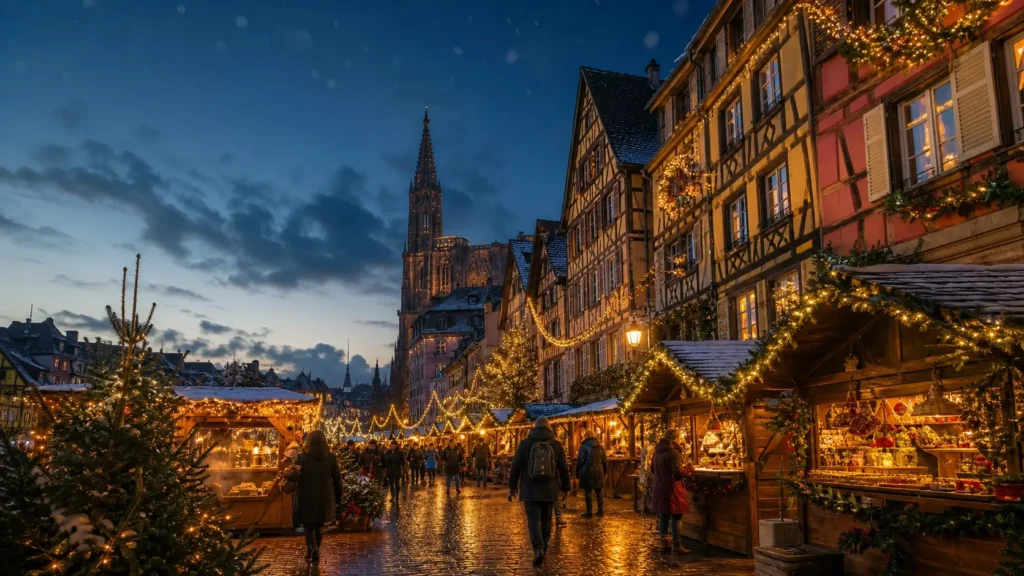
Strasbourg is the anchor of the region: multiple market squares spread across the city centre, the Grande Île, the huge tree on Place Kléber and a scale nothing else in Alsace matches. It’s also the busiest and the one where you most need a plan of attack. Full breakdown on the Strasbourg Christmas market page.
Colmar runs several themed markets across its old town, all within walking distance of each other, in a setting that photographs beautifully after dark. It’s more compact than Strasbourg and easier to do well in a single evening. See Colmar’s Christmas markets for the layout square by square.
Mulhouse is the least visited of the three and the most distinctive, with its long-running textile theme and its own fabric design each year. Worth a stop if you’re arriving via Basel. Details on the Mulhouse Christmas market page.
The village markets
This is where Alsace earns its reputation. Smaller, shorter, sometimes only open at weekends — but set inside walled medieval villages.
- Riquewihr at Christmas — a single main street of half-timbered houses inside intact ramparts.
- Kaysersberg’s Christmas market — craft-focused, held over specific weekends, with a strong artisan reputation.
- Eguisheim in December — concentric circular streets, one of the prettiest layouts in the region.
Ribeauvillé runs a medieval-themed market over set weekends, and smaller villages along the road put on one- or two-day events. If you want a ranked shortlist by size, atmosphere and ease of access, the best Christmas markets in Alsace page compares them directly.
Our advice: pair one city with villages that sit close together. Riquewihr, Kaysersberg and Ribeauvillé form a natural triangle north-west of Colmar. Eguisheim and Turckheim sit just west of it.
How many days do you need?
| Trip length | What fits comfortably |
|---|---|
| 1 day | One city market, evening only, or two villages |
| 2 days | One city plus a half-day village loop |
| 3 days | One city, three or four villages, one castle or museum |
| 4–5 days | Both cities, five or six villages, wine tasting, breathing room |
Two full days is the practical minimum for a market trip that doesn’t feel rushed. Three is the sweet spot. If you’re weighing this against a longer Alsace visit, how many days you need in Alsace works through the trade-offs, and the 3-day Alsace itinerary can be adapted to December with minor changes.
Note that December daylight is short — realistically usable light runs from mid-morning to around 4.30pm. Plan castles, viewpoints and vineyard drives for the morning, markets for the afternoon and evening.
Getting there and getting around in December
Strasbourg is the easiest arrival point: direct high-speed trains from Paris take under two hours, and there are good connections from Germany. Colmar sits about 30 minutes south of Strasbourg by regional train. From further afield, EuroAirport Basel-Mulhouse-Freiburg and Strasbourg airport are the main options, covered on the Alsace airports page, with the wider picture on how to get to Alsace.
The Strasbourg–Colmar leg is frequent and quick; getting between Strasbourg and Colmar sets out the train, bus and car options with realistic durations.
With a car
A car gives you the village circuit on your own schedule, which matters most for markets that close early. The trade-off is parking: on December weekends, town centres are restricted or full, and you’ll typically be directed to peripheral car parks with a walk or shuttle into the centre. Arrive before midday or after the afternoon rush.
Winter driving in Alsace is generally straightforward on the plain and the Wine Route, but the Vosges passes can get snow. If you’re booking a vehicle for a December trip, pick it up at the airport rather than in a city centre, allow for winter equipment, and reserve well ahead — December stock at Alsatian pick-up points is genuinely limited and prices climb as the month advances.
Driving in December: check your winter equipment
In France, winter tyres or snow chains are mandatory from 1 November to 31 March in communes designated under loi Montagne II, which covers parts of the Vosges and other French massifs. Rental vehicles are not equipped as standard — verify what your booking includes.
Christmas market season is also the tightest period of the year for rental stock. Prices rise steadily through December and airport pick-up points run out first.
Full detail on vehicle choice and pick-up logistics on the car rental in Alsace page.
Without a car
Entirely feasible. Strasbourg, Colmar, Mulhouse, Sélestat, Obernai and Ribeauvillé are all reachable by train or scheduled bus, and seasonal shuttles connect Colmar to several Wine Route villages during Advent. The constraint is timetables: rural buses thin out in the evening and on Sundays, which clashes with market opening hours. Check the last return before you commit to a village.
The Christmas markets without a car page maps out which markets are realistically reachable on public transport, and getting around Alsace covers the wider network.
Guided tours: when they’re worth it
A tour makes sense in three situations: you’re visiting from Paris or Basel on a tight schedule, you don’t want to drive in the dark, or you want to reach three villages in an afternoon without solving the timetable puzzle yourself.
Most Christmas market tours depart from Strasbourg or Colmar and combine two or three villages in a half-day or full-day loop, usually with a drop at a large market for the evening. Day trips from Paris also run in December, though the travel time is substantial.
December departures fill faster than any other month, and small-group options in particular sell out weeks ahead for the pre-Christmas weekends. If your dates are fixed, lock this in early rather than on arrival.
Compare formats on the Alsace Christmas market tours page, and see day trips from Colmar for the non-seasonal alternatives.
Where to stay for the Christmas markets
Your base decides your trip more than any other choice.
| Base | Best for | Consider |
|---|---|---|
| Strasbourg | Big-city market, rail access, restaurants | Priciest in December; villages need a day trip |
| Colmar | Village circuit, compact old town, photography | Smaller evening scene than Strasbourg |
| Wine Route village | Atmosphere, quiet mornings, low prices off-peak | Limited dining and transport after dark |
| Mulhouse or Sélestat | Value, rail links | Less Christmas atmosphere on your doorstep |
Two structural facts matter. First, December is the tightest accommodation month in Alsace — Strasbourg and Colmar rooms for the pre-Christmas weekends go months in advance, and village guesthouses have very few rooms to begin with. Second, if you’re relying on trains, staying within walking distance of a station saves you far more hassle than a slightly better room does.
Decide your city-versus-village question first, then book. The where to stay for the Alsace Christmas markets page compares neighbourhoods and village options in detail.
If you’re still weighing the wider question, choosing where to base yourself in Alsace applies year-round, and where to stay in Colmar breaks the old town down street by street.
What to eat and drink at the markets
Alsatian market food is a real cuisine, not fairground filler. What to look for:
- Vin chaud — mulled red wine, and in Alsace also a white version made with local wine. Served in a deposit cup you can return or keep.
- Bredele — the small Christmas biscuits baked in dozens of regional variations through Advent. Sold by weight; buy a mixed bag.
- Tarte flambée — thin, crisp, cooked in front of you. The most reliable hot meal on any market.
- Choucroute and baeckeoffe — served in market chalets and nearby winstubs. Substantial, warming, best sat down.
- Mannele — the little brioche figures that appear around Saint Nicholas in early December.
- Bretzels, roasted chestnuts, spiced gingerbread (pain d’épices) — the reliable snacks between stalls.
The Christmas market food and drink page goes further on what to order and what to skip. For the year-round background, see traditional Alsatian dishes and the guide to tarte flambée.
On wine: Crémant d’Alsace is the local sparkling wine and it’s everywhere in December. Cellars along the Wine Route generally stay open through Advent, typically Monday to Saturday with a lunchtime closure, though hours shorten. Combining a morning tasting with an afternoon market is one of the best uses of a December day — see wine cellars and tastings for how cellar visits work.
Common mistakes to avoid
- Assuming every village market opens daily. Many run only on specific weekends. Verify each one individually before building your route.
- Arriving in a city market at 5pm on the Saturday before Christmas. It’s the single most crowded slot of the season. Shift to a weekday, or arrive earlier.
- Underestimating the cold. Standing still for hours in damp winter air is colder than walking in it. Layers, waterproof shoes, gloves and a hat are not optional.
- Booking accommodation late. December sells out first in Alsace. This is the one thing you cannot fix on arrival.
- Planning outdoor sightseeing for the afternoon. Daylight fades around 4.30pm. Do castles and viewpoints in the morning.
- Trying to see six markets in two days. You’ll spend the trip in transit. Three well-chosen towns beat six rushed ones.
- Forgetting that Christmas Day and the days after are quiet. Most markets have closed, and many restaurants shut too.
What to pack for a December trip
Alsatian winters are cold and often damp, with temperatures frequently around or below freezing in the evening and occasional snow, especially towards the Vosges.
- Warm waterproof coat and a proper hat and gloves
- Thermal base layers — you’ll be outdoors and stationary for long stretches
- Waterproof shoes with grip for wet cobbles
- A small bag for bredele, pottery and other purchases
- A portable charger, since cold drains phone batteries fast
The full seasonal list is on the Alsace packing list, and Alsace weather by season gives realistic temperature expectations.
Combining markets with the rest of Alsace
Markets don’t need to fill every hour. December pairs well with indoor and half-day options:
- Château du Haut-Kœnigsbourg is spectacular in winter light and open outside the summer season, though weather can affect access.
- Museums including the Unterlinden in Colmar and Strasbourg’s collections make good afternoons — see museums in Alsace.
- Rainy day activities doubles as a cold-day list.
- Families will find December well suited to Alsace; the Alsace with kids at Christmas page covers what works with children in tow.
If you’re building a longer trip around the season, the Alsace itineraries hub has route templates you can adapt, and things to do in Alsace covers the year-round attractions.
Frequently asked questions
When do the Alsace Christmas markets open and close?
Most open in the final days of November and close on or around 24 December. A few city markets continue to the end of December or into early January, while many village markets run only on selected weekends. Dates shift each year and vary by town, so confirm the current calendar for every market on your list before booking travel.
Which is the best Christmas market in Alsace?
Strasbourg is the largest and most famous, with several markets across the city centre. Colmar is more compact and easier to cover in one evening. For atmosphere, the village markets at Riquewihr, Kaysersberg and Eguisheim are the ones most visitors remember. The strongest trip combines one city with two or three villages.
Can you visit the Alsace Christmas markets without a car?
Yes. Strasbourg, Colmar, Mulhouse, Sélestat, Obernai and Ribeauvillé are reachable by train or scheduled bus, and seasonal shuttles link Colmar to several Wine Route villages during Advent. The limitation is evening and Sunday timetables in rural areas, so always check the last return before heading to a village market.
How many days do you need for the Christmas markets?
Two full days is the practical minimum and three is comfortable. Three days lets you cover one city market, three or four villages and one castle or museum without rushing. One day works only if you limit yourself to a single city or two nearby villages.
Is Strasbourg or Colmar better for a Christmas market trip?
Choose Strasbourg for scale, rail connections, a wider restaurant scene and the biggest market atmosphere. Choose Colmar if the village circuit is your priority, since Riquewihr, Kaysersberg, Eguisheim and Ribeauvillé are all within about 30 minutes. Colmar’s old town is also smaller and easier to navigate on foot.
How cold does it get in Alsace in December?
Cold and often damp, with evening temperatures frequently around or below freezing and snow possible, particularly closer to the Vosges. Standing at outdoor stalls for hours feels considerably colder than the thermometer suggests. Thermal layers, waterproof shoes, gloves and a hat make the difference between an enjoyable evening and a short one.
Do you need to book Christmas market tours and hotels in advance?
Yes for both. December is the tightest accommodation period of the Alsatian year, and rooms in Strasbourg, Colmar and the villages for the pre-Christmas weekends go months ahead. Small-group tours for the same dates also fill early. Book as soon as your dates are fixed rather than on arrival.
Are the Alsace Christmas markets suitable for children?
Very much so. Most markets include carousels, children’s areas, Saint Nicholas appearances in early December and plenty of food children will eat. The main constraints are cold, crowds and early darkness, so keep visits short, go earlier in the day and favour the smaller village markets over the busiest city squares.