
Some links on this page are affiliate links. If you book or buy through them, I earn a small commission — at no extra cost to you. How this site is funded →
Mulhouse is the one Alsatian city that isn’t sold on half-timbered charm. It is southern Alsace’s largest urban centre, an industrial city with two of the finest technical museums in Europe, and the closest major town to EuroAirport. This page tells you what genuinely deserves your time here, how long to give it, and when Mulhouse is the wrong choice.
In short
- Best for: car and train enthusiasts, textile and design lovers, rainy days, families with older children, travellers flying into or out of EuroAirport.
- Time needed: half a day for one museum plus the old town; a full day for two museums; two nights only if museums are your main reason for visiting Alsace.
- Not for: travellers whose priority is flower-filled wine villages — Mulhouse is a working city, not a postcard.
- Getting there: direct TER trains from Colmar (roughly 30 minutes) and Strasbourg (around 50–70 minutes depending on service); EuroAirport is a short shuttle ride away.
- Base here if: you want lower accommodation prices, an early flight, or easy access to Basel and the Black Forest.
- Don’t miss: Cité de l’Automobile and Cité du Train — book ahead in school holidays and in December.
Is Mulhouse worth visiting?
Yes, if you match it to the right traveller. Mulhouse will not compete with Colmar or Riquewihr on looks, and pretending otherwise wastes your time. What it offers instead is a concentration of world-class collections that no wine village can match, at prices and crowd levels that make a visit relaxed rather than a scramble.
The city grew rich on printed textiles in the nineteenth century, and the money went into industry and machines rather than picturesque timber frames. That heritage is exactly why the museums exist and why they are so good. If your trip already includes several villages and you want one genuinely different day, Mulhouse is the strongest candidate in Alsace. If you only have three days in the region, it probably isn’t. Our broader take on that trade-off sits in is Alsace worth visiting and in the Alsace destinations overview.
The two museums that justify the trip
Cité de l’Automobile
Mulhouse holds one of the largest car collections in the world, built around an extraordinary group of Bugattis. The scale is the point: rows of pre-war coachbuilt bodies, racing machines, and a chronological run through motoring history. Even people who claim no interest in cars tend to stay longer than planned.
Allow two to three hours minimum. Signage is generally available in English, and there is enough space that even a busy day never feels crushed. Check current opening days and any timed-entry arrangements before you travel, as schedules shift between seasons.
Cité du Train
France’s national railway museum sits a short distance away and is arguably the more atmospheric of the two. Presidential carriages, steam locomotives and staged scenes make it strong with children, and the covered halls make it a reliable wet-weather option.
Allow two hours, more with kids who want to climb aboard. Combining both museums in one day is feasible but tiring — expect a full, museum-heavy day with little energy left for anything else.
If you are travelling with children, Mulhouse is one of the easiest days in the region to plan; there is more on that in things to do in Alsace with kids and in our list of family attractions.
Both museums sell tickets online, and slots in the February and Easter school holidays and across the Christmas period fill faster than at other times of year. Buying in advance also saves you queuing at the desk on arrival.
The other collections
Mulhouse also holds a textile printing museum reflecting the city’s original industry, an electricity and energy museum, and a wallpaper museum in nearby Rixheim. These are specialist rather than headline attractions — worthwhile if the subject appeals, skippable otherwise. Our wider round-up of museums across Alsace puts them in context.
How much time to give Mulhouse
| Time available | What it covers | Verdict |
|---|---|---|
| 2–3 hours | Old town, Place de la Réunion, Temple Saint-Étienne, a coffee | Enough for a stopover between trains |
| Half day | One major museum plus a short old-town walk | The efficient choice for most visitors |
| Full day | Both major museums, lunch in between | Best for enthusiasts and families |
| 2 days | Both museums, a specialist collection, plus a trip to Basel or the Black Forest | Only if southern Alsace is your base |
Most travellers get the balance right with half a day. If Mulhouse is the last stop before an early flight, arriving the previous afternoon and doing one museum works neatly. For how this fits a wider trip, see how many days you need in Alsace.
The old town in an hour
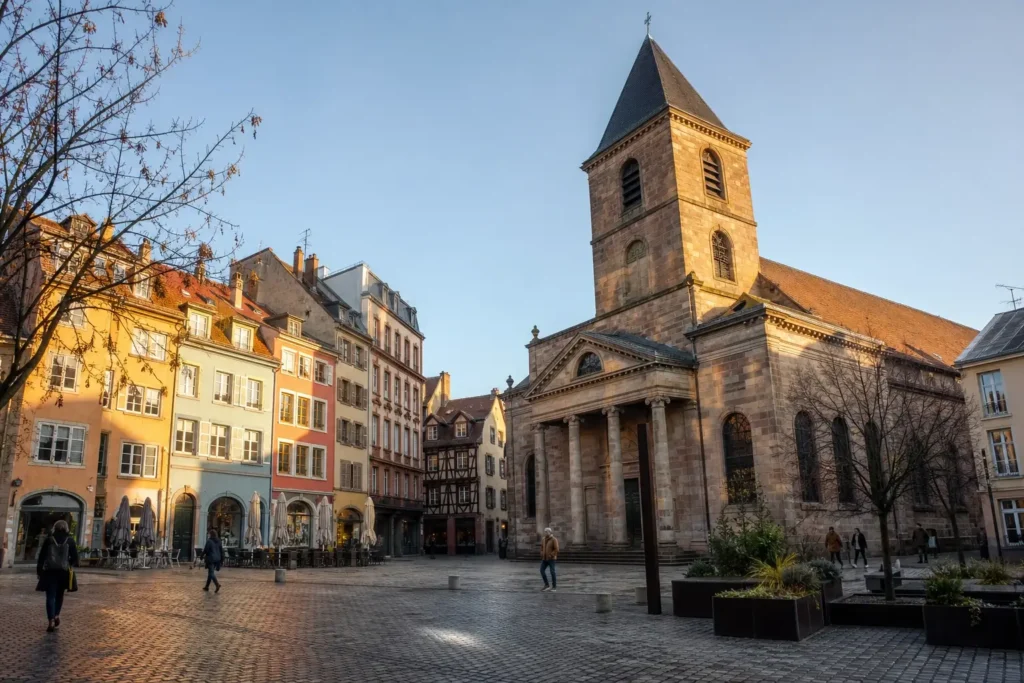
Place de la Réunion is the centre: a broad square framed by the painted Renaissance town hall and the Temple Saint-Étienne, whose spire is among the tallest Protestant church towers in France. The square hosts markets and terrace cafés, and it takes ten minutes to cross and an hour to enjoy properly.
From there, wander the pedestrian streets north and west for shops and brasseries. The scale is human, the crowds are local, and prices are noticeably softer than in Colmar. Mulhouse was a Protestant free city allied with the Swiss for centuries before joining France, which is why its architecture and civic mood differ from the rest of Alsace — background worth a glance in the Alsace history timeline.
Practical note: several museums sit outside the immediate centre. Trams are frequent and straightforward, and buying a day pass is simpler than repeat single tickets. Our page on getting around Alsace covers the wider network.
Getting to Mulhouse
By train
Mulhouse sits on the main north–south Alsatian line, so trains are the easy answer. TER services from Colmar take roughly half an hour and run frequently; from Strasbourg, allow around an hour, sometimes less on faster services. Direct TGV links from Paris also serve the city, making Mulhouse a viable first stop rather than an afterthought.
Regional fares are modest and rarely need booking far ahead, but long-distance TGV seats from Paris get more expensive the later you leave it. If you have fixed dates, securing those legs early is straightforward and usually cheaper. Full detail sits in our guide to visiting Alsace by train.
By air
EuroAirport Basel-Mulhouse-Freiburg is the closest airport, shared between three countries and served by a good range of European budget and full-service carriers. To reach Mulhouse, take bus 11 to Saint-Louis station, then a direct train to Mulhouse. Allow roughly 45–60 minutes for the complete journey, depending on the connection. Compare it with Strasbourg and the German alternatives on our Alsace airports page.
By car
Mulhouse sits on the A35 motorway, roughly 40 kilometres south of Colmar and around 110 kilometres from Strasbourg. Driving is simple, and the city is a practical place to collect a hire car if you are flying into EuroAirport and heading north up the vineyards afterwards.
Picking up at the airport rather than in the city centre usually means a wider choice of vehicles and no need to navigate urban one-way systems on day one. Automatic transmissions are the scarce category in France, so if you need one, reserve it well ahead — especially for September and December travel.
💡 Booking a car at EuroAirport
Automatic transmissions are the scarce category in France — if you need one, book well ahead, especially for September and December travel. Comparing rental agencies side by side is the easiest way to filter by transmission type, insurance level, and pick-up terminal (French or Swiss side).
Compare car rental deals at EuroAirport
Picking up at the airport rather than in central Mulhouse usually means a wider vehicle choice and no need to navigate urban one-way systems on day one.
Once you have wheels, Mulhouse is an easy launch point for the southern Wine Route and the villages around Eguisheim. See also our overview of how to get to Alsace.
Day trips from Mulhouse
| Destination | Approx. distance | Getting there | Why go |
|---|---|---|---|
| Écomusée d’Alsace, Ungersheim | ~20 km | Car, or train plus short bus | Large open-air village museum, excellent with children |
| Eguisheim | ~30 km | Car | One of Alsace’s most complete circular villages |
| Colmar | ~40 km | Direct train, ~30 min | Old town, canals, Unterlinden Museum |
| Basel, Switzerland | ~35 km | Direct train, ~30 min | Major art museums, Rhine bathing in summer |
| Freiburg, Germany | ~65 km | Train with change | Black Forest gateway, minster and market |
| Thann and the Thur valley | ~20 km | Train or car | Southern vineyards and access to the Vosges |
The Écomusée d’Alsace is the strongest half-day pairing with Mulhouse, and the two combine well over a single overnight stay. If you want to build the Swiss and German options into a proper loop, our page on combining Alsace, the Black Forest and Switzerland sets out the sensible routings, and there are organised options departing from Basel and Freiburg.
Where to stay in Mulhouse
Mulhouse offers the best value of any Alsatian city. Hotel rates are consistently lower than Colmar or Strasbourg, and availability holds up in periods when the wine villages sell out. Three practical zones:
- Around the station: most convenient for trains and the airport shuttle, and best if you have an early departure.
- Old town and Place de la Réunion: the most pleasant for evenings, with restaurants within walking distance.
- Outskirts and business districts: cheapest, often with free parking, but you will rely on the tram.
Because Mulhouse is largely a business city, weekend rates can undercut weekday rates — the reverse of the pattern in the villages. That makes it a genuinely useful fallback during December, when Colmar and Strasbourg accommodation tightens sharply and prices climb. Choosing a station-side property gives you the flexibility to day-trip north by train without moving hotels.
💡 Where to book
Station-side hotels give you the most flexibility — easy access to trains, the airport shuttle, and both major museums by tram. Old town properties near Place de la Réunion are better for evenings out.
Browse hotels in Mulhouse on Booking.com
Remember: weekend rates in Mulhouse often undercut weekday rates, the reverse of what you’ll find in the wine villages — a useful fact if you’re planning a short city break.
For comparisons across the region, see where to stay in Mulhouse and the wider question of where to base yourself in Alsace.
Eating in Mulhouse
You will find the full Alsatian repertoire here — tarte flambée, choucroute, pork in various excellent forms — alongside a broader, more international restaurant scene than the villages offer, and better late-evening options.
Two practical points. First, brasseries in the centre serve continuously in a way village winstubs often do not, which matters if museums leave you eating at odd hours. Second, southern Alsace sits close to Basel, so Swiss and Italian influences show up on menus more than they do further north. If you want the traditional experience specifically, read up on what a winstub actually is and on Alsatian traditional dishes before you order.
The covered market is worth an hour on market mornings for local produce and a strong multicultural presence reflecting the city’s industrial history; our page on Alsace food markets covers timings across the region.
Mulhouse at Christmas
Mulhouse runs a Christmas market with a distinctive textile theme, drawing on the city’s printing heritage — a new fabric design is created each year and used to decorate the stalls. It is smaller and calmer than Strasbourg’s, which is precisely its appeal if crowds concern you.
The market typically opens in late November and runs to shortly before Christmas, with a few illuminations lingering into the New Year. Exact dates and hours vary annually, so confirm before booking travel. Full detail sits on our Mulhouse Christmas market page, with comparisons in the Alsace Christmas markets guide and current market dates and opening times.
Practically, Mulhouse works well as a December base: you can day-trip by train to the Colmar Christmas markets and still find a room when the honeypot towns are full.
Good to know before you go
- Don’t judge Mulhouse by the ring road. The approach is industrial and unpromising. The old town is compact and pleasant, but you have to reach it.
- Museums are not in the centre. Factor in tram time both ways rather than assuming you can walk everywhere.
- Check closing days. Many French museums close one day a week, and some reduce hours out of season. A wasted trip across the city is avoidable.
- Two museums in a day is a lot. If you have children or limited stamina, pick one and enjoy it properly.
- Sunday is quiet. Shops largely close and the centre empties. Fine for museums, poor for browsing.
- It’s a real city. Some districts feel more workaday than tourist-polished. Normal urban awareness is all that’s needed, but adjust your expectations accordingly.
- Bring layers in winter. Southern Alsace can be damp and cold from November onwards; see our Alsace packing list.
Frequently asked questions
How long do you need in Mulhouse?
Half a day covers one major museum plus a walk around Place de la Réunion, which suits most visitors. Give it a full day if you want both the car and railway museums, since each deserves two hours or more. Two nights only makes sense if you are using Mulhouse as a base for Basel, the Écomusée and the southern vineyards.
Is Mulhouse better than Colmar?
They serve different purposes. Colmar wins decisively on old-town beauty, canals and access to the wine villages. Mulhouse wins on museums, value for money, fewer crowds and transport links to Switzerland and Germany. Most trips should include Colmar; Mulhouse is the addition for enthusiasts, families or anyone flying via EuroAirport.
How do you get from Mulhouse to Colmar?
Direct regional trains run frequently and take roughly half an hour, making this one of the easiest connections in Alsace. Driving takes a similar time on the A35, around 40 kilometres. No advance booking is needed for regional trains, though you should check the last evening departure if you plan a late dinner.
Is Mulhouse good for a day trip from Strasbourg?
It works, but it is a long day. Allow around an hour each way by train, which leaves enough time for one museum and lunch rather than a leisurely visit. If museums are your priority, consider basing in Mulhouse or Colmar for a night instead of commuting from Strasbourg.
Can you visit Mulhouse without a car?
Easily. The train station is central, trams reach the major museums, and the airport shuttle connects to EuroAirport. Mulhouse is one of the more car-free-friendly stops in Alsace, which is why it features in our car-free Alsace itineraries.
Is Mulhouse worth it in the rain?
It is one of the best wet-weather destinations in Alsace. Both major museums are indoors and large enough to fill several hours, and the city has more covered options than the villages. See our wider list of rainy day activities in Alsace.
Do people speak English in Mulhouse?
In museums, hotels and larger restaurants, generally yes. In smaller shops and neighbourhood cafés, less reliably than in Colmar or Strasbourg, since Mulhouse sees fewer international tourists. A few polite French phrases go a long way; see do you need French in Alsace.
Is Mulhouse close to Basel?
Very. Direct trains reach Basel in around half an hour, and EuroAirport is located entirely on French territory, but the terminal has separate French and Swiss sectors connected by an internal border crossing. That proximity makes Mulhouse a practical base for anyone combining Alsace with Switzerland, though remember Switzerland uses the Swiss franc and sits outside the EU customs area.