
Some links on this page are affiliate links. If you book or buy through them, I earn a small commission — at no extra cost to you. How this site is funded →
Strasbourg is a natural entry point to Alsace: it has direct high-speed trains from Paris, an international airport, and a compact historic centre that is easy to explore on foot. This guide covers how long to stay, which districts to walk, what to book in advance, where to eat Alsatian food properly, and how to use the city as a base for the vineyards and villages further south.
In short
- Time needed: two full days for the city itself; three if you want a day trip to the vineyards or Germany.
- Where to stay: Grande Île (the island historic centre) for first-timers; Petite France for atmosphere; the station area for value and easy rail connections.
- Unmissable: the cathedral (including the astronomical clock and the platform climb), Petite France, the covered footbridges at the Ponts Couverts, and Palais Rohan.
- Best months: May–June and September for weather and light crowds; late November to Christmas Eve for the markets, when the city is at its busiest.
- Getting around: on foot in the historic centre, with trams for the outer districts. A car is usually more of a nuisance than an advantage in central Strasbourg, where many streets are pedestrianised, access is restricted and parking is limited or expensive.
- Day trips: Colmar and the Wine Route villages by train and bus, Haut-Kœnigsbourg by car or tour, and the German bank of the Rhine within easy reach.
Why start your Alsace trip in Strasbourg
Strasbourg does two jobs at once. It is a genuine city — a cathedral, museums, a university, European institutions, restaurants that stay open year-round — and it is the best-connected point in the region. If you are arriving from Paris, London or a long-haul flight into a hub, this is where you land and where the trip logically begins. See how to get to Alsace for the routes and the regional airports compared if you are still choosing a flight.
The practical consequence is that Strasbourg often works best at the start of an Alsace itinerary. Arrive, recover from the journey in a city where you do not need a car, then continue south towards Colmar and the vineyards. This also means you can collect a rental car only when you actually need one, rather than paying for a vehicle that will sit unused during your city stay.
How many days do you need in Strasbourg?
| Time available | What it realistically covers |
|---|---|
| Half a day | Cathedral, Place Kléber, a loop through Petite France. Rushed but worthwhile on a stopover. |
| One full day | The above plus one museum, the Ponts Couverts and Barrage Vauban, a proper winstub dinner. |
| Two full days | Add Palais Rohan or Musée Alsacien, the Neustadt district, a boat tour, the European quarter. |
| Three days | Two days in the city plus a full day trip to the Wine Route, Haut-Kœnigsbourg or Germany. |
| Four days or more | Use Strasbourg as a single base and radiate outwards, or split nights between here and the south. |
Two nights is the sweet spot for most visitors. If your total trip is a week, three nights here and the rest further south works well — compare the options in our guide to how many days to spend in Alsace.
What to see in Strasbourg
Strasbourg Cathedral
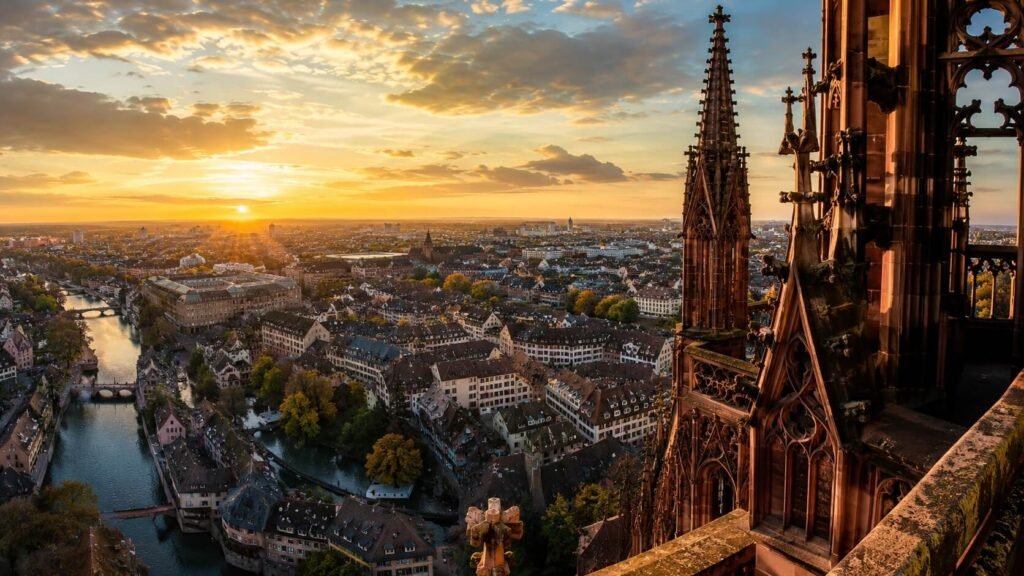
The sandstone cathedral dominates the city, and it rewards more than a quick look inside. Three things are worth planning for: the astronomical clock, whose presentation and apostle procession usually take place around midday; the stained glass and the Pillar of Angels inside; and the climb to the viewing platform. The platform is reached by a long staircase with no lift, but the view over the rooftops — and towards the Black Forest on clear days — is well worth the effort.
Entry to the nave is generally free, while access to the viewing platform and the astronomical clock presentation may require separate tickets. Opening hours and access arrangements can change around religious services, ceremonies and special events. Check the cathedral’s current schedule before visiting rather than building your itinerary around assumed opening times.
Petite France and the Ponts Couverts
Petite France is the canal district of tanners’ houses with steep timbered roofs, and it is the image most people arrive with. It is small — you can walk it in 30 minutes — and it fills up between roughly 10am and 5pm. Come at 8am or after dinner and you will have the water reflections largely to yourself. Read more about why these half-timbered houses look the way they do before you go; it changes what you notice.
Walk west to the Ponts Couverts, a historic group of bridges that once had protective roofs and are still flanked by squat medieval towers. Continue up onto the Barrage Vauban terrace for one of the best elevated views back over the canals and rooftops of Petite France. That terrace is the single best free photo position in the city — one of several gathered in our guide to the best views and photo spots in Alsace.
Museums worth your time
Strasbourg has a serious museum offer, which matters enormously if the weather turns. Palais Rohan houses the decorative arts, fine arts and archaeology collections in one former episcopal palace. Musée Alsacien covers regional domestic life, costume and folk objects across a warren of old houses. The Musée d’Art Moderne et Contemporain sits across the water near the Barrage Vauban.
A combined pass covering several municipal museums may be available, depending on the current ticketing arrangements. It can be worthwhile if you plan to visit more than one museum, so ask about the available options at the first ticket desk you reach. For the wider picture, see the best museums in Alsace and our list of rainy day activities.
Neustadt and the European quarter
North and east of the island lies the Neustadt, the monumental German imperial district built after 1871 — wide avenues, heavy stone façades, a completely different register from the timbered lanes. It is UNESCO-listed alongside the Grande Île and takes about an hour on foot. Further out by tram, the European Parliament and Council of Europe buildings sit on the water. Visits to the European Parliament are possible, but the format, booking requirements and available dates vary. Some visits require advance registration and a valid physical photo ID. Availability can also depend on the parliamentary calendar, so check the official visitor information before planning your visit.
For a fuller list of options including boat tours, gardens and seasonal events, see things to do in Strasbourg.
Where to stay in Strasbourg
Choosing your district matters more than choosing your hotel here, because the island centre is closed or restricted to traffic and walking distances decide your day.
| District | Best for | Trade-off |
|---|---|---|
| Grande Île (centre) | First-timers, walkability, evening atmosphere | Highest prices, harder for cars |
| Petite France | Romantic stays, short trips | Small rooms, busy by day |
| Around the station | Value, rail day trips, arrivals by TGV | Less charming streets, 15-min walk to the cathedral |
| Neustadt / Krutenau | Quieter nights, more space for the money | Slightly further out, still walkable |
| Outer districts on the tram | Budget, parking, families needing space | You will rely on the tram after dark |
Availability becomes particularly tight in two periods: December, when the Christmas markets attract visitors across the region, and some mid-week periods during European Parliament sessions, when demand for business accommodation can increase. If your dates fall into either period, secure your room before finalising the rest of your itinerary. If your dates fall in either, secure a room before you fix anything else — and if you are coming in December, look at where to stay for the Christmas markets as well.
💡 Booking tip
Once you’ve picked your district, book sooner rather than later. Rooms on the Grande Île and in Petite France go first, and availability tightens considerably in December and during the September–October harvest season.
Compare available hotels in Strasbourg.
Our detailed district-by-district breakdown is in where to stay in Strasbourg, and if you are torn between city and vineyards, choosing your base in Alsace compares the two head-to-head.
What and where to eat
Strasbourg is where you should learn the regional repertoire, because the city has enough winstubs — traditional Alsatian taverns, wood-panelled and unfussy — to make comparison easy.
Order this, at least once:
- Tarte flambée (flammekueche): thin dough, crème fraîche, onion, bacon. Usually shared, often served in rounds. Details in our guide to tarte flambée.
- Choucroute garnie: fermented cabbage with sausages and cured pork. Substantial; not a summer lunch. See what choucroute actually involves.
- Baeckeoffe: a slow-baked casserole of meat, potatoes and vegetables, traditionally cooked in a lidded terracotta dish. Some restaurants require advance notice or offer it only on selected days, so check when booking. Read about baeckeoffe.
- Munster cheese: a strong, aromatic regional cheese, often served with cumin and sometimes accompanied by potatoes or bread. Our page on Munster explains how to eat it without regret.
- A glass of Riesling or Pinot Blanc rather than beer with your meal — though Alsatian beer and breweries have their own strong case.
Winstubs fill early by French standards; arriving at 7pm often beats a wait. Booking a day ahead is sensible at weekends. For the format and etiquette, see our guide to the Alsatian winstub, and for the wider regional picture, traditional Alsatian dishes.
Market shopping is a good use of a morning if your accommodation has a kitchen or you are assembling a picnic; the city’s covered and open-air markets are covered in Alsace food markets.
Getting around Strasbourg
Walk. The Grande Île is roughly 1km across, and almost everything a first-time visitor wants sits inside it or just beyond. For the European quarter, the outer districts or your hotel on the edge of town, the tram network is fast, frequent and easy to use with a ticket bought at the platform machine.
Cycling is genuinely practical here. Strasbourg has a well-developed cycle network, bike-hire options and mostly flat terrain, making it easy to reach districts beyond the historic centre. As in any city, take care at tram crossings and busy junctions.
Do not plan to drive into the historic centre unless your accommodation has confirmed that you need vehicle access. Large parts of the Grande Île are pedestrianised or subject to restricted access, while parking is limited and expensive. Strasbourg’s wider urban area is also covered by low-emission regulations, so check the current Crit’Air requirements before entering the city, particularly if you are driving a foreign-registered or older vehicle. If you are hiring a car for the vineyards, the simplest arrangement is to stay car-free in Strasbourg and collect the vehicle on the morning you leave the city. Depending on your itinerary, collection at Strasbourg station or the airport may be convenient, but compare locations, opening hours and transfer arrangements before booking. Weekend and September collections go quickly, and automatics are a small minority of the fleet in France — if you cannot drive a manual, book early and specify it.
🔍 Booking tip
Pick-up at Strasbourg station or the airport works well if you’re leaving the city car-free and heading to the Wine Route afterwards. Automatics are a small share of the fleet in France, so if you can’t drive a manual, book early and filter for automatic transmission specifically — especially for weekend and September pick-ups, which go first.
Compare car rental options in Strasbourg
More on the mechanics in getting around Alsace and renting a car in Alsace.
Day trips from Strasbourg
Strasbourg works well as a single base for a short trip, provided you are comfortable with some travel time on excursion days. Journey times below are indicative and can vary according to the service, season, connections and waiting time.
| Destination | Rough journey time one way | Car needed? |
|---|---|---|
| Colmar | Well under an hour by direct train | No |
| Sélestat | Around 20–30 minutes by train | No |
| Obernai | Around 30 minutes by train | No |
| Barr / Mittelbergheim area | Around 40 minutes by train | Helpful |
| Haut-Kœnigsbourg | Around an hour by car; longer by public transport | Car or organised tour; public-transport itineraries require connections and may involve a seasonal shuttle from Sélestat |
| Riquewihr / Ribeauvillé | Around 1h15 or longer, combining train and bus | Possible without a car, but a car or organised tour is usually more convenient; buses can be infrequent outside peak periods |
| Baden-Baden (Germany) | Around 1h–1h30 | No car needed, but check the route and cross-border connections for your chosen date |
The Strasbourg–Colmar leg is the most-asked question in the region, and it is easier than most people expect; we’ve broken down the train, bus and driving options in Strasbourg to Colmar.
If you want the vineyard villages without renting a car and without spending your day decoding rural bus timetables, a small-group day tour from Strasbourg is the efficient answer: one pick-up, three or four villages, a cellar visit, back by evening. Departures in September, October and December are the first to fill, since these are the harvest and market months. Compare formats in day trips from Strasbourg and guided versus self-guided touring.
Strasbourg at Christmas
Strasbourg markets itself as the Capital of Christmas, and its Christmas market is one of the largest and oldest in France. It is spread across several squares rather than concentrated in a single location, with different areas offering different atmospheres and specialities. The market usually opens in late November and runs until around Christmas Eve, with the main tree on Place Kléber and separate market areas around the cathedral, Place Broglie and other central squares. Exact dates, opening hours and access arrangements change from year to year and should be checked on the city’s official website before booking non-refundable travel.
Two practical realities. Weekends and late afternoons are extremely crowded, with controlled access points around the island at peak times; weekday mornings are calm by comparison. And accommodation across the whole region — not just the city — sells out months ahead at inflated rates. Read Strasbourg Christmas market for the layout and Christmas market dates and opening times for the annual pattern, plus what to eat and drink once you’re there.
December here is damp and cold rather than reliably snowy, and you will be standing outdoors for hours. Waterproof outer layers, proper shoes and gloves make the difference between an evening you enjoy and one you cut short.
When to visit
- April–June: mild, long days, gardens and terraces open, moderate crowds. Arguably the best all-round window.
- July–August: warm to hot, busiest for general tourism, some restaurants close for holidays in August.
- September–October: harvest in the vineyards, warm days, excellent light. Popular and worth booking ahead.
- Late November–24 December: Christmas markets. Maximum crowds, maximum prices, strong atmosphere.
- January–March: quiet, cheap, cold, some village businesses closed. Fine for a city-focused trip.
Season-by-season detail sits in the best time to visit Alsace and Alsace weather and seasons.
Common mistakes to avoid
- Driving into the Grande Île. Restricted access, scarce parking, and a low-emission zone across the urban area. Park on the outskirts at a tram park-and-ride, or stay car-free.
- Assuming the cathedral is open all day. It closes to sightseeing during services, and the platform and clock have their own separate hours and tickets.
- Visiting Petite France at midday. The same lanes are calm and photogenic at 8am and after 8pm.
- Booking December accommodation late. Rooms across the region go months ahead. If Christmas markets are your reason for coming, book lodging before flights.
- Treating Strasbourg as a half-day stop. Many itineraries give it three hours between trains. Two days is closer to right.
- Expecting shops open on Sundays. Most retail closes, and many restaurants close Sunday evening or Monday. Plan Sunday around museums, walks and a boat tour.
- Ordering only beer. Alsace is a white wine region first. Ask for a glass of the house Riesling or Sylvaner with your tarte flambée.
Frequently asked questions
Is Strasbourg worth visiting?
Yes — and it is the strongest single argument for coming to Alsace at all. You get a UNESCO-listed historic island, one of Europe’s great Gothic cathedrals, serious museums, a distinctive regional cuisine, and the region’s best transport links, all in a centre you can cross on foot in twenty minutes. Two days here justify the journey on their own.
Is Strasbourg or Colmar better?
They serve different purposes. Strasbourg is a real city with museums, nightlife and rail connections; Colmar is smaller, prettier in a concentrated way, and sits closer to the vineyard villages. First-time visitors with three days or more usually do both. If you must pick one, choose Strasbourg for culture and convenience, Colmar for the Wine Route.
How do I get from Paris to Strasbourg?
By high-speed train from Paris Gare de l’Est. Direct services are usually the fastest and take roughly two hours, with the exact journey time depending on the train. Services run throughout the day, and advance fares are often considerably cheaper than tickets bought shortly before departure. Check the timetable and fare conditions for your travel date. Flying is rarely worth it once airport transfers are counted. See our page on reaching Alsace by train.
Do I need a car in Strasbourg?
No, and it is actively unhelpful in the centre. Walk, tram or cycle within the city, and use the train for Colmar, Sélestat and Obernai. Rent a car only for the stage of your trip covering the Wine Route villages, and collect it on the day you leave the city.
Do people speak English in Strasbourg?
Widely, in hotels, museums, tourist restaurants and shops in the centre. Staff in smaller neighbourhood places and outside the city may have less, so a few polite French phrases go a long way. Our guide to whether you need French in Alsace covers the essentials.
How many days should I spend in Strasbourg?
Two full days covers the cathedral, Petite France, one or two museums, the Neustadt and a proper dinner without rushing. Add a third day if you want a day trip to Colmar, the vineyard villages or Haut-Kœnigsbourg. A half-day stopover works but leaves you with a photo of Petite France and little else.
Is Strasbourg good for families?
Yes. The centre is compact and largely traffic-free, boat tours hold children’s attention, the cathedral clock is a genuine event, and the Parc de l’Orangerie has a stork enclosure. See Alsace with kids for the wider regional options.
When does the Strasbourg Christmas market open?
The pattern is late November through to around Christmas Eve, across several squares in the centre. Precise opening and closing dates, plus daily hours, change each year and are confirmed by the city in the autumn — check before you book non-refundable travel.