
Some links on this page are affiliate links. If you book or buy through them, I earn a small commission — at no extra cost to you. How this site is funded →
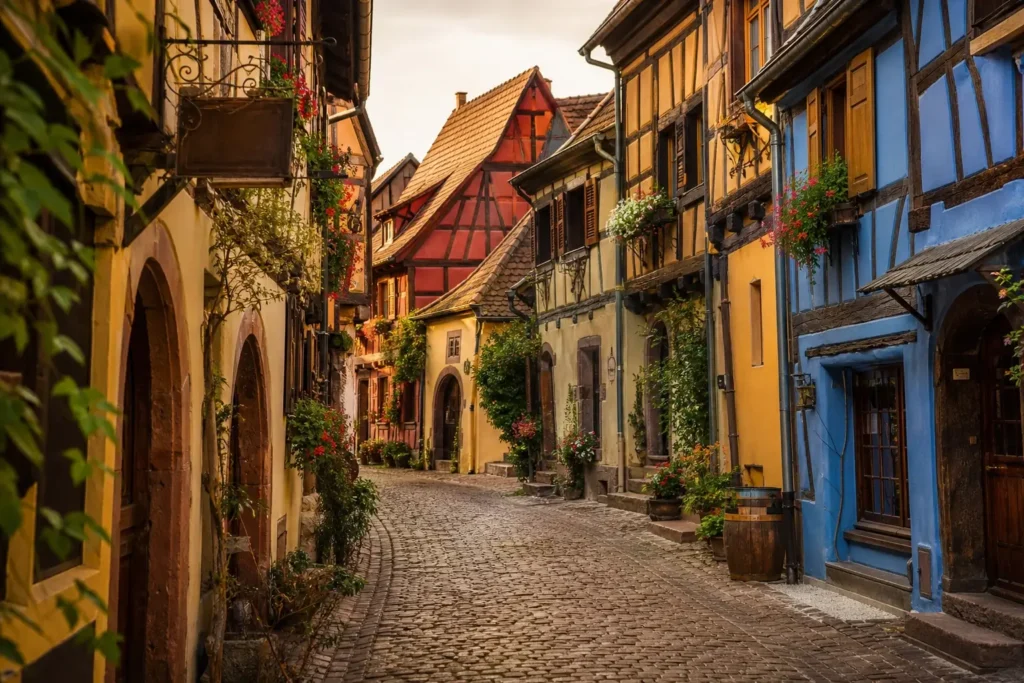
Eguisheim sits about 7 kilometres south-west of Colmar, wrapped in vineyards, and it is the easiest of the famous Alsace wine villages to see properly in a couple of hours. Its layout is unusual: instead of a grid or a single main street, the lanes curve in concentric rings around a central castle courtyard. This page covers how to get there, what to walk, where to taste wine, where to park, and how to fit Eguisheim into a wider Alsace trip.
In short
- Where: Haut-Rhin, roughly 7 km from Colmar, on the Alsace Wine Route
- How long you need: 2 to 3 hours for the village; half a day if you add a tasting and lunch
- Best way to arrive: car (free car parks on the edge of the village) or bus from Colmar; also reachable by bike
- Signature sight: the circular Rempart lanes — walk the full loop, it takes about 25 minutes
- Wine: a major Riesling and Gewurztraminer village with two Grand Cru sites, Eichberg and Pfersigberg
- Quietest hours: before 10am and after 5pm from May to October; midweek in shoulder season
Why Eguisheim is worth a stop
Three reasons, all practical. First, the concentric street plan means you cannot really get lost and you see the whole village on one continuous loop — good if your time is tight. Second, it is extremely close to Colmar, so it works as a first taste of the wine villages before you commit to a longer drive. Third, it is a genuine wine village rather than a purely ornamental one: family cellars open onto the streets you are walking, and many will pour a tasting without an appointment.
Eguisheim carries the « Plus Beaux Villages de France » label, which it shares in Alsace with neighbours such as Riquewihr, Hunawihr and others covered in our villages guide. That label brings crowds in summer. Come early or late in the day and the difference is dramatic.
If you are still deciding whether the region suits your travel style at all, our honest assessment of whether Alsace is worth visiting is a better starting point than a village page.
How to get to Eguisheim
| From | By car | By public transport | Notes |
|---|---|---|---|
| Colmar | 10–15 min | Local bus, roughly 12–20 min | Simplest combination; check the timetable, as departures vary by day |
| Strasbourg | About 1 h 15 | Train to Colmar, then bus | See our Strasbourg to Colmar comparison first |
| Basel / EuroAirport | About 1 h | Train to Colmar, then bus | Common arrival point for long-haul visitors |
| Riquewihr | 20–25 min | Awkward without a car | Classic pairing on a Wine Route drive |
| Kaysersberg | About 25 min | Awkward without a car | Pair with Kaysersberg for a two-village morning |
Times are indicative and depend on season and traffic. Check current bus timetables before you rely on them, as service thins out at weekends and on public holidays.
By car
Eguisheim is signposted from the D83 and the Colmar ring road. There are several signposted car parks on the village edge; the historic centre is largely closed to through traffic and the lanes are narrow, so do not attempt to drive into the middle. Arriving before 10am in high season makes parking far easier.
A car unlocks the villages on either side of Eguisheim in a single morning, which is exactly the kind of trip public transport handles badly. If your itinerary includes more than one or two villages, hiring a vehicle for two or three days is usually the deciding factor between seeing three villages and seeing eight. Demand for automatics in particular tightens sharply in September and December, so book those dates well ahead.
[AFF-SLOT | car-rental | pick-up at Colmar station or Basel EuroAirport for Wine Route villages]
Our practical notes on driving the Alsace Wine Route cover road types, village parking habits and drink-driving limits, and car hire in Alsace explains cross-border pick-ups.
Without a car
Eguisheim is one of the few star villages genuinely reachable by public transport, thanks to the Colmar bus network. Plan around the timetable rather than the other way round, and give yourself a buffer for the return journey. Cyclists have it even better: the terrain between Colmar and Eguisheim is essentially flat, and the village is a standard stop on the vineyard cycle routes described in our guide to cycling the Wine Route.
For a full picture of the options, see visiting the Wine Route without a car and, for whole-trip planning, Alsace itineraries without a car.
What to see in Eguisheim
The Rempart loop
The village is organised around three concentric streets, including Rue du Rempart Nord and Rue du Rempart Sud, which follow the line of its former fortifications. Walking the full circle takes roughly 25 minutes at a slow pace and delivers the flower-covered timbered façades the village is known for. Do the loop once clockwise, then cut into the inner lanes.
Place du Château Saint-Léon
The central square holds a Renaissance fountain and the octagonal remains of the castle associated with Pope Leo IX, who was born in Eguisheim in the 11th century. It is the natural orientation point: everything radiates from here.
Church of Saints Peter and Paul
The parish church, in the centre of the village, retains a Romanesque tympanum from the earlier building. It takes ten minutes and it is free. More context on regional church architecture sits in our overview of churches and cathedrals in Alsace.
The vineyard footpaths
A marked trail leaves the village and climbs gently into the Eichberg and Pfersigberg slopes. Allow 45 minutes to an hour for a short circuit. This is where you get the view back over the tiled roofs, and it is far less crowded than the lanes. Sturdy shoes are enough; no technical walking involved. For longer options, see hiking and the outdoors in Alsace.
The three castles ridge
Above the village stand the ruined towers of Dagsbourg, Wahlenbourg and Weckmund, known collectively as the Three Castles of Eguisheim. They are reachable on foot from the village on a steeper climb — expect a solid uphill hour each way — and the towers themselves are ruins rather than furnished monuments. Our guide to visiting Alsace castles helps you judge whether these or the fully restored Château du Haut-Kœnigsbourg suit your day better.
Half-timbered detail
Eguisheim rewards looking up: dates carved on lintels, oriel windows, painted door frames. If you want to know what you are actually looking at, our explainer on Alsatian half-timbered houses decodes the structures and the colours.
Wine tasting in Eguisheim
Eguisheim is a serious wine village. It holds two Grand Cru vineyards — Eichberg and Pfersigberg — and the streets are lined with family estates whose cellar doors open directly onto the pavement. Riesling, Gewurztraminer and Pinot Gris dominate; Crémant is widely produced too.
How it usually works:
- Look for a sign reading dégustation or caveau at street level.
- Ring or walk in. In smaller family cellars, someone comes up from the cellar to serve you.
- Tastings of several wines are commonly offered without charge or for a modest fee, sometimes waived if you buy.
- Expect the pattern to be dry-to-sweet, and expect the grower to want to talk. That is the point.
- Many cellars close for a long lunch break and are shut on Sundays outside high season.
Do not turn up at 12.15 expecting a tasting. And if you are driving, one designated non-drinker in the car changes the whole experience — French drink-driving limits are lower than in the UK or most of the US.
Bigger estates and cooperative cellars take groups, while the smallest family operations prefer a phone call ahead in harvest season. If you would rather not manage any of it — or you want to taste properly without worrying about who drives — a small-group tour from Colmar covering Eguisheim and one or two neighbouring villages is the straightforward solution. September and December departures fill first.
[AFF-SLOT | tours | small-group wine tour from Colmar including Eguisheim]
Before you taste, it is worth five minutes on Alsace grape varieties, and if labels confuse you, how to read Alsace wine labels will save you guessing. For the Grand Cru question specifically, which Grand Cru vineyards to visit is the practical version and the terroir and Grand Cru system the explanatory one. Broader etiquette sits in wine cellars and tastings in Alsace.
Where and what to eat
Eguisheim has a cluster of restaurants and winstubs around the central square and along the main lanes — enough choice for lunch, thinner in the evening than Colmar. Book ahead for dinner in summer and December; several places close one or two days a week, often Monday and Tuesday.
What to order, if you want the regional thing rather than the safe thing:
- Tarte flambée — thin, crisp, cream-and-bacon; usually evening only and often only on certain days. See tarte flambée explained.
- Baeckeoffe — slow-baked meat and potato casserole, frequently needs ordering in advance. Details in our Baeckeoffe guide.
- Choucroute garnie — the big one, better in cold weather. Background in our choucroute guide.
- Munster cheese — local, pungent, served with cumin. See Munster cheese.
- Kougelhopf and other bakes — covered in Alsatian pastries and desserts.
If you have never eaten in one, read what a winstub actually is before you sit down. The wider picture is in our Alsace food and wine guide and the list of traditional Alsatian dishes.
Best time to visit Eguisheim
| Period | What it’s like | Verdict |
|---|---|---|
| April–May | Vines waking up, mild, moderate crowds | Excellent balance |
| June–August | Full flower displays, warm, busiest lanes | Come at 8am or after 6pm |
| September–mid-October | Harvest activity, golden vines, cellars busy | Best overall for wine visitors |
| Late October–November | Quiet, some closures, bare vines | Good for solitude, thin for atmosphere |
| Late Nov–end-December | Small Christmas market, evening lighting | Charming but very crowded at weekends |
| January–March | Very quiet, many closures | Only if you want emptiness |
Christmas 2026: Important Information
Eguisheim’s Christmas market will take place from 27 November to 30 December 2026. Unlike many Alsatian Christmas markets, it will remain open after Christmas. Opening hours may vary, so check the official schedule before your visit.
Eguisheim’s Christmas market is small and concentrated in the central square area, which is precisely its appeal and also its problem: it gets tight fast on December weekends. Alsace Christmas markets generally run from late November into December, but their exact closing dates vary considerably. Always check the current dates before building a trip around one — see Christmas market dates and opening times and our page on the Eguisheim Christmas market.
For the region as a whole, the best time to visit Alsace and when to visit the Wine Route cover seasonality in more depth, and harvest season explains what actually changes in September.
Should you stay in Eguisheim or day-trip?
Day-trip if this is your first Alsace visit, you have three days or fewer, and you want restaurants and rail links on your doorstep. Colmar is 15 minutes away and gives you both.
Stay in Eguisheim if you want the village empty at breakfast and after dark, you have a car, and you value atmosphere over choice. Accommodation is mostly small hotels and guesthouses, often within or beside vineyards, and inventory is genuinely limited — a village of this size has a fraction of Colmar’s rooms. September and December fill months ahead, and the best-located guesthouses go first.
[AFF-SLOT | accommodation | small hotels and guesthouses in and around Eguisheim]
Weigh the options with where to base yourself in Alsace, staying on the Wine Route and vineyard hotels. Guesthouse specifics are in Alsace bed and breakfasts, and if you are leaning towards town instead, see where to stay in Colmar.
How to combine Eguisheim with other villages
Eguisheim sits in the central section of the Wine Route, which is the densest cluster of well-known villages. Two workable shapes:
Half-day, no car: Colmar → bus to Eguisheim → village loop plus one tasting → bus back → afternoon in Colmar.
Full day, with car: Eguisheim early (8.30–10.30am) → Turckheim for coffee → Kaysersberg or Ribeauvillé for lunch → Riquewihr late afternoon. That is roughly 45 minutes of total driving spread across the day.
More structured versions are in Wine Route itineraries, the central Wine Route section and day trips from Colmar. Trip-length planning lives in Alsace itineraries and how many days you need.
Common mistakes to avoid
- Arriving between 11am and 4pm in July or August. The lanes are narrow and every coach group is on the same loop. Early morning is a different village.
- Driving into the centre. Use the edge car parks. The historic core is not designed for cars and turning around is unpleasant.
- Planning a tasting or lunch during the midday break. Many cellars and some kitchens shut for one to two hours around noon.
- Assuming everything opens on Sunday and Monday. Outside peak weeks, closures are common in villages of this size.
- Treating Eguisheim as a full day. The village itself is small. Pair it with a neighbour or with Colmar.
- Underestimating the vineyard walk in summer heat. There is little shade on the slopes; carry water.
- Expecting the Three Castles to be a monument visit. They are ruined towers on a steep hill, rewarding for walkers, disappointing for anyone expecting interiors.
Check our Alsace packing list if you plan on the vineyard paths, and do you need French in Alsace for language expectations in small cellars.
Frequently asked questions
How long do you need in Eguisheim?
Two to three hours covers the concentric lanes, the central square, the church and a look at the shops. Add an hour for a cellar tasting and another 90 minutes for lunch, and you have a comfortable half day. A short vineyard walk pushes it towards four to five hours. Most visitors combine it with a second village or with Colmar rather than staying all day.
Is Eguisheim better than Riquewihr?
They are different. Eguisheim is smaller, flatter, more circular and slightly less commercial; Riquewihr is larger, more dramatic, and busier with shops and coach traffic. If you only see one, Riquewihr is more spectacular. If you want a working wine village that you can walk in half an hour, choose Eguisheim. Seeing both takes one relaxed morning by car.
Can you visit Eguisheim from Colmar without a car?
Yes. Local buses connect Colmar with Eguisheim in roughly 12 to 20 minutes, making it one of the most accessible wine villages by public transport. Service is more frequent on weekdays than at weekends. Cycling is also realistic, as the route is flat and short. Confirm current timetables before you go, especially for the return trip.
Where do you park in Eguisheim?
Use the signposted car parks on the edge of the village rather than driving in. The historic centre has narrow lanes with restricted access. Several parking areas sit within a few minutes’ walk of the ramparts. In high season and on December weekends they fill by mid-morning, so arriving early is the practical solution.
Does Eguisheim have a Christmas market?
Yes, Eguisheim hosts a compact Christmas market centred on the village’s historic core. Its dates and opening days vary from year to year, and the market may continue after Christmas Eve, so check the official calendar before travelling. It is atmospheric precisely because it is compact, but it becomes very crowded on December weekends. Weekday visits are far more pleasant. Always verify the current year’s dates and hours before planning around them.
What wine is Eguisheim known for?
Riesling, Gewurztraminer and Pinot Gris above all, plus Crémant d’Alsace. The village has two Grand Cru vineyards, Eichberg and Pfersigberg, both known for ripe, structured whites. Many family estates in the village offer tastings at street level, usually Monday to Saturday with a midday break, and Gewurztraminer from these sites is a regional benchmark.
Is Eguisheim suitable for children?
Reasonably. The circular route is short and pushchair-manageable on most streets, and storks are often visible on rooftops in the area. There is no dedicated attraction for children in the village itself, so keep the visit short and pair it with something more active. Our Alsace with kids guide has better-suited options nearby.
Is Eguisheim wheelchair accessible?
Partly. The main circular streets are flat, which helps considerably compared with hillside villages, but surfaces are cobbled and some lanes are narrow with uneven kerbs. The vineyard paths and the Three Castles climb are not accessible. Contact accommodation and restaurants directly about specific access, as adapted facilities in historic buildings are limited.