
Some links on this page are affiliate links. If you book or buy through them, I earn a small commission — at no extra cost to you. How this site is funded →
Turckheim sits about six kilometres west of Colmar, at the mouth of the Munster valley, and it is one of the easiest Wine Route villages to reach without a car. It is smaller and quieter than Riquewihr or Eguisheim, still walled, and it holds one of Alsace’s best-known Grand Cru vineyards on the slope above town. This guide covers what to see, how long to stay, when to come, and how to fit Turckheim into a wider trip.
In short
- Where: Haut-Rhin, roughly 6 km west of Colmar, at the entrance to the Munster valley.
- How long: 2 to 3 hours for the old town; half a day if you add a tasting or a vineyard walk.
- Getting there: Direct TER train from Colmar in around 10 minutes, or a short drive; the station is a five-minute walk from the old town.
- The signature experience: the night watchman’s round, a long-running local tradition that takes place on summer evenings — check the current schedule locally before planning around it.
- The wine: Brand is Turckheim’s Grand Cru, planted mainly to Riesling, Gewurztraminer, Pinot Gris and Muscat.
- Best paired with: Colmar, Niedermorschwihr, Eguisheim or the Munster valley on the same day.
Why visit Turckheim rather than another Wine Route village
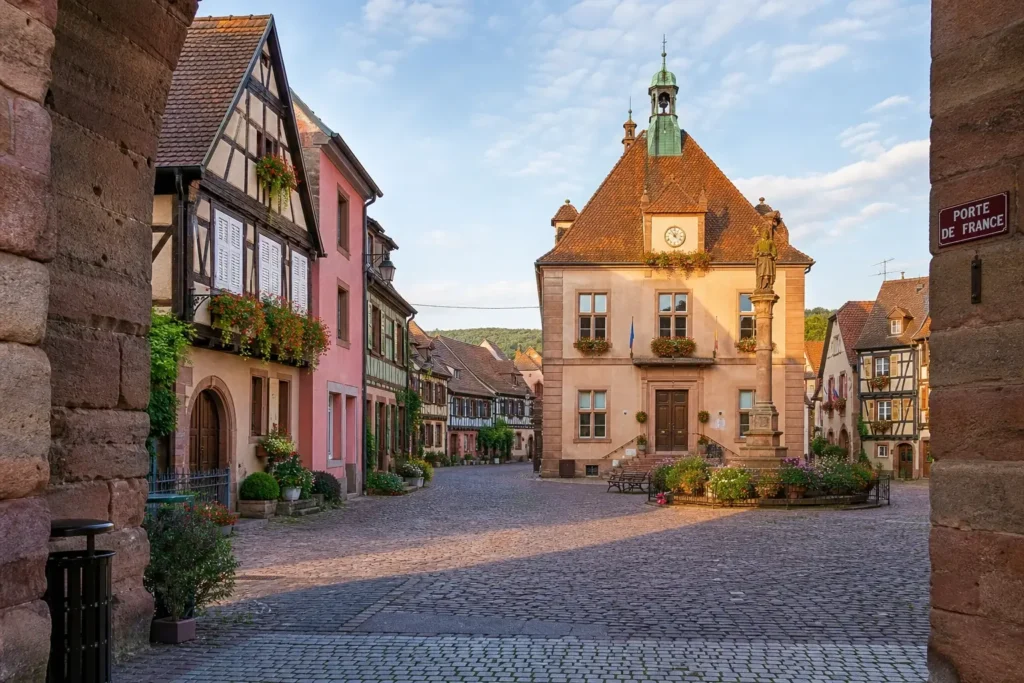
Turckheim’s distinguishing feature is its intact defensive plan. The three gates mark the historic entrances to the old town: the Porte de France to the south, the Porte de Munster to the west and the Porte du Brand to the east. You can walk the full circuit of the historic centre in twenty minutes, which makes the layout unusually easy to read compared with the more sprawling villages further north.
The second difference is the crowd level. Turckheim receives far fewer coach groups than Riquewihr or Eguisheim, even in high season. If you have already seen one or two of the postcard villages and want the same architecture without the queues, this is a sensible addition. It also works well as a first stop for anyone weighing up the prettiest villages in Alsace and wondering which are genuinely worth the detour.
The third is position. Turckheim is the point where the vineyard belt meets the Vosges valleys. Head east and you are in Colmar in ten minutes; head west and you are climbing into the Munster valley, cheese country and the high Vosges. Few villages let you switch landscapes that quickly.
What to see in Turckheim
The three gates and the Place Turenne
Start at the Porte de France, the largest of the three, and walk in. The main square, Place Turenne, is the natural centre: town hall, fountain, and the sixteenth-century Corps de Garde building. Most of the half-timbered façades worth photographing are within two streets of here. If you want to understand what you are looking at, the construction techniques and the meaning of the decorative panels are covered in the guide to Alsatian half-timbered houses.
The night watchman’s round
Turckheim keeps one of the last active night watchman traditions in France. On summer evenings the watchman sets out from Place Turenne in cape and hat, carrying a lantern and halberd, and makes a short circuit of the old town, sharing anecdotes about the town as he walks through the historic centre. It typically runs during the warmer months and stops in winter, but the exact season and start time change from year to year — confirm with the tourist office or the commune before you build an evening around it.
The ramparts and the storks
The outer walls can be followed for much of their length, and the stretch along the Fecht river is the pleasant one. Turckheim has hosted nesting storks in the past; sightings are seasonal and never guaranteed, but if you want to know where and when your chances are best across the region, see the page on storks in Alsace.
The Brand vineyard
The slope rising to the north-west of the village is Brand, one of the 51 Alsace Grands Crus. It is a granite site, warm and well-exposed, and the wines are typically fuller and riper than those from cooler terroirs. A marked vineyard path climbs into it directly from the edge of town — an hour’s loop, some gradient, good views back over the valley. For context on what the classification actually means, read up on the Alsace terroir and Grand Cru system; for which crus to prioritise on the ground, see the practical guide to visiting Alsace Grand Cru vineyards.
How to get to Turckheim
| From | Best option | Approximate journey | Notes |
|---|---|---|---|
| Colmar | TER train | around 10 minutes | Frequent on weekdays, thinner on Sundays |
| Colmar | Car | around 10 minutes | Park outside the walls; the centre is tight |
| Strasbourg | Train via Colmar | roughly 1h 15 total | Change at Colmar |
| Basel EuroAirport | Car | around 1 hour | Or shuttle to Basel/Mulhouse, then train |
| Eguisheim | Car or bike | 10–15 minutes | Flat, easy cycling between the two |
Turckheim’s own station is on the Colmar–Metzeral line running up the Munster valley, and it sits just outside the walls. That makes the village one of the few Wine Route stops you can genuinely treat as car-free. If you are building a wider trip on public transport, the options are set out in exploring the Wine Route without a car and in the broader getting around Alsace guide. For the Colmar leg specifically, the comparison in Strasbourg to Colmar covers train, bus and driving times.
Driving gives you far more range once you are here, because the villages north and south of Turckheim are not all rail-served. If you plan to combine Turckheim with Niedermorschwihr, Kaysersberg and the Munster valley in one day, a car is close to essential, and demand at the airports peaks in September and December.
Renting a car for the Wine Route
Rates are usually lowest 4–6 weeks ahead, and automatics disappear first — particularly in September and December. Compare pick-ups at Colmar station and Basel-Mulhouse airport before booking; the same dates can differ by half the price between suppliers.
Wine tasting in Turckheim
Turckheim has both a large cooperative cellar and a number of independent growers with tasting rooms in the old town. Opening patterns are typical for the region: most cellars open Monday to Saturday, many close over lunch, and Sunday is unreliable outside high season. Smaller domaines often prefer a phone call or email a day ahead, particularly for groups.
What to ask for here:
- Riesling from Brand — the benchmark. Riper and rounder than Riesling from limestone sites.
- Gewurztraminer — Brand produces powerful, lychee-scented examples; ask for a dry or off-dry style if you want it at the table rather than after dessert.
- Pinot Gris — smoky and broad, good with the region’s charcuterie.
- Crémant d’Alsace — most producers make one, and it is usually the best-value bottle on the list.
If the varieties are unfamiliar, start with the overview of Alsace grape varieties and the deeper notes on Alsace Riesling and Gewurztraminer. Knowing how to decode a bottle before you walk into a cellar also helps — see reading Alsace wine labels.
Tastings at small domaines are often free or nominal, sometimes waived on purchase; larger cellars may charge a modest fee for a structured flight. Expect roughly €5–€15 for a guided tasting where one applies, but confirm when you book. If you would rather not drive between cellars, a guided half-day out of Colmar removes the problem entirely and usually covers three or four villages.
Where to eat
Turckheim has a handful of winstubs and restaurants clustered around Place Turenne and along the three main streets. The offer is small, which matters in practice: on summer weekends and throughout December, walk-in tables disappear early. Book ahead or eat at the edges of service.
Order locally where you can. Tarte flambée is the standard evening dish and is usually only served from around 18:00 or 19:00 — background in the guide to tarte flambée. Munster cheese comes from the valley just up the road and is at its most convincing here; see Munster cheese for how it is served and what to drink with it. For the wider repertoire, the page on traditional Alsatian dishes explains what appears on a typical menu, and what a winstub actually is sets expectations for the format.
When to visit
| Season | What it’s like | Worth knowing |
|---|---|---|
| April–June | Green vineyards, mild, quiet | Best balance of weather and space |
| July–August | Warmest, longest evenings | Night watchman season; busiest restaurants |
| September–October | Harvest, golden vines | Cellars busy with picking; call ahead |
| Late Nov–late Dec | Small Christmas market atmosphere | Short daylight, cold; weekends crowded |
| January–March | Very quiet, some closures | Cheapest, but many cellars restrict hours |
Turckheim’s Christmas period is modest compared with the big names, and that is its appeal — no ticketing, no crush. Markets in Alsace typically run from late November to Christmas Eve, though village markets often operate weekends only. Check the current pattern in Christmas market dates and opening times before committing to a date, and if the markets are the reason you are coming, compare options in the guide to the best Christmas markets in Alsace.
For the wider seasonal picture across the region, see the best time to visit Alsace. If your trip is built around wine specifically, the best time to visit the Wine Route covers harvest timing and vine colour in more detail.
Christmas 2026: Important Information
27 November–30 December 2026
Christmas market, festive lights and traditional events in Turckheim.
How to combine Turckheim with a day out
A workable half-day-plus itinerary from Colmar:
- 09:30 — Train or drive to Turckheim. Enter via the Porte de France.
- 09:45 — Walk Place Turenne and the three main streets; circle the ramparts.
- 10:45 — Vineyard loop up into Brand for the views. Allow an hour.
- 12:00 — Lunch in the old town.
- 14:00 — Tasting at one or two cellars.
- 15:30 — Drive on to Niedermorschwihr and Kaysersberg, or turn west into the Munster valley.
- 18:00 — Back in Colmar, or stay on for the night watchman in summer.
Turckheim also pairs naturally with the central section of the Wine Route. The villages immediately north and south are covered in the central Wine Route, and full multi-day routing is laid out in Wine Route itineraries. If you have only one or two full days in the region, the ready-made plans in Alsace itineraries will save you an evening of map-reading.
Where to stay
Most visitors sleep in Colmar and treat Turckheim as an excursion, which is a reasonable default given the transport link. Staying in the village itself is a different proposition: quieter evenings, easy access to the vineyard paths, and the old town to yourself after the day visitors leave. The trade-off is a small stock of rooms — guesthouses and a few small hotels — which fills early for September and December.
Decide first whether you want a town base or a village base. The comparison in where to base yourself in Alsace sets out the arguments, and if you lean village, the options are ranked in the best villages to stay in. Vineyard-side properties across the region are covered in staying on the Wine Route.
Se loger à Turckheim ou à Colmar
Le parc de Turckheim est réduit — quelques hôtels familiaux et des chambres d’hôtes, souvent complets dès juin pour septembre et décembre. Colmar offre bien plus de choix et reste à dix minutes en train.
Deux réflexes utiles : viser un hébergement à moins de dix minutes à pied de la gare de Colmar si vous voyagez sans voiture, et vérifier que le stationnement est inclus si vous en avez une (le centre historique de Colmar est très contraint).
Good to know before you go
- Park outside the walls. The streets inside the gates are narrow and largely unsuited to visitor traffic. Use the car parks on the perimeter and walk in.
- Don’t assume Sunday opening. Many cellars and some restaurants close on Sundays and Mondays outside peak season. Two hours of research the night before avoids a wasted trip.
- Check the last train back. Services on the Munster valley line thin out in the evening and at weekends. If you plan to stay for dinner or the night watchman, confirm the return before you commit.
- The vineyard path has real gradient. Brand climbs. Wear proper shoes rather than sandals, and carry water in summer.
- Lunch service ends early. As across rural France, kitchens often stop around 13:30 or 14:00. Arriving at 14:15 with no reservation is a common and avoidable mistake.
- Two hours is not enough if you want to taste. Budget half a day if a cellar visit matters to you; the old town alone can be walked in far less.
- The night watchman is seasonal. It does not run year-round. Verify before making it the reason for your visit.
Frequently asked questions
How long do you need in Turckheim?
Two to three hours covers the old town, the three gates, Place Turenne and a slow circuit of the ramparts. Add an hour for the vineyard loop into Brand and another one to two hours for lunch and a tasting, and you have a comfortable half day. Most visitors combine it with Colmar or a neighbouring village rather than staying all day.
Can you visit Turckheim without a car?
Yes. Turckheim is on the TER line from Colmar and the journey takes around ten minutes, with the station a short walk from the walls. It is one of the most accessible Wine Route villages by rail. Services are less frequent on Sundays and in the evening, so check timetables in advance if you plan a late return.
Is Turckheim worth visiting compared with Riquewihr or Eguisheim?
If you want the single most photographed village, Riquewihr wins. Turckheim’s case is different: intact walls with three gates, a Grand Cru vineyard on the doorstep, an active night watchman tradition and noticeably fewer visitors. It works best as a complement rather than a replacement, particularly for travellers who dislike crowds.
What wine is Turckheim known for?
Brand, one of Alsace’s 51 Grands Crus, on the granite slope above the village. It is planted mainly to Riesling, Gewurztraminer, Pinot Gris and Muscat, and the warm exposure produces fuller, riper wines than cooler sites. Both the village cooperative and several independent growers offer tastings in the old town.
Does Turckheim have a Christmas market?
Turckheim runs a small seasonal market during the Advent period, considerably more low-key than Strasbourg or Colmar. Village markets in Alsace commonly operate on weekends only rather than daily. Dates and formats change from year to year, so confirm with the commune or tourist office before planning a trip around it.
When does the night watchman go out?
The round takes place on summer evenings, setting off from Place Turenne. The season, the days of the week and the start time all vary, and the tradition pauses in winter. Check the current schedule with the tourist office rather than relying on older online listings.
What else is nearby?
Colmar is ten minutes away, Niedermorschwihr and Kaysersberg are a short drive north, and Eguisheim is roughly fifteen minutes south. Head west instead and you climb into the Munster valley towards cheese farms and the high Vosges. Turckheim’s position at the valley mouth makes it a good hinge point between vineyard and mountain.