
Some links on this page are affiliate links. If you book or buy through them, I earn a small commission — at no extra cost to you. How this site is funded →
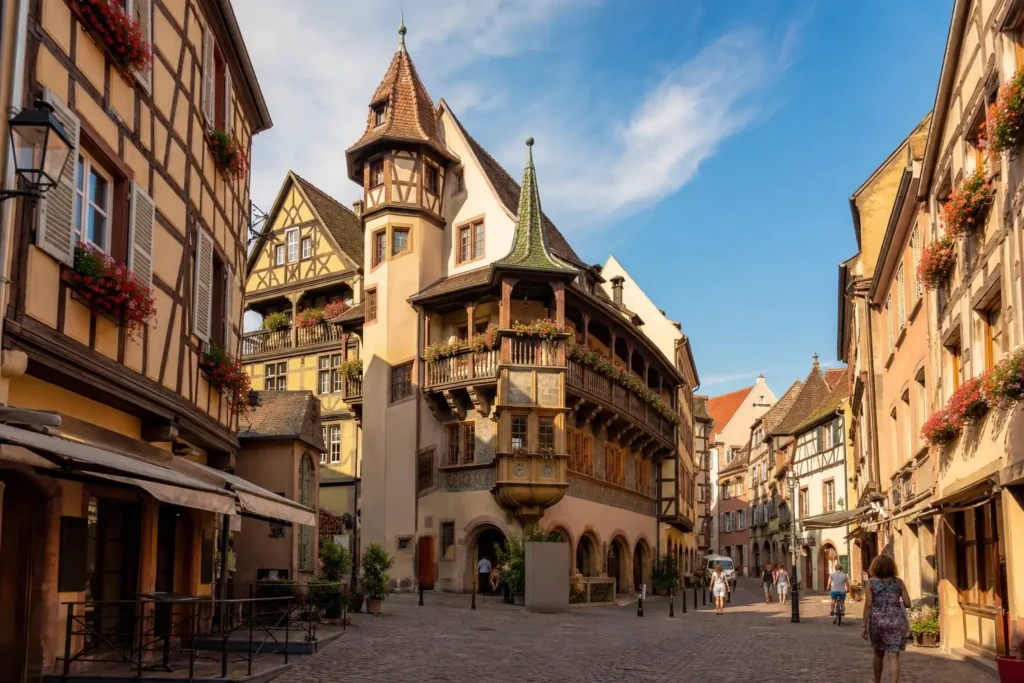
Colmar is the town most people picture when they think of Alsace: canals, painted half-timbered façades, and a compact old town you can cross on foot in fifteen minutes. It is also the best base in the region for reaching the wine villages. This guide covers what to see, how long to stay, where to eat and sleep, and how to get in and out efficiently.
In short
- Time needed: half a day for the old town, two full days to use Colmar as a base for the Wine Route.
- Getting there: direct trains from Strasbourg (roughly 30–50 minutes depending on service); Basel and Strasbourg airports are the practical arrival points.
- Best areas to stay: inside or just outside the old town for walkability; near the station if you plan to travel by train.
- Don’t miss: the Unterlinden Museum, Petite Venise, the covered market, and the Quartier des Tanneurs.
- Car or no car? You don’t need a car in Colmar itself. You do want one, or an organised tour, to reach the villages.
- Busiest periods: December (Christmas markets) and September (harvest). Book accommodation early for both.
Why base yourself in Colmar
Colmar sits in the middle of the Haut-Rhin, with the vineyard slopes rising immediately to the west. Eguisheim, Turckheim, Kaysersberg, Riquewihr and Ribeauvillé are all within a 30-minute drive, which is why Colmar works better than Strasbourg as a base for wine-country days. Strasbourg is the bigger city with the cathedral, the European institutions and better long-distance rail links; Colmar is smaller, quieter after dark, and closer to the vines.
If you’re still weighing the two, our comparison of where to base yourself in Alsace breaks it down by trip length and travel style. For a broader view of how the region fits together, see the Alsace destinations overview.
A rough rule: one or two nights in Colmar for a short trip, two to three if you want unhurried village days. Our guide to how many days you need in Alsace puts this in context.
What to see in Colmar’s old town
The historic centre is small and pedestrianised in large part. You can walk the main sights in a morning, but the town rewards a slower second pass in late afternoon when the coach groups have left.
Petite Venise
The stretch of the Lauch canal south of the covered market, lined with low, brightly painted houses. It is the most photographed part of town and the most crowded in the middle of the day. Come early or after 6pm. Small flat-bottomed boat trips operate on the canal in the warmer months; they typically last around 25 minutes and are worth it mainly for the angle they offer on the houses.
Quartier des Tanneurs
Tall, narrow timber-framed houses built high because tanners dried hides in the upper storeys. Quieter than Petite Venise and just a couple of streets away. Read more about the architecture of Alsatian half-timbered houses if you want to know what you’re looking at.
Unterlinden Museum
Housed in a former Dominican convent, this is the region’s most significant art museum and home to the Isenheim Altarpiece by Matthias Grünewald. Allow 90 minutes to two hours. It gets busy on rainy days and in December. Check current opening times and any closure days before you go — the museum’s own site is the reliable source. It also features in our round-up of museums in Alsace and our list of rainy day activities.
Collégiale Saint-Martin
The large Gothic church at the heart of the old town is often called the cathedral locally, although it is not the seat of a Roman Catholic diocese today. It was also the seat of the short-lived constitutional Bishopric of the Haut-Rhin during the French Revolution. Free to enter outside services. See also our guide to churches and cathedrals in Alsace.
Maison Pfister and Maison des Têtes
Two of the most distinctive Renaissance houses in Alsace, both on or near Rue des Marchands. The Maison des Têtes takes its name from the carved heads covering its façade. Exteriors only for most visitors.
Musée Bartholdi
Auguste Bartholdi, sculptor of the Statue of Liberty, was born in Colmar, and his birthplace is now a small museum. A replica of the statue stands at the northern entrance to the town, on the roundabout by the Route de Strasbourg — easy to spot if you arrive by car from the north.
More ideas, including seasonal options, in our guide to things to do in Colmar.
How long do you need in Colmar?
| Time available | What’s realistic |
|---|---|
| 3–4 hours | Old town loop: Collégiale, Rue des Marchands, covered market, Petite Venise, Tanneurs |
| Half a day + evening | The above plus Unterlinden, dinner in a winstub |
| 1 full day | Old town, one museum, and a relaxed afternoon with a wine tasting |
| 2 days | Colmar itself plus a full day on the Wine Route villages |
| 3 days | Add Haut-Kœnigsbourg or a second village loop, plus a market or cookery experience |
If Colmar is one stop on a wider route, our Alsace itineraries cover trips from one day upward, and the 3-day Alsace itinerary uses Colmar as its second base.
Where to eat and what to order
Colmar’s old town has a high density of restaurants, and quality varies sharply between the main tourist streets and the side lanes. Two practical filters: look for a handwritten or short seasonal menu rather than a laminated multilingual one, and book dinner in advance between May and October and throughout December.
A winstub is the traditional Alsatian tavern — wood panelling, wine by the glass or in the local 250ml pichet, hearty plates. Our guide to Alsatian winstubs and how they work explains the etiquette and typical menu.
What to order:
- Tarte flambée — thin, crisp, cream-and-bacon base, usually served in the evening. See tarte flambée explained.
- Baeckeoffe — slow-baked meat and potato casserole; often needs ordering for two. More in our baeckeoffe guide.
- Choucroute garnie — the classic winter plate; details in our choucroute guide.
- Munster cheese — pungent, washed-rind, local. See Munster cheese.
- Kougelhopf and other bakes — covered in Alsatian pastries and desserts.
The covered market (Marché Couvert), a brick-and-iron hall near Petite Venise, is the best single stop for cheese, charcuterie and a quick lunch counter. It is generally open from Monday to Saturday, with limited Sunday-morning opening; check the official schedule before you go, as hours may vary on public holidays. See our overview of food markets in Alsace for more.
For wine, most of what you’ll drink here is white: Riesling, Pinot Gris, Gewurztraminer, Sylvaner and Pinot Blanc, plus sparkling Crémant. Start with the seven Alsace grape varieties and, if you want to order well, our notes on pairing Alsace wine with local food.
Day trips from Colmar
This is Colmar’s strongest argument. Almost everything visitors come to Alsace for lies within a 40-minute radius.
| Destination | Approx. drive | Why go |
|---|---|---|
| Eguisheim | 10 min | Concentric circular village, one of the most walkable |
| Turckheim | 10 min | Fortified gates, night watchman tradition, few crowds |
| Kaysersberg | 20 min | Ruined castle above the village, strong wine scene |
| Riquewihr | 20 min | Walled village, the busiest and most photographed |
| Ribeauvillé | 25 min | Three castle ruins on the ridge above |
| Haut-Kœnigsbourg | 35–40 min | Restored hilltop castle with wide Rhine plain views |
| Écomusée d’Alsace | 30 min | Large open-air heritage village, excellent with children |
| Basel (Switzerland) | 55–70 min | City break, art museums, easy cross-border day |
For structured options, see our page on day trips from Colmar and the practical guide to visiting Haut-Kœnigsbourg and the Écomusée d’Alsace.
Village hopping is far easier with your own vehicle, especially if you want to stop at cellars that sit outside village centres. Pick-up is straightforward at Colmar station, and at Basel or Strasbourg airports if you’re flying in. Automatic transmissions are a minority of the fleet in France, so reserve one specifically if you can’t drive a manual, and book early for September and December when demand peaks.
🚗 Renting a car for the Wine Route
Compare prices across major rental companies for pick-up in Colmar or at Basel and Strasbourg airports. If you can’t drive a manual, filter for automatic transmission early — it’s a minority of the fleet in France and the first option to sell out, especially in September and December.
Compare car rental prices for Colmar
If you’d rather not drive — sensible if you plan to taste seriously — small-group tours leave Colmar daily in season, typically visiting three or four villages with one or two cellar stops in a half or full day. Half-day departures suit travellers with only one night in town. Compare formats in our guides to Colmar and villages tours and guided versus self-guided touring.
Where to stay in Colmar
Three broad choices:
- Inside the old town. Best for atmosphere and evening walks; expect narrow streets, limited or paid parking, and some noise on the busiest lanes. Prioritise this if you don’t have a car.
- Just outside the historic centre. A 5–15 minute walk in, easier parking, generally better value for the same standard.
- Near the station. Practical if you’re arriving and leaving by rail, or doing a day trip to Strasbourg or Basel.
- A vineyard village nearby. Quieter nights, cellar doors on your doorstep, but you’ll need a car and evening dining options shrink.
Rooms in the old town are limited in number and December fills months ahead — the Christmas market period is the single tightest window of the year, followed by harvest in September. If your dates are fixed and fall in either, secure accommodation before locking anything else in.
🏨 Where to stay in Colmar
The old town has a limited number of rooms, and demand spikes sharply twice a year: during the Christmas markets (Nov–Dec) and the September harvest. Both periods can sell out months ahead. If you’re travelling during either, book your accommodation first — before restaurants, tours, or anything else.
Check availability for Colmar hotels
For detail on neighbourhoods, property types and price bands, see where to stay in Colmar, plus our pages on vineyard hotels and bed and breakfasts in Alsace.
Getting to Colmar
By train. Colmar is on the main Strasbourg–Basel line, with frequent regional services and some faster trains. Strasbourg to Colmar takes roughly 30–50 minutes depending on the service; the station is a 10-minute walk from the old town. Our dedicated page on Strasbourg to Colmar compares train, bus and driving times, and travelling Alsace by train covers ticketing and regional lines.
By air. EuroAirport Basel-Mulhouse-Freiburg is the closest airport, roughly an hour away by road. Strasbourg airport is a smaller option, and Frankfurt or Paris work for long-haul arrivals with a train connection. Compare all of them in our guide to airports for Alsace.
By car. The A35 motorway runs the length of the Alsace plain, with Colmar directly on it. Drive into the old town only to drop luggage; use one of the peripheral or underground car parks otherwise.
From Paris. TGV to Strasbourg, then a regional train onward, or TGV services routed towards Mulhouse and Basel. Both work; see how to get to Alsace for the comparison.
Rail is the low-stress option for the Paris–Colmar leg, and reserved TGV seats on Friday and Sunday services sell out well ahead in peak weeks.
Colmar at Christmas
Colmar runs one of the region’s best-known Christmas market seasons, spread across several distinct squares in the old town rather than concentrated in one place, with the Petite Venise area among the most atmospheric. Markets in Alsace typically open in the second half of November and run to around Christmas or shortly after, with variation by town — always confirm the current calendar before booking.
Practical realities: weekends are extremely busy, hotel rates rise sharply, and the town is at its best on weekday mornings and after 8pm. Layers matter more than a single heavy coat, since you’ll move between crowded market lanes and cold open squares.
See our Colmar Christmas market guide, the regional Alsace Christmas markets overview, and Christmas market dates and opening times. If you’re travelling without a car in December, visiting the Christmas markets without a car covers the train options.
When to visit
| Period | What it’s like |
|---|---|
| April–June | Mild, gardens and window boxes in flower, moderate crowds |
| July–August | Warmest and busiest; book restaurants and rooms ahead |
| September–mid October | Harvest, vineyard colour, cellar activity; very popular |
| Late Oct–mid Nov | Quietest window; some village businesses take a break |
| Late Nov–December | Christmas markets, cold, highest demand and prices |
| January–March | Cheapest and calmest; shorter days, some closures |
For the full seasonal picture see the best time to visit Alsace, and for vineyard-specific timing, when to visit the Wine Route.
Good to know: common mistakes
- Treating Colmar as a full-day sight. The old town is genuinely small. Pair it with a museum, a tasting, or a village trip, or you’ll finish by lunchtime.
- Photographing Petite Venise at noon. It’s the most crowded spot in Alsace at midday. Early morning and evening are transformed.
- Driving into the historic centre. Much of it is pedestrian or restricted, and signage is in French. Park on the edge and walk.
- Assuming everything opens Monday. Several museums and the covered market close on specific weekdays, and many cellars shut over lunch. Confirm the day before.
- Booking a December weekend late. Christmas-market weekends are the hardest dates of the year for accommodation in Colmar.
- Underestimating village transport without a car. Bus links between wine villages are thin and Sunday service is minimal. See the Wine Route without a car before committing.
- Skipping the wine. A cellar visit takes an hour and is often free or low-cost with purchase. Our guide to wine cellars and tastings explains how to approach it.
FAQ
Is Colmar worth visiting?
Yes, particularly as a base. The old town is one of the best-preserved in France, with the Unterlinden Museum and Petite Venise as anchors, and it sits within 30 minutes of the main wine villages. If you only have a single day in Alsace, Strasbourg offers more depth; for two days or more, Colmar is the stronger choice. See is Alsace worth visiting.
How many days should I spend in Colmar?
Two nights suits most visitors: one day for the town and one for the villages. One night works if you’re passing through and accept a compressed old-town visit. Three nights makes sense if you want Haut-Kœnigsbourg, a second village loop, or an unhurried tasting day without rushing.
Do I need a car in Colmar?
Not for Colmar itself — the old town is compact and pedestrian-friendly, and the station is a short walk away. You do want a car, or an organised tour, for the wine villages, since public transport between them is limited. Our page on getting around Alsace sets out the options.
Which is better, Colmar or Strasbourg?
Different trips. Strasbourg is a city with a major cathedral, a large old town, museums and the best long-distance rail links. Colmar is a small town, prettier per square metre, and closer to the vineyards. Many visitors split their stay between the two. Compare on where to base yourself.
Is Colmar walkable?
Very. The historic centre is roughly 1km across, largely flat and mostly pedestrianised, and the walk from the railway station takes about ten minutes. Cobbles are uneven in places, so choose footwear accordingly. All the main sights sit within a single loop of under 3km.
What is Colmar famous for?
Its half-timbered old town and the Petite Venise canal district, the Unterlinden Museum with the Isenheim Altarpiece, its position as the capital of the Alsace wine trade, and its Christmas markets. It’s also the birthplace of Auguste Bartholdi, who sculpted the Statue of Liberty.
Can I visit Colmar as a day trip from Strasbourg?
Yes. Trains run frequently and take roughly 30–50 minutes each way, and the station is a short walk from the old town. Leave early to see Petite Venise before the crowds. A day trip covers the town but not the wine villages — those need an overnight stay or a tour. Details on Strasbourg to Colmar.
Do people speak English in Colmar?
Widely, in hotels, restaurants and shops in the tourist centre. Smaller village cellars and rural businesses may have less English, though many winemakers deal with international buyers. A few French courtesies go a long way; see do you need French in Alsace.
Keep planning
- The Alsace Wine Route: complete guide — the route Colmar sits at the heart of
- Where to stay in Colmar — neighbourhoods and property types
- Day trips from Colmar — organised and self-drive options
- The most beautiful Wine Route villages — which ones to prioritise
- Alsace itineraries — routes from one day to a week
- How to plan a trip to Alsace — the full planning checklist