
Some links on this page are affiliate links. If you book or buy through them, I earn a small commission — at no extra cost to you. How this site is funded →
Most visitors see the same five or six villages between Strasbourg and Colmar, then leave convinced they have seen Alsace. This page ranks the prettiest villages in Alsace by what actually makes them worth your driving time — architecture, setting, atmosphere at the hours you will be there — and adds the ones that sit well away from the vineyards, in the far north and the deep south. Use it to build a shortlist before you fix your route.
In short
- If you have one day: Eguisheim and Kaysersberg, both within 15 km of Colmar, give you the highest concentration of half-timbered streets for the least driving.
- If you have two or three days: add Riquewihr, Hunawihr, Mittelbergheim and Niedermorschwihr for variety of setting rather than more of the same.
- Off the Wine Route: Hunspach and Seebach in the Outre-Forêt (northern Bas-Rhin) look nothing like the vineyard villages — whitewashed timber frames, no wine cellars, almost no coaches.
- The far south: the Sundgau’s ochre-yellow farmhouses and the castle village of Ferrette suit travellers arriving via Basel or Mulhouse.
- A car changes everything outside the Colmar–Sélestat corridor. Villages in northern and southern Alsace are reachable by rail or bus, but on thin timetables.
- Best hours: before 10am or after 5pm. Between 11am and 4pm the central villages fill up, especially from May to October and in December.
What makes an Alsatian village worth the detour
Village-hopping in Alsace gets repetitive fast if you choose badly. Four things separate the memorable ones from the merely photogenic:
- A distinctive plan. Eguisheim’s streets curve in concentric rings around a former castle courtyard; Riquewihr is a walled rectangle you enter through a gate tower; Zellenberg runs along a single ridge.
- A setting you can see from inside the village. Vines climbing to the doorstep (Katzenthal, Niedermorschwihr), a fortified church on a rise (Hunawihr), a river and a covered bridge (Kaysersberg).
- One genuine landmark, not just pretty façades: a twisted spire, a Romanesque frieze, a witches’ tower, a pottery workshop.
- Working life. Villages where growers, bakers and potters still trade at street level feel different from those that survive on souvenir shops alone.
If you want the architectural background — why the timber frames are coloured, what the dates carved on lintels mean — read our guide to Alsace’s half-timbered houses before you go. It changes what you notice.
The prettiest villages on the Wine Route
These are the classics, and they earn their reputation. The full ranking, with parking notes and walking routes for each, sits in our dedicated guide to the most beautiful villages along the Alsace Wine Route. In brief:
- Eguisheim — around 7 km from Colmar, listed among Les Plus Beaux Villages de France, and the easiest village to love. Walk the ring road (Rempart Sud) rather than only the central square.
- Riquewihr — walled, dense, and the busiest village in Alsace by mid-morning. Arrive early, then climb into the vines behind the Dolder gate.
- Kaysersberg — castle ruins above, a fortified bridge over the Weiss below, and a main street with more real shops than most.
- Ribeauvillé — larger, less manicured, with three ruined castles on the ridge above and good walking straight from town.
- Turckheim — three surviving gates and a night watchman who traditionally makes his rounds on summer evenings; check the current schedule locally.
- Hunawihr — the fortified church ringed by vineyards is the single best village silhouette in Alsace. A stork and otter reintroduction centre sits just outside; see our page on Alsace’s storks for how the birds came back.
- Mittelbergheim — also on the Plus Beaux Villages list, and different in feel: sandstone and stone-built winegrowers’ houses rather than colourful timber. It sits above Barr in the northern half of the route.
- Bergheim — ramparts, an avenue of ancient lime trees, and a quieter atmosphere than its famous neighbours.
The official Plus Beaux Villages de France network currently includes several Alsatian members — Eguisheim, Riquewihr, Mittelbergheim, Bergheim and Hunspach among them. The list is reviewed periodically, so check the network’s own site if the label matters to you.
Niedermorschwihr and the villages just off the main road
The signposted Wine Route follows one line. Turn 2 or 3 km off it and the crowds vanish.
Niedermorschwihr, roughly 8 km west of Colmar, is the best example. Its church carries a twisted, spiralling spire — a shape you will not see anywhere else in Alsace — and the village sits in a bowl of Grand Cru vineyard on the Sommerberg slope. It is also known among food lovers for artisan jam-making of national reputation. There is very little parking; leave the car at the edge and walk in.
Katzenthal, the next valley over, gives you the same vineyard amphitheatre with a ruined castle above and almost no visitors. Zellenberg takes ten minutes to cross on foot but delivers the widest vineyard panorama on the central route. Andlau, in the north, has an abbey church with a carved Romanesque frieze and three Grands Crus on its doorstep — useful if you want to taste seriously rather than casually, as our guide to visiting Alsace’s Grand Cru vineyards explains.
Two more, close to Obernai: Boersch, entered through three medieval gates around a Renaissance well, and Rosheim, which holds one of the oldest surviving stone houses in Alsace alongside a substantial Romanesque church.
Hunspach, Seebach and the villages of northern Alsace
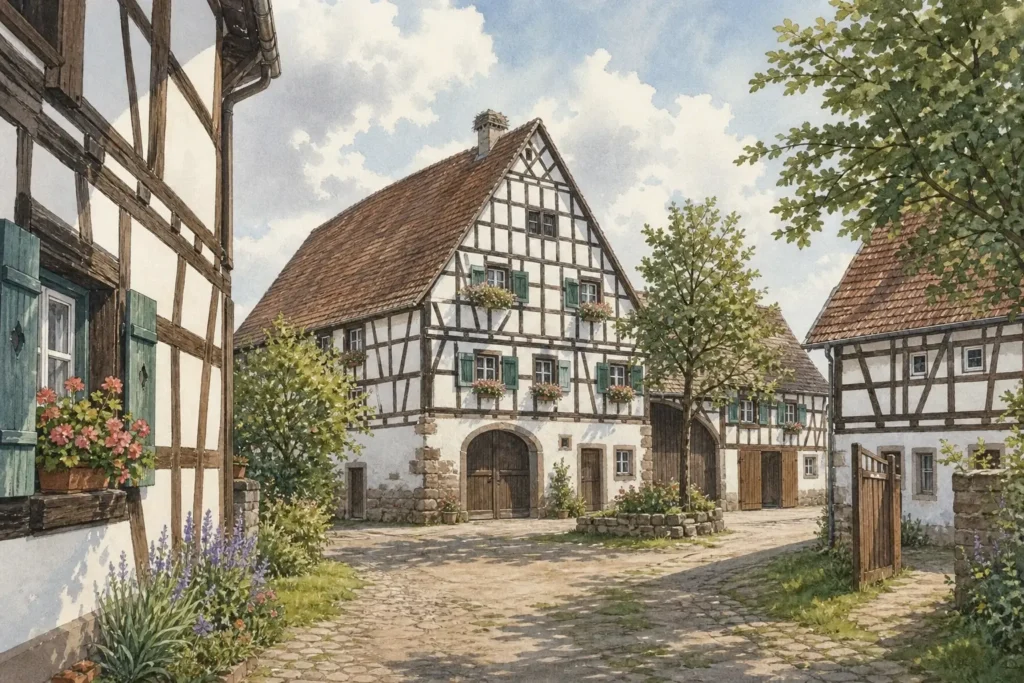
This is the part of Alsace almost no English-speaking visitor reaches, and it looks genuinely different. In the Outre-Forêt, the flat farming country north of the Haguenau forest and roughly 55–60 km north of Strasbourg, the half-timbered houses are whitewashed rather than coloured, set back behind open farmyards, with small bulging bottle-glass windows on the ground floor.
Hunspach is the showpiece and a Plus Beaux Villages de France member: a single long street of white gabled farmhouses, no wine cellars, no souvenir shops. Seebach, a few kilometres east, is its livelier neighbour, heavily flower-decked in summer and known for maintaining local folk traditions and costume. Its traditional wedding festival, the Streisselhochzeit, was held for the last time in 2019 and is currently no longer organised; check the municipality’s event calendar for current summer festivities instead. Hoffen and Ingolsheim, both within a couple of kilometres, follow the same architectural pattern with far fewer cars.
Pair the visit with something substantial nearby: Wissembourg, an attractive small town on the German border about 10 km away; a preserved Maginot Line fort in the same district; or the potters’ villages of Betschdorf (grey salt-glazed stoneware) and Soufflenheim (brightly glazed earthenware), where workshops sell directly and make far better souvenirs than anything on a village high street. Our page on Alsatian souvenirs worth bringing home covers what to look for.
Northern Alsace works as a full day out of Strasbourg, not as a detour on the way to Colmar. If you are planning your route logically, check the distances on our Alsace map and geography guide first — the north is a genuine commitment.
Southern Alsace: the Sundgau and the Jura Alsacien
South of Mulhouse, the Sundgau’s rolling farmland has its own building style: long farmhouses with ochre-yellow or deep-red timber frames, often lined up along a single street. Grentzingen and the neighbouring villages of the Ill valley are the clearest examples. Further south, Ferrette sits under ruined castle towers in the Jura Alsacien, with real hiking country around it and fried carp as the regional dish in local inns.
This corner makes sense if you fly into EuroAirport or come up from Switzerland, and it pairs well with the star-shaped fortified town of Neuf-Brisach or with Mulhouse and its museums on a rainy day.
Compare the villages at a glance
| Village | Area | Why it stands out | Without a car |
|---|---|---|---|
| Eguisheim | Near Colmar | Concentric ring streets, flower-covered façades | Bus from Colmar, feasible |
| Riquewihr | Central Wine Route | Walled village, gate tower, vineyard walks | Bus from Colmar, seasonal |
| Kaysersberg | Central Wine Route | Castle ruin, fortified bridge, real shops | Bus from Colmar, feasible |
| Hunawihr | Central Wine Route | Fortified church encircled by vines | Walk from Riquewihr (approx. 2 km) |
| Niedermorschwihr | Near Colmar | Twisted church spire, Grand Cru bowl | Difficult; limited bus |
| Katzenthal | Near Colmar | Vineyard amphitheatre, no crowds | Difficult |
| Mittelbergheim | Northern Wine Route | Stone winegrowers’ houses, Sylvaner Grand Cru | Train to Barr, then walk/taxi |
| Boersch | Near Obernai | Three medieval gates, Renaissance well | Train to Obernai, then bus/taxi |
| Hunspach | Northern Alsace | Whitewashed timber farmhouses, no tourism | Regional train, sparse service |
| Seebach | Northern Alsace | Living folk traditions, flower displays | Very limited |
| Grentzingen area | Sundgau | Ochre-yellow farmhouse frontages | Very limited |
| Ferrette | Jura Alsacien | Castle ruins, hiking, carp country | Bus from Mulhouse/Basel area |
Do you need a car?
For the central Wine Route between Colmar and Sélestat, no — regional trains reach Sélestat, Colmar and Barr, and seasonal buses link the best-known villages. Our guide to seeing the Wine Route without a car sets out what is realistic.
For everything in this page’s off-route sections, a car is close to essential. Northern Alsace and the Sundgau have village stops served a few times a day at best, and the whole point of these areas is stringing together three or four small places in an afternoon. If you are combining the north with the vineyards, plan to collect the car in Strasbourg and drop it in Colmar, or the reverse — one-way arrangements within Alsace are usually straightforward. Demand peaks in September, October and December, and automatic transmissions are the first category to sell out, so book well ahead if you cannot drive a manual. Our page on hiring a car in Alsace covers licences, tolls and parking.
Renting a car for the Wine Route
Rates are usually lowest 4–6 weeks ahead, and automatics disappear first — particularly in September and December. Compare pick-ups at Colmar station and Basel-Mulhouse airport before booking; the same dates can differ by half the price between suppliers.
If you would rather not drive, the regional line from Strasbourg towards Wissembourg puts you within walking or short-taxi distance of Hunspach and Hoffen. Services thin out considerably at weekends, so check timetables the day before and build in generous margins.
Two driving loops that actually work
Loop 1 — Colmar’s inner ring (half a day, roughly 40 km)
- Leave Colmar early for Eguisheim; park outside the ring road and walk the ramparts first.
- Drive to Wettolsheim and up to Niedermorschwihr for the twisted spire.
- Continue over to Katzenthal, then Ammerschwihr.
- Finish in Kaysersberg by late afternoon, when the coaches have gone.
Loop 2 — Northern Alsace (full day from Strasbourg, roughly 130 km round trip)
- Drive north to Betschdorf or Soufflenheim and visit a pottery workshop.
- Continue to Hunspach; park at the edge and walk the length of the village.
- Add Seebach, Hoffen and Ingolsheim — 15 minutes each is enough.
- End with a late lunch or early dinner in Wissembourg.
For longer routes that tie the villages into castles, cities and vineyards, see our Alsace road trip itinerary, or the driving-focused version in the Wine Route by car guide.
Where to stay if villages are your priority
Sleeping in a village rather than a city changes the experience completely: you get the streets to yourself between 6pm and 9am, which is when they look their best. The trade-off is fewer restaurants open late and, in winter, some places closing entirely.
Practical filters: choose a village with at least two dinner options within walking distance; check whether parking is inside or outside the walls; and confirm whether breakfast is served if you plan early starts. Village inns and guest houses have small room counts — often fewer than a dozen — so the best-placed rooms go months ahead for September, October and the Christmas market weekends. Compare options in our guides to staying in Alsace’s villages and to Alsatian bed and breakfasts.
Where to stay in the villages
Sleeping in a village means having the streets to yourself between 6pm and 9am. Ribeauvillé and Kaysersberg give you the most restaurants within walking distance; Eguisheim is the most convenient for Colmar. Room counts are small, so book early for autumn and December.
When to come for the best village atmosphere
- April to June: window boxes filling out, long light, moderate crowds.
- July and August: peak flowers, peak visitors, and the warmest evenings. Villages are busiest 11am–4pm.
- September and October: harvest activity, colour in the vines, and the strongest atmosphere overall — also the hardest period to book.
- Late November to Christmas: the small village markets, particularly in the walled villages, transform the streets. See our comparison of the best Christmas markets in Alsace.
- January to March: many village restaurants and cellars close for several weeks. Beautiful, empty, and requires checking every opening.
Full month-by-month guidance is in our page on the best time to visit Alsace.
Common mistakes to avoid
- Cramming six villages into one day. Four is the sensible maximum, three if you want to taste wine or eat properly. The villages are close, but parking and walking eat the time.
- Arriving at midday. You will see the same street as everyone else. Shift your day earlier or later.
- Driving into village centres. Most historic cores are pedestrianised or too narrow. Use the signed car parks on the edge; they are rarely more than five minutes’ walk from the centre.
- Assuming everything is open at lunchtime. Shops and cellars in small villages routinely close for two hours or more in the middle of the day, and many close on Sundays or Mondays.
- Treating northern Alsace as a quick stop. Hunspach and Seebach are a full day from Strasbourg, not a detour en route to Colmar.
- Only photographing the main street. The best views are usually from the vineyard paths or ramparts just outside the village — our guide to Alsace’s best viewpoints and photo spots lists where to stand.
- Skipping the towns entirely. Strasbourg and Colmar hold the museums, the late dining and the transport links that make a village-based trip work.
Frequently asked questions
What is the prettiest village in Alsace?
There is no single answer, and it depends on what you value. Eguisheim wins on the coherence of its layout and the density of flowered façades. Riquewihr wins on the completeness of its walls and gate tower. Hunawihr wins on setting. If you want somewhere that looks unlike the postcard image of Alsace, Hunspach in the far north is the strongest choice.
Which Alsace villages carry the Plus Beaux Villages de France label?
Several Alsatian villages belong to the network, including Eguisheim, Riquewihr, Mittelbergheim, Bergheim and Hunspach. Membership is reviewed periodically and villages can be added, so check the network’s official list before building a trip around the label. Plenty of equally attractive villages — Hunawihr, Niedermorschwihr, Boersch — are not members.
Can you visit the villages without a car?
Yes for the central Wine Route: trains reach Colmar, Sélestat, Barr and Obernai, and buses plus seasonal shuttles serve the best-known villages. It becomes difficult for the off-route villages, where services may run only a few times a day. Guided day trips from Colmar or Strasbourg solve the problem if you want several villages in one outing.
How many villages can you see in a day?
Three to four is comfortable with a car, allowing roughly an hour to ninety minutes in each plus a proper lunch. Small villages such as Zellenberg or Hoffen need only 15–20 minutes. Trying for six leaves you with a day of car parks. Distances are short — often 5 to 10 km — but parking and walking in add up quickly.
Are Hunspach and Seebach worth the drive from Strasbourg?
They are if you want a side of Alsace with almost no tourism and a distinctly different architecture — whitewashed timber frames, working farmyards, no wine trade. Budget a full day and combine them with Wissembourg, a Maginot Line fort or the pottery villages. If you only have two or three days in Alsace, prioritise the vineyard villages instead.
Which village is the best base for two or three nights?
Ribeauvillé and Kaysersberg give you the most restaurants and shops within walking distance while still emptying out at night. Eguisheim is the most convenient for Colmar. Barr and Obernai suit the northern half of the route and have rail links. Choose on dinner options and parking rather than on looks alone.
Do the villages get uncomfortably crowded?
The central ones do, in a narrow window. Riquewihr, Kaysersberg and Eguisheim fill between late morning and mid-afternoon in summer and on December weekends. The same streets are calm before 10am and after 5pm, and villages 3 km off the signposted route stay quiet all day.