
Some links on this page are affiliate links. If you book or buy through them, I earn a small commission — at no extra cost to you. How this site is funded →
The Strasbourg Christmas market is not one single market but a series of separate markets spread across the city centre, each with its own character and crowd level. In 2025, the official programme listed eight markets. This guide shows you where they are, which ones are worth your time, how to avoid the worst of the crush, and what to do with the rest of your day once you have seen enough wooden chalets.
In short
- Strasbourg’s market, known as the Christkindelsmärik, dates back to 1570 and is one of the oldest in Europe.
- It typically runs from the last weekend of November to Christmas Eve, with a handful of stalls sometimes staying open a few days longer. Always confirm dates before booking.
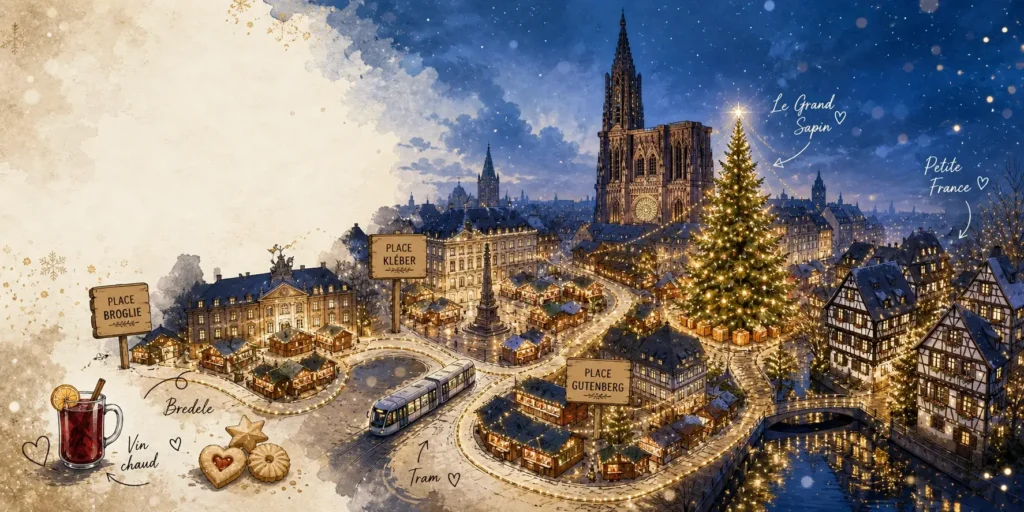
- Stalls are spread over roughly a dozen squares in and around the Grande Île; the main clusters are Place Broglie, Place de la Cathédrale, Place Kléber and Place Gutenberg.
- Weekday mornings and early afternoons are calm. Friday evenings and Saturdays are extremely busy.
- Two nights is enough for Strasbourg alone; add a third if you want to reach the villages.
- Accommodation in the city sells out months ahead for December weekends. Book early or base yourself outside the centre.
Where the Strasbourg Christmas market actually is
There is no single entrance and no ticket. The market occupies public squares across the historic centre, so you walk from one to the next. Distances are short — the whole circuit is comfortably under an hour on foot without stopping, but you will stop.
Here is how the main sites break down.
| Square | What you’ll find | Crowd level | Worth prioritising? |
|---|---|---|---|
| Place Broglie | The historic heart of the Christkindelsmärik; the largest concentration of chalets | Very high evenings | Yes, but go early |
| Place de la Cathédrale | Stalls at the foot of the cathedral, strong on decorations and crafts | Very high | Yes, for the setting |
| Place Kléber | The Great Christmas Tree and a charity-focused village around it | High | Yes, mainly for the tree |
| Place Gutenberg | Craft and design-leaning stalls, often a partner-region theme | Moderate | Good for gifts |
| Place du Marché aux Poissons | Riverside stalls near the Palais Rohan | Moderate | Pleasant, less pressured |
| Place Benjamin Zix (Petite France) | Small cluster in the prettiest quarter | Moderate to high | Yes, for photographs |
| Place des Meuniers / Petite France area | Smaller, quieter clusters | Lower | Good escape valve |
| Place du Temple Neuf | Smaller square, often food and drink-focused | Lower | Yes if you want breathing room |
The exact allocation of squares shifts slightly from one year to the next, and a partner region or country is invited annually with its own dedicated stalls. Check the current layout on arrival — free maps are usually available at the tourist office beside the cathedral.
Our advice: do not try to see everything. Pick three or four squares, walk the connecting streets slowly, and accept that you will miss some. The streets between the squares are decorated too, and Rue Mercière and Rue des Orfèvres are as memorable as any chalet.
When to go: dates, hours and the crowd calendar
The market traditionally opens in the final days of November and closes on 24 December. Some years a small number of stalls remain open into the days just after Christmas. Individual chalets set their own hours, but the usual pattern is late morning to around 8pm, with later closing on Fridays and Saturdays and earlier closing on 24 December. Confirm the current schedule before you commit to non-refundable travel — full details for all Alsace markets are collected on our Christmas market dates and opening times page.
Crowd levels vary enormously, and this matters more than anything else for your enjoyment.
| Timing | What to expect |
|---|---|
| Weekday mornings (until about 2pm) | Genuinely relaxed; you can browse and photograph properly |
| Weekday evenings | Busy but manageable; best atmosphere-to-crowd ratio |
| Friday evening | Very busy from around 5pm |
| Saturday all day | The peak; expect slow-moving crowds in narrow streets |
| Sunday afternoon | Busy, but easing after around 5pm |
| The week before Christmas | Consistently packed, all days |
The first week is quieter than the rest and the decorations are already up. The last full week before Christmas has the strongest atmosphere and the worst crowds. If you have flexibility, aim for a Tuesday to Thursday stay in the first half of December.
Security controls are in place around the historic centre during the market period, with some vehicle restrictions and bag checks at pedestrian entry points. Allow a few extra minutes and travel light.
Getting to Strasbourg for the market
Strasbourg is one of the easiest French cities to reach without a car. The TGV from Paris Gare de l’Est takes under two hours and arrives at Strasbourg station, a ten-minute walk or one tram stop from the market squares. Direct services also run from Germany, and connections from Brussels and beyond are straightforward.
Because December is the single busiest month on this line, advance fares disappear quickly and last-minute tickets can cost several times the early price. If your dates are fixed, booking rail as soon as the schedule opens is the single biggest saving you can make on this trip. Our Alsace by train guide explains how the network works, and the wider how to get to Alsace page compares flying, driving and rail.
Flying in, your realistic options are Strasbourg’s own airport, EuroAirport Basel-Mulhouse-Freiburg, or one of the German airports across the Rhine. The Alsace airports guide sets out transfer times and onward connections for each.
Driving into Strasbourg during the market is the one option we would actively discourage. The historic centre is closed or restricted to traffic, parking demand is extreme, and the park-and-ride tram system on the edge of the city is far quicker. If you do drive, use a park-and-ride and take the tram in. More on that in our getting around Alsace guide.
What to eat and drink at the market
This is where a Strasbourg market visit is either excellent or forgettable, depending on what you order. The staples are consistent across the squares.
- Vin chaud — mulled red wine, the default drink. Alsace also does a white version, made with Riesling or Pinot Blanc and often better balanced.
- Bredele — the small spiced Christmas biscuits sold by weight in dozens of shapes. Buy from a stall selling several varieties and mix your own bag.
- Pain d’épices — gingerbread, sold as loaves, hearts and small cakes.
- Tarte flambée — thin, crisp and cooked in front of you; the most satisfying hot food on the market. Full background in our tarte flambée guide.
- Choucroute and sausages — served in cardboard trays at the food-focused squares. See choucroute explained if you want to know what you are ordering.
- Mannele — small brioche figures, traditionally eaten around St Nicholas at the start of December.
A practical point: the market is for snacking, not dinner. Book a table at a proper winstub for at least one evening — December bookings in central Strasbourg fill up well ahead. Our overview of Christmas market food and drink covers the full range across Alsace.
If you want to bring something home, the best buys are ceramics, textiles, glass decorations and wine rather than mass-produced ornaments. There is more on distinguishing the two in our guide to Alsatian souvenirs worth buying.
What else to do in Strasbourg beyond the stalls
Two full days of chalets is too many. Build in these instead.
Strasbourg Cathedral. The cathedral’s astronomical clock normally has a daily presentation, but the main show may be suspended during the Christmas market period. Check the cathedral’s current schedule before planning your visit. The platform climb offers a panoramic view over the city, although access may be busy or subject to specific opening hours in December.
Petite France. The canal quarter with the half-timbered houses everyone photographs. Best at first light or after dark when the market crowds thin.
Museums. The Palais Rohan houses three collections under one roof, and the Musée Alsacien covers regional domestic life. A useful reserve for cold or wet afternoons — see rainy day activities in Alsace.
A boat trip. Covered, heated boats circle the Grande Île year-round and give you a different angle on the illuminations.
For a fuller list, our things to do in Strasbourg page goes well beyond December, and the Strasbourg destination guide covers the city as a whole.
Combining Strasbourg with the village markets
Strasbourg is the biggest market in Alsace but not the prettiest. The village markets — smaller, tighter, set among half-timbered houses and vineyards — are what most visitors remember. The good news is they are close.
| From Strasbourg to | Approximate journey | Practical for a day trip? |
|---|---|---|
| Colmar | ~30 min by train | Yes, very easy |
| Obernai | ~30 min by train | Yes |
| Sélestat | ~25 min by train | Yes, and a base for Haut-Kœnigsbourg |
| Ribeauvillé | ~1 hr, train + bus | Yes, with planning |
| Riquewihr | ~1 hr 15, train + bus | Yes, but check bus times |
| Kaysersberg | ~1 hr 15, train + bus | Yes, weekends are heaviest |
Note that several village markets only run at weekends, or on specific weekends rather than continuously. This catches out a lot of visitors. Our best Christmas markets in Alsace page ranks them by what they actually offer, and the Colmar Christmas market, Riquewihr and Kaysersberg pages go into detail on the strongest alternatives.
Without a car, the train and bus combination works but requires timetable discipline, especially for return journeys after dark. We set out the workable routes in visiting the Christmas markets without a car.
An organised day trip removes the timetable problem entirely and usually covers two or three villages in an afternoon and evening. December departures from Strasbourg are limited in number and go early, particularly for weekend dates.
Alternatively, the Christmas market tours page compares the formats available, and day trips from Strasbourg covers the wider options.
Where to stay for the Strasbourg Christmas market
Staying inside or immediately beside the Grande Île is the ideal: you can return to your room mid-afternoon, then come back out when the day-trippers have gone. That convenience is priced accordingly, and December rooms in the centre are among the first to sell out anywhere in Alsace.
Three realistic strategies:
- Central Strasbourg. Best atmosphere, highest prices, book furthest ahead. Look at the Grande Île, the cathedral quarter or Petite France.
- Near the station or the Krutenau. Ten to twenty minutes’ walk or a short tram ride, noticeably better value.
- Outside the city on a tram line or rail line. The largest savings, at the cost of an evening commute. Practical if you have a car and use a park-and-ride.
If you are splitting your time between the city and the villages, read where to base yourself in Alsace before booking anything. For Strasbourg specifically, our where to stay in Strasbourg guide breaks the city down by neighbourhood, and where to stay for the Christmas markets covers the region-wide picture.
Sort your accommodation early
Whichever of the three strategies above suits you, the booking window matters more than the choice. Rooms across Strasbourg — central, station-side and outer — are all significantly cheaper and more plentiful in autumn than in November.
Common mistakes to avoid
- Arriving on a Saturday and expecting to browse. You will shuffle. Come midweek if you have any choice at all.
- Booking accommodation late. December is the peak of the Alsace year. Rooms in central Strasbourg and the wine villages go months in advance.
- Driving into the centre. Traffic restrictions apply during the market period. Use a park-and-ride and the tram.
- Assuming the village markets run daily. Many operate only on specific weekends. Check each one individually before planning a day trip around it.
- Underdressing. Evenings on the squares are cold and often damp, and you will be standing still. Proper layers, waterproof footwear and gloves make the difference between an enjoyable evening and a short one. Our Alsace packing list has the detail.
- Treating market food as dinner. Snack at the stalls, then sit down somewhere warm. Reserve ahead.
- Only visiting Strasbourg. The city is impressive; the villages are the reason people come back.
A workable two-day plan
Day one. Arrive by lunchtime. Start at Place Broglie while it is quiet, work down through Place Gutenberg to Place de la Cathédrale, then climb the cathedral platform in the afternoon. Petite France after dark. Dinner in a winstub.
Day two. Early train to Colmar or a village market for the morning and early afternoon. Back to Strasbourg for the illuminations and Place Kléber’s tree in the evening.
Add a third day and you can fit in Haut-Kœnigsbourg castle or a wine tasting along the Alsace Wine Route, which stays open in December even if the vines are bare. If you are building a longer trip, our Alsace itineraries collection has structured plans from one to seven days.
Frequently asked questions
Is the Strasbourg Christmas market free to enter?
Yes. There is no ticket and no entrance fee. The stalls occupy public squares and streets across the city centre, and you simply walk in. You pay only for what you buy. Some indoor attractions and the cathedral platform have their own charges, and organised guided tours are paid separately.
How many days do you need for the Strasbourg Christmas market?
Two nights is right for most visitors. That gives you one full evening for the market squares, a full day for the cathedral, Petite France and museums, and time for a village day trip. One night works if you arrive early and stay late, but it will feel compressed. Three nights lets you add the Wine Route properly.
When does the Strasbourg Christmas market open and close each year?
It traditionally opens in the last days of November and closes on 24 December, with individual stalls generally trading from late morning until around 8pm and later at weekends. Dates and hours are confirmed by the city each autumn, so verify the current schedule before booking non-refundable travel.
Which square is the best one to visit?
Place Broglie is the historic core and has the greatest concentration of chalets. Place de la Cathédrale has the best setting. Place Kléber has the Great Christmas Tree. If you only have an hour, walk Broglie to Gutenberg to Cathédrale, which links the three strongest sites with decorated streets in between.
Can you visit the Strasbourg Christmas market without a car?
Easily. Strasbourg is reachable by direct TGV from Paris and by rail from Germany, and the market squares are within walking distance of the station. Trams cover the wider city. Village markets are reachable by regional train and bus, though services thin out in the evening, so check return times carefully.
Is Strasbourg or Colmar better for Christmas markets?
They are different rather than ranked. Strasbourg is larger, older and has far more stalls, spread across a real city. Colmar is more compact and visually prettier, with markets set among half-timbered houses. Most visitors with two or more days do both — they are around thirty minutes apart by train.
How cold does it get in December?
Expect daytime temperatures around freezing to mildly above, colder after dark, with a real chance of rain, fog or occasional snow. Wind along the river adds to it. Because you stand still while browsing, dress for colder conditions than the forecast suggests: layers, a warm hat, gloves and waterproof shoes.
Keep planning
- Alsace Christmas markets: the complete guide — the full regional overview
- Best Christmas markets in Alsace — which ones deserve your limited time
- Christmas market traditions in Alsace — the background to what you’re seeing
- Where to stay in Alsace — bases compared across the region
- Best time to visit Alsace — how December compares to the rest of the year
- How to plan a trip to Alsace — the starting point for a first visit