
Some links on this page are affiliate links. If you book or buy through them, I earn a small commission — at no extra cost to you. How this site is funded →
Alsace has dozens of Christmas markets between late November and Christmas, and they are not interchangeable. Some are huge and commercial, some are small and quiet, some are only open at weekends. This page compares the best Christmas markets in Alsace so you can pick three or four that suit your trip, rather than trying to see everything and enjoying none of it.
In short
- Best all-rounder: Strasbourg — the largest, most varied and easiest to reach without a car.
- Best atmosphere per square metre: Colmar — several linked markets in a compact old town.
- Best village market: Riquewihr and Kaysersberg, both intimate, both very busy at weekends.
- Best for avoiding crowds: Eguisheim, Turckheim, Ribeauvillé and the smaller Bas-Rhin markets.
- Realistic plan: two or three markets in three days. One city plus two villages is the sweet spot.
- Most village markets open Fridays to Sundays only — check opening patterns before building your itinerary.
How the Alsace Christmas markets differ from each other
The first thing to understand is that « Christmas market » covers three very different experiences here.
City markets (Strasbourg, Colmar, Mulhouse) are large, run daily for roughly a month, and combine gift stalls, food and drink chalets, illuminations and a full programme of concerts and events. They stay open in the evening and have the infrastructure — hotels, trains, restaurants — to absorb the numbers.
Village markets (Riquewihr, Kaysersberg, Eguisheim, Ribeauvillé, Turckheim) are smaller, often set around a single square or along one main street, with craft producers and regional food. Many run only on weekends, sometimes only for two or three weekends in December. The setting — half-timbered houses, narrow lanes, vineyard backdrop — is the whole point.
Themed and one-off markets are the wildcards: medieval markets, artisan-only markets, single-weekend events in small communes. These are hard to plan a trip around but excellent if you happen to be nearby.
Deciding which category you want is the single most useful thing you can do before booking anything. If you want scale, illuminations and daily opening, base yourself in a city. If you want atmosphere and craft, plan around village weekends. Our complete guide to the Alsace Christmas markets sets out the full picture; this page is the comparison shortlist.
Comparison table: the main Alsace Christmas markets
| Market | Size | Typical opening pattern | Crowd level | Best for |
|---|---|---|---|---|
| Strasbourg | Very large, multiple squares | Daily, late November to late December | Very high, especially weekends | First-timers, illuminations, variety |
| Colmar | Large, several linked markets | Daily through December | Very high at weekends | Compact old-town atmosphere |
| Riquewihr | Small | Mostly weekends, some extended days | Very high for its size | Postcard setting, wine stalls |
| Kaysersberg | Small to medium | Mainly weekends in December | High | Craft quality, riverside setting |
| Eguisheim | Small | Weekends, plus some extra days | Moderate to high | Circular village layout, calmer feel |
| Ribeauvillé | Small, themed medieval market | Usually one or two weekends | High during the event | Something different |
| Mulhouse | Medium to large | Daily through December | Moderate | Textile theme, fewer tourists |
| Obernai | Small to medium | Weekends and some weekdays | Moderate | Bas-Rhin base, easy from Strasbourg |
| Turckheim | Small | Selected evenings and weekends | Low to moderate | Quiet, local, close to Colmar |
Opening patterns change every year and some villages adjust their calendar at short notice. Confirm on the official commune or tourist office site before you commit to a date; our page on Christmas market dates and opening times explains the usual rhythm in more detail.
Strasbourg: the one to see if you only see one
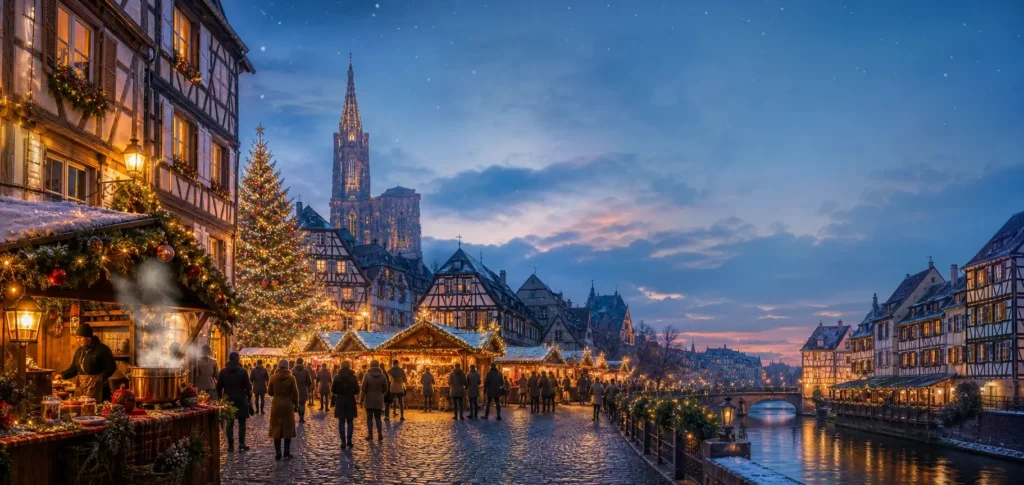
Strasbourg’s Christkindelsmärik is the anchor event of the Alsatian season and the reason most visitors come. It is not one market but a network of them spread across the city centre, each square with a slightly different character — one heavier on food, one on regional crafts, one on gifts for children. The enormous tree on Place Kléber and the illuminated streets around the cathedral do most of the heavy lifting.
What this means practically: you need at least a full evening and ideally a morning too. Weekday visits are noticeably calmer than Saturdays, when the city fills with regional day-trippers. Late afternoon into early evening gives you both daylight on the half-timbered façades and the lights switching on.
Accommodation in central Strasbourg is the single tightest resource of the Alsatian year. December weekend rooms in the Grande Île and around the station go early, and prices climb steeply as availability drops. If Strasbourg is your base, lock in the room before you finalise anything else, and think about whether a weekday arrival buys you a better room for less.
Book Strasbourg early — this is not filler advice
Central Strasbourg rooms for December weekends often go months ahead, and the good-value ones disappear first. The sensible move: hold a free-cancellation room as soon as your dates are roughly fixed, then build the rest of the trip around it.
Tip: if the Grande Île is full, widen the search to the station quarter or Neudorf — 10 to 15 minutes by tram, and often 30 to 40% cheaper.
For the full breakdown of squares, timings and where to eat between stalls, see the dedicated Strasbourg Christmas market guide. If you are deciding between the two big cities, our comparison of where to stay for the Christmas markets is the practical follow-up.
Colmar: the best density of atmosphere
Colmar runs several markets within a short walk of each other in the old town, including one specifically for children and one in the Little Venice quarter. Because the historic centre is small and almost entirely pedestrianised, you move between them in minutes, which makes Colmar feel more concentrated and more festive than its actual size suggests.
The trade-off is congestion. Saturday afternoons on the main axes can be shoulder-to-shoulder, and the photogenic canal corners attract queues of people waiting to take the same picture. Go early in the morning for photographs, come back after dark for the atmosphere, and eat away from the central squares.
Colmar is also the best base if you intend to combine city and village markets, because most of the famous wine-route villages sit within a 20-minute drive. Details are in the Colmar Christmas market page, and general orientation in our guide to Colmar.
Riquewihr and Kaysersberg: the two village markets everyone wants
These are the images that sell Alsace in December: timber-framed houses under garlands, wooden chalets in a walled village, vineyards on the slope behind.
Riquewihr packs its market into a single walled street, which is exactly why it looks so good and exactly why it becomes uncomfortable at peak times. Arrive before mid-morning or after most coaches have left in the late afternoon. Parking is outside the walls and fills quickly.
Kaysersberg spreads a little more, along the river and around the church, and is generally regarded as one of the stronger markets for genuine craft producers rather than mass-produced goods. It is also close enough to Colmar to combine with an afternoon in the city.
Both are worth doing; doing both on the same Saturday is a mistake unless you start very early. Read the specifics in the Riquewihr Christmas market guide and the Kaysersberg Christmas market guide, and see Riquewihr and Kaysersberg for what else there is to do in each village.
Eguisheim, Ribeauvillé, Turckheim and the calmer options
If crowds are your main worry, these are your answer.
- Eguisheim is built in concentric rings around a central square, so the market wraps around you rather than funnelling you down one street. It is close to Colmar and has a slightly gentler rhythm than Riquewihr. See the Eguisheim Christmas market page.
- Ribeauvillé hosts a medieval-themed market with costumes, period crafts and a distinctly different soundtrack. It typically runs on limited dates, so it is a plan-around-it event rather than a drop-in. Background on the village is in our Ribeauvillé guide.
- Turckheim is small, walled and only a few minutes from Colmar, which makes it a good early-evening addition when the bigger names are saturated. Village details are on the Turckheim page.
- Obernai and the Bas-Rhin markets north of Strasbourg tend to see far fewer international visitors, which is precisely their appeal. Obernai works well as a half-day from Strasbourg.
- Mulhouse runs a market with a textile theme reflecting the city’s industrial history, and attracts a mostly regional crowd. See the Mulhouse Christmas market page.
How many markets should you actually visit?
Two or three well-chosen markets beat six rushed ones. December days are short — usable daylight runs roughly from mid-morning to mid-afternoon — and every village transfer costs you parking time at both ends.
| Trip length | Realistic plan |
|---|---|
| 1 day | One city only: Strasbourg or Colmar |
| 2 days | One city plus one village |
| 3 days | One city, two villages, one leisurely afternoon |
| 4–5 days | Two cities, three villages, plus a castle or museum for a non-market day |
A useful structure: city markets in the evening (they stay open and lit), village markets in the morning and early afternoon (they close earlier and empty out sooner). Build the day in that order and you double what you see.
Our Christmas market itinerary ideas and the broader Alsace itineraries hub show how this works day by day.
Getting between the markets
With a car, the classic village cluster around Colmar — Eguisheim, Turckheim, Kaysersberg, Riquewihr, Ribeauvillé — sits within about 20 kilometres of each other, but December traffic and full car parks stretch those distances considerably. Allow far more time than a map suggests, and expect to park outside village walls and walk in. Winter tyres or all-season tyres are not automatically standard on hire cars in Alsace. If you plan to drive towards the Vosges, check the vehicle’s equipment when booking: between 1 November and 31 March, winter equipment is compulsory in certain mountain communes, but you can generally comply either with four suitable winter tyres or with snow chains/socks carried in the vehicle.
Driving in December: check your winter equipment
In France, winter tyres or snow chains are mandatory from 1 November to 31 March in communes designated under loi Montagne II, which covers parts of the Vosges and other French massifs. Rental vehicles are not equipped as standard — verify what your booking includes.
Christmas market season is also the tightest period of the year for rental stock. Prices rise steadily through December and airport pick-up points run out first.
Without a car, you are not stuck. Strasbourg, Colmar, Sélestat, Obernai and Mulhouse all sit on the railway, and seasonal shuttle buses typically link Colmar with several wine-route villages during the market season. The frequency is limited and the last return is often early, so plan the return leg first. Full detail is in our guide to the Christmas markets without a car, with wider context in getting around Alsace and travelling by train.
On a guided tour, someone else deals with the parking, which in December is worth more than it sounds. Small-group evening tours from Colmar or Strasbourg to two or three village markets are a common format, and they sell out on December weekends well before the date. If you want one, book it at the same time as your accommodation rather than on arrival.
Compare formats and pick-up points on our Christmas market tours page and in the wider Alsace tours and day trips guide.
What to eat and drink at each market
The food is a genuine reason to choose one market over another, and the range is broader than mulled wine.
- Vin chaud — hot spiced wine, usually white in Alsace rather than red. Most stalls charge a small refundable deposit on the mug.
- Bredele — the small Christmas biscuits sold by the bag, in dozens of regional varieties. Village markets generally have better ones than city stalls.
- Tarte flambée — thin, crisp and cooked to order at many stalls. More on it in our tarte flambée guide.
- Choucroute and baeckeoffe — the substantial winter dishes, better in a winstub than from a chalet.
- Mannele — the small brioche figures that appear around Saint Nicholas in early December.
Detail on all of this, including what to avoid, is on the Christmas market food and drink page. If you want to bring something home, our guide to Alsatian souvenirs covers what actually travels well.
Common mistakes to avoid
- Assuming every village market opens daily. Many run Friday to Sunday only, and some for just one or two weekends. Turning up on a Tuesday to a closed square is the most common December disappointment here.
- Trying to do four villages in a day. Parking, walking in from the car park and the queue to get back out will eat the time you thought you had.
- Visiting only on Saturdays. Saturday is the busiest day everywhere. A Thursday in mid-December gives you a far better experience of the same market.
- Underdressing. Standing still outdoors at 2°C in damp air is colder than walking around at the same temperature. Thermal layers, waterproof shoes and gloves, not just a nice coat. See the Alsace packing list.
- Booking accommodation late. December weekends in Strasbourg and Colmar are the tightest of the year, and the good-value rooms disappear first.
- Ignoring the end date. Several markets close on or just before 24 December, and the days between Christmas and New Year are quieter than most visitors expect. Confirm before booking a late-December trip.
- Driving into village centres. Most historic cores are closed or heavily restricted. Follow the signposted car parks outside the walls.
If you are visiting for the first time and want a broader orientation, start with our first-time visitor guide to Alsace.
Beyond the markets: what else to do in December
The markets are the headline, but they occupy evenings and weekends more than full days. Fill the gaps with indoor and off-season options: the Musée Unterlinden and other Alsace museums, the Château du Haut-Kœnigsbourg with snow on the Vosges below, or a warm afternoon of tasting in a cellar — many producers stay open through December, though shorter winter hours are common. Our page on wine cellars and tastings explains how visits usually work.
For grey afternoons, rainy day activities in Alsace lists what stays open and warm.
Where to base yourself for a Christmas market trip
Short version: Strasbourg if you are travelling by train and want daily markets and a wide restaurant choice; Colmar if you want to mix city and villages and are comfortable with a small, busy centre; a wine-route village if atmosphere matters more than convenience and you have a car.
Village stays in December are limited in number — these are small communes with few hotels and guesthouses — so the choice narrows quickly once the season starts. If a village base is your priority, treat it as the first booking you make rather than the last.
Staying in a wine-route village
Riquewihr, Kaysersberg and Eguisheim each have only a handful of hotels and guesthouses between them. In December the availability thins out almost as soon as the season starts. If a village base is what you want, make it the first booking you make, not the last.
Weigh the options in detail on our page about choosing a base in Alsace, and see the full where to stay in Alsace guide for neighbourhoods and property types.
Frequently asked questions
Which is the best Christmas market in Alsace?
Strasbourg, if you want scale, daily opening and the widest range of stalls, food and events. Colmar is the better choice for concentrated old-town atmosphere in a smaller area. For village character, Riquewihr and Kaysersberg lead, though both get extremely busy at weekends. Most visitors are happiest combining one city with one or two villages.
When do the Alsace Christmas markets open and close?
Markets typically open in the second half of November and run until around Christmas Eve, with the larger cities opening daily and many villages restricted to weekends. A few extend into early January. Exact dates shift each year and are published by each commune in the autumn, so confirm before booking travel.
Can you visit the Christmas markets without a car?
Yes. Strasbourg, Colmar, Mulhouse, Sélestat and Obernai are all on the rail network, and seasonal shuttle buses usually connect Colmar with several wine-route villages during the season. Frequencies are limited and last departures are often early, so check return times before you set out.
How many Christmas markets can you see in a day?
Realistically two, or three if they are close together and you start early. A city market in the evening plus one or two villages during the day works well. December daylight is short and village car parks fill quickly, so plan fewer stops than a map might suggest.
Are the Alsace Christmas markets suitable for children?
Yes. Both Strasbourg and Colmar run markets aimed specifically at children, and villages are generally easy to navigate with a pushchair on flat sections, though cobbles and crowds can be awkward. Early afternoon is calmer than evening. See our page on Alsace at Christmas with kids.
What is the quietest Alsace Christmas market?
Turckheim, Obernai and the smaller Bas-Rhin markets north of Strasbourg see far fewer international visitors than the wine-route names. Eguisheim is also noticeably calmer than Riquewihr. Any market visited on a weekday morning will feel emptier than the same market on a Saturday afternoon.
Is one day enough for the Alsace Christmas markets?
One day covers a single city market properly, and that is a reasonable taster. Two to three days lets you add villages and see the region rather than one square. If you only have a day, arrive by mid-afternoon, stay through the evening illuminations, and skip attempting a village.
Do the markets stay open after Christmas?
Most close on or around 24 December. A handful of larger sites continue into the days after Christmas or up to early January, sometimes as a scaled-back version. If your trip falls in that window, verify the specific market’s closing date rather than assuming the region-wide pattern.