
Some links on this page are affiliate links. If you book or buy through them, I earn a small commission — at no extra cost to you. How this site is funded →
Riquewihr is a walled medieval village on the Alsace Wine Route, roughly 15 km north-west of Colmar, and it is the single busiest village on the route. This page tells you what there is to see, how long you actually need, when to turn up to avoid the crush, where to park, and how to reach Riquewihr without a car. It also covers the practical decisions: whether to stay overnight, what to taste, and which villages to pair it with.
In short
- Time needed: 2–3 hours for the village itself; half a day if you add a tasting or a vineyard walk.
- Best arrival time: before 10am or after 5pm. Midday between May and October is the most crowded window.
- Getting there: easiest by car; feasible by bus from Colmar. No train station in the village.
- Parking: visitors generally use paid car parks outside the walls, while some residents, accommodation providers and authorised vehicles may park inside the historic centre. Access and traffic restrictions vary according to the period.
- Highlights: Rue du Général de Gaulle, the Dolder gate-tower, the town walls, cellar doors on the main street, vineyard footpaths starting at the village edge.
- Best paired with: Ribeauvillé and Hunawihr — both within 5 km.
Why Riquewihr is worth your time (and when it isn’t)
Riquewihr survived the Second World War almost intact, which is unusual in Alsace. The result is a compact walled village where the 16th-century merchant houses, wine-grower courtyards and defensive towers are still standing in one continuous streetscape. Vineyards run right up to the walls, so the transition from village to Grand Cru slope takes about ninety seconds on foot.
The trade-off is volume. Riquewihr sits on every coach itinerary between Colmar and Strasbourg, and on a warm Saturday in September the main street can feel more like a queue than a village. That doesn’t make it a bad stop — it makes timing the single most important decision you’ll take. If you can only visit at midday in high season and crowds ruin places for you, consider swapping it for Turckheim or one of the quieter villages covered in our guide to the prettiest villages in Alsace.
If you want the full context of the route Riquewihr sits on, start with the complete Alsace Wine Route guide.
What to see in Riquewihr
The village is small enough that you don’t need a route, but these are the things worth slowing down for.
Rue du Général de Gaulle
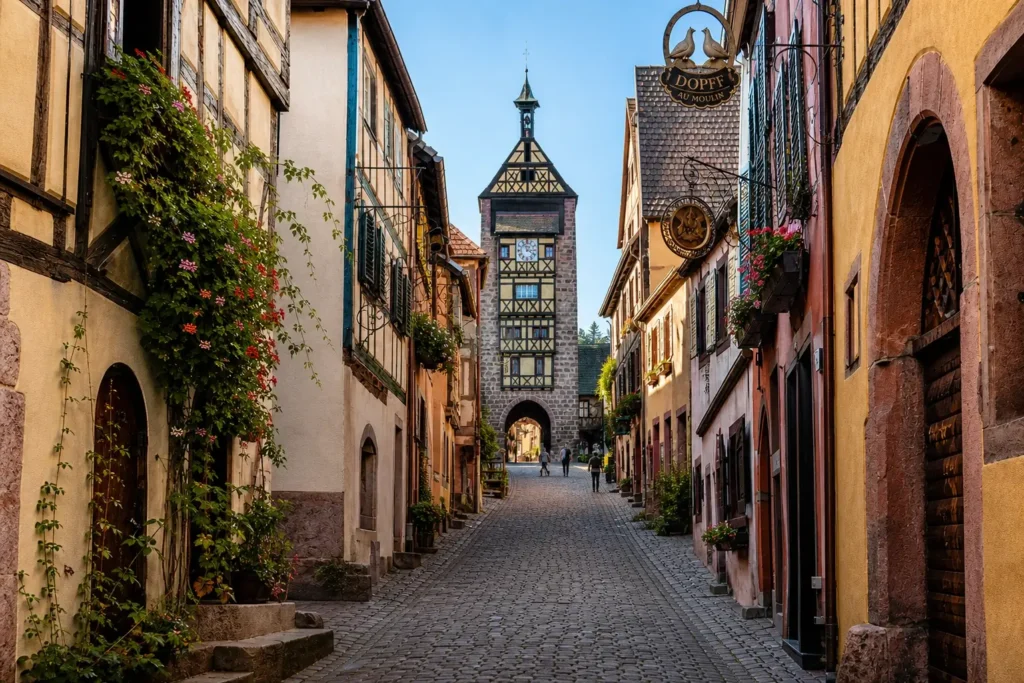
The single main street runs uphill from the lower gate to the Dolder. Everything else branches off it. Walk it once for the façades and the painted signs, then double back through the side lanes — Rue des Juifs, Rue de la Couronne and the small courtyards behind the main street are where the crowds thin out and the wine-grower architecture is clearest.
The Dolder
The gate-tower at the top of the street is the village’s landmark, dating from the 13th century and later heightened. It houses a small local history collection, and the upper levels give you the view down the main street that you’ve probably already seen in photos. Opening tends to be seasonal and reduced in winter, so check locally on the day.
The town walls and towers
Riquewihr kept its double ring of fortifications. You can follow sections of the wall on the outside of the village, which is also the fastest way to escape the main street. The Tour des Voleurs (thieves’ tower) with its former prison and torture chamber is on this circuit and usually opens in the warmer months.
Vineyards on the doorstep
Marked footpaths leave from the upper and lower edges of the village into the Schoenenbourg and Sporen slopes. Twenty minutes uphill gives you the classic view back over the rooftops. For longer routes and how the trails link villages, see our guide to hiking and the outdoors in Alsace and the best viewpoints and photo spots.
How long do you need in Riquewihr?
| Your plan | Time to allow | What it covers |
|---|---|---|
| Quick stop | 1–1.5 hours | Main street, Dolder from outside, a bakery stop |
| Standard visit | 2–3 hours | Main street, side lanes, walls, one cellar tasting |
| Half day | 4–5 hours | The above plus a vineyard loop and a sit-down lunch |
| Overnight | — | Village to yourself before 9am and after 6pm |
Most visitors treat Riquewihr as one stop among three or four in a day. That works, and it’s how our Wine Route itineraries are built. But if you only ever see the village between 11am and 4pm, you’re seeing its busiest version.
When to visit: month by month
| Period | Village atmosphere | Practical notes |
|---|---|---|
| January–March | Very quiet, many shops shut | Cheapest, but limited opening; grey vineyards |
| April–June | Green vines, moderate crowds | Good balance; cellars generally open |
| July–August | Busiest daytime hours, long evenings | Arrive early; book restaurants ahead |
| September–mid October | Harvest activity, golden vines | Peak scenery and peak demand together |
| Late November–December | Christmas market, evening lights | Very busy at weekends; short daylight |
Harvest and the Christmas weeks are the two periods when accommodation anywhere near Riquewihr gets tight, and village properties are small — there simply aren’t many rooms. For the wider seasonal picture, see the best time to visit Alsace and, specifically for vines and cellars, when to travel the Wine Route.
Riquewihr Christmas market
Riquewihr runs a Christmas market in the weeks before Christmas, typically from late November to around Christmas Eve, with stalls along the main street and a heavily decorated village centre. Because the streets are narrow and the market is small, it fills quickly at weekends and after dark. Weekday afternoons are far more comfortable, and staying overnight nearby is the only reliable way to see the village lit and half-empty.
Full detail on stalls, timing and how the village compares with its neighbours is on our Riquewihr Christmas market page, and the regional overview sits in the Alsace Christmas markets guide.
Wine tasting in Riquewihr
Riquewihr sits at the foot of two Grand Cru vineyards, Schoenenbourg and Sporen, both long associated with Riesling and, on the Sporen’s heavier soils, with Gewurztraminer and Pinot Gris. Several producers have cellar doors directly on or just off the main street, which makes tasting here unusually easy — you don’t need a car to reach a cellar, only a walk.
A few practical points:
- Most cellars open Monday to Saturday, and many close over lunchtime. Sunday opening is patchy.
- Small family estates often prefer a call or email ahead, especially for groups of four or more.
- Harvest weeks are the worst time for unannounced visits — the family is in the vineyard.
- Tasting is usually free or low-cost at cellar doors; guided cellar visits are priced and worth booking.
For how tastings actually work, what to say and what not to do, read visiting Alsace wine cellars and tastings. If you want to understand what you’re drinking first, our pages on Alsace grape varieties and Riesling are the shortest route in, and reading Alsace wine labels explains the Grand Cru mentions you’ll see on bottles here.
If you’d rather not drive between cellars, a small-group tour from Colmar covers Riquewihr plus two or three neighbouring villages in half a day, with the driving and the appointments handled. Half-day departures fill first in September and December.
Where to eat in Riquewihr
The main street is lined with restaurants and winstubs, and quality varies with footfall — the busier the terrace, the more likely it is aimed at coach traffic. Two rules help: step one street back from the main drag, and look for a short menu with seasonal dishes rather than a photo-laminated card in six languages.
What to order here:
- Tarte flambée in the evening — thin, cream-based, cooked in a wood oven. Not usually a lunch dish. See tarte flambée explained.
- Baeckeoffe, the slow-cooked meat and potato casserole, when it’s cold. More on baeckeoffe.
- Choucroute garnie as a shared, filling lunch — expect a generous plate. Details on choucroute.
- Kougelhopf and local pastries from a village bakery for the walk uphill; see Alsatian pastries and desserts.
Reserve for dinner in summer and December. Many kitchens in Alsace stop serving early, often around 9pm, and some restaurants close one or two days a week. Our guide to the winstub and how to eat in one covers the etiquette, and traditional Alsatian dishes gives you the full menu vocabulary.
How to get to Riquewihr
By car. The quickest and most flexible option. Roughly 20 minutes from Colmar, about an hour from Strasbourg, and around 1 hour 15 minutes from Basel-Mulhouse-Freiburg EuroAirport, depending on traffic. Riquewihr is signposted from the D1B and the wine road (Route des Vins).
By bus. Regional buses connect Colmar with Riquewihr and neighbouring Wine Route villages. Services are designed for local life, which means reduced frequency at weekends and in school holidays — check the timetable in both directions before you commit to a day.
By train. There’s no station in Riquewihr. The nearest usable railheads are Colmar and Sélestat, both on the main Strasbourg–Basel line, and you continue by bus, taxi or bike. See travelling Alsace by train and, if you’re basing yourself on the main line, Sélestat.
By bike. Riquewihr is on well-signposted cycle routes through the vineyards, with a steady but manageable gradient from the plain. Details on cycling the Wine Route.
A car makes the difference between seeing one village and seeing four, and it lets you arrive before the coaches. Pick-up at Colmar station or at the EuroAirport are the two most practical options; automatics are limited in France and go first, so book early if you need one.
🚗 CAR HIRE FROM COLMAR
Riquewihr has no train station — a car is the easiest way to see several villages in one day.
Convenient pick-up points: Colmar train station or Basel-Mulhouse-Freiburg EuroAirport.
⚠️ Automatics are limited in France and go first in high season — book at least 2-3 weeks ahead if you need one.
Compare car rental prices
If you’d rather not drive at all, it is genuinely possible to see Riquewihr on public transport with some planning — our page on doing the Wine Route without a car sets out the workable combinations, and getting around Alsace compares your options overall.
Parking in Riquewihr
During busy periods, most visitors should park in the signposted paid car parks outside the walls and walk into the historic centre. Access to some streets and parking areas inside the walls is restricted and reserved for residents, authorised vehicles and, in some cases, accommodation guests. Expect signposted paid car parks on the approach roads, with coach and car areas separated. Practical advice:
- Arrive before 10am in high season; the closest car parks fill first.
- Bring a card and small change — payment methods vary by machine.
- Budget roughly a few euros for a couple of hours; prices are modest but not free.
- Don’t attempt to drive up the main street to « just drop someone off ». You’ll block it.
- In December, park further out and accept the extra ten-minute walk.
For general driving conditions, village access rules and route planning, see driving the Alsace Wine Route.
Should you stay overnight in Riquewihr?
Staying inside the walls is the one way to get the version of Riquewihr the day-trippers never see: the main street at 8am, and again after the last coach leaves. The catch is supply. The village is tiny, accommodation is mostly small hotels and guesthouses, and rooms for harvest weekends and December go months ahead.
Your realistic choices:
| Base | Best for | Trade-off |
|---|---|---|
| Riquewihr itself | Early mornings and evenings in the village | Few rooms, books out early, quiet after dark |
| Ribeauvillé or Kaysersberg | Village atmosphere with more choice | Still need a car for wider touring |
| Colmar | Restaurants, transport links, evening life | Not in the vineyards; day-trip in |
| Strasbourg | City break plus one Wine Route day | Too far for repeat village visits |
If a vineyard setting matters more to you than a wide restaurant choice, compare options in where to stay on the Wine Route and the best villages to stay in Alsace. If you’re still weighing city versus village, where to base yourself in Alsace is the page to read first.
Village stays in Riquewihr and its immediate neighbours are limited in number and highly seasonal — for September and December dates, look at availability well before you fix your travel plans.
🛏️ WHERE TO STAY NEAR RIQUEWIHR
Village rooms are few, and they book out fast — especially for September (harvest) and the December Christmas markets.
Riquewihr itself gives you the quietest mornings and evenings, but options are limited. Ribeauvillé and Kaysersberg offer more choice within a short drive, and Colmar has the widest range if you’d rather base yourself in a small city.
⚠️ Booking early matters more here than almost anywhere elseon the Wine Route.
Check availability in Riquewihr
What to combine with Riquewihr
Riquewihr sits in the densest cluster of villages on the whole route, which is why it works so well as one stop rather than a destination.
- Hunawihr — 2 km. Fortified hilltop church, storks, almost no coaches.
- Ribeauvillé — 5 km. Longer main street, three ruined castles above the village, more everyday life.
- Kaysersberg — 8 km. River, bridge, castle ruin, strong Christmas market.
- Château du Haut-Kœnigsbourg — about 25 minutes’ drive. The region’s big castle visit, best combined as a morning.
- Colmar — 15 km. Museums, canals and dinner options.
A comfortable day: Haut-Kœnigsbourg early, Ribeauvillé and Hunawihr mid-morning, lunch in Riquewihr, one tasting, then Kaysersberg late afternoon. Ready-made versions of this loop are in our Alsace road trip itineraries and three days in Alsace.
Castle entry and guided visits at Haut-Kœnigsbourg see long queues on summer weekends and school holidays, so fixing your slot before you leave saves the worst of the wait.
Common mistakes to avoid
- Arriving at midday in high season. You’ll spend your visit in a slow-moving crowd on one street. Before 10am or after 5pm changes the village completely.
- Trying to park inside the walls. The centre is pedestrianised in season. Use the outer car parks and walk.
- Never leaving the main street. The side lanes, courtyards and wall circuit are where Riquewihr becomes interesting, and they’re almost empty.
- Turning up at cellars during harvest without warning. Late September is the least likely moment to be welcomed for a spontaneous tasting.
- Assuming everything is open in winter. Outside the Christmas weeks, January to March sees many shops, museums and restaurants close or cut hours. Verify before you build a day around it.
- Planning dinner for 9.30pm. Kitchens across Alsace often close earlier than visitors expect, and village restaurants take weekly closing days.
- Treating Riquewihr as a full day. It isn’t. Pair it with two or three neighbours.
Frequently asked questions
How long should I spend in Riquewihr?
Two to three hours covers the main street, the side lanes, the town walls and one cellar tasting at a relaxed pace. Add another two hours if you want a sit-down lunch and a short vineyard walk. Anything under an hour means seeing the main street and little else, which misses the quieter and more interesting parts of the village.
Can you visit Riquewihr without a car?
Yes, with planning. Regional buses connect Colmar to Riquewihr, and Colmar is on the main Strasbourg–Basel railway line. Check return times carefully, as evening and weekend services are limited. A guided half-day tour from Colmar is the simpler alternative, and cycling from Colmar through the vineyards is realistic in good weather.
Is Riquewihr better than Colmar?
They’re different visits, not competing ones. Colmar is a small city with museums, canals, restaurants and rail links, and works well as a base. Riquewihr is a walled village surrounded by vineyards, best seen in two or three hours. Most itineraries include both, with Colmar for nights and Riquewihr as a day stop.
Is Riquewihr very crowded?
Between roughly 11am and 4pm from May to October, and on December weekends, yes — it is the busiest village on the Wine Route. Early mornings, late afternoons, weekdays and the winter months outside the Christmas period are noticeably calmer. Staying overnight is the most reliable way to see it quiet.
Where do you park in Riquewihr?
In signposted paid car parks outside the town walls, since the historic centre is closed to visitor traffic during the day in season. The nearest car parks fill first, so arriving before 10am in summer or in December makes a real difference. Bring a card and some coins, as payment options vary.
Does Riquewihr have a Christmas market?
Yes. It typically runs from late November to around Christmas Eve, with stalls along the main street and extensive decoration through the village. It is small and gets very busy at weekends and after dark. Weekday afternoons are the most comfortable, and exact dates and hours should be confirmed before you travel.
Is Riquewihr one of the Plus Beaux Villages de France?
Yes, Riquewihr holds the « Plus Beaux Villages de France » label, as do several of its neighbours on the Alsace Wine Route. The label reflects heritage and architectural quality rather than visitor numbers, so it’s a useful shortlist but not a guarantee of a quiet visit.
Where should I stay if I want a village atmosphere?
Riquewihr itself gives you the earliest mornings and quietest evenings, but rooms are few and book far ahead. Ribeauvillé and Kaysersberg offer more choice within a short drive, with the same half-timbered setting. Colmar remains the easiest base if restaurants and transport links matter more than waking up among vines.
Keep planning your Alsace trip
- The Alsace Wine Route: complete guide — the full route, north to south
- Most beautiful villages on the Wine Route — how Riquewihr compares with its neighbours
- Alsace destinations overview — cities, towns and villages side by side
- How many days do you need in Alsace? — sizing your trip realistically
- Wine Route map — distances and driving order
- Day trips from Colmar — Riquewihr as part of a wider loop