
Some links on this page are affiliate links. If you book or buy through them, I earn a small commission — at no extra cost to you. How this site is funded →
Kaysersberg sits at the mouth of the Weiss valley, about 10 kilometres north-west of Colmar, with a ruined castle keep above it and a fortified bridge across the river in the middle of town. It is one of the most visited stops on the Wine Route, and one of the easiest to underestimate: most people give it 90 minutes when it deserves half a day. This guide covers what to see, how to arrive, where to park, when to come, and how to build Kaysersberg into a wider route.
In short
- Where: Haut-Rhin, 10 km from Colmar, at the entrance to the Weiss valley (Vallée de Kaysersberg).
- How long: 2 to 3 hours for the village core; half a day if you climb to the castle and add a tasting.
- Getting there: easiest by car; regular buses run from Colmar, so it is one of the more accessible villages without your own vehicle.
- Best time: late spring and September for weather and vineyard colour; December for the Christmas market, which is busy and best visited on a weekday.
- Don’t miss: the fortified bridge, Sainte-Croix church and its carved altarpiece, the castle keep viewpoint, and the side streets off the main road.
- Pair it with: Riquewihr, Ribeauvillé, Turckheim and the Haut-Kœnigsbourg castle, all within a short drive.
Why visit Kaysersberg
Three things set the village apart from its neighbours on the Alsace Wine Route.
First, the setting. Most Wine Route villages sit on open slopes. Kaysersberg is wedged into a narrow valley entrance, with wooded hills closing in on both sides and vineyards climbing the sunnier flank. The change of landscape is immediate if you arrive from Riquewihr or Colmar.
Second, the castle. The keep of the Château de Kaysersberg stands directly above the rooftops, a five-to-ten-minute climb from the centre, and the view over the tiled roofs and the valley beyond is the single best reward-for-effort in the village.
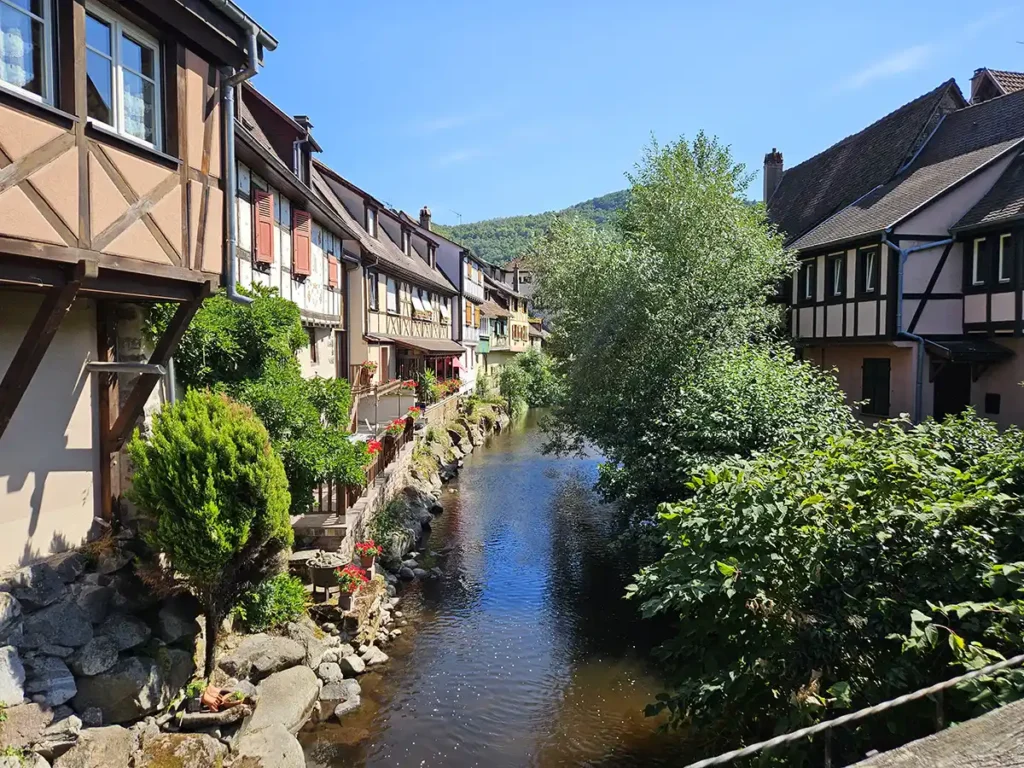
Third, the river. The Weiss runs straight through the middle of town, crossed by a fortified bridge dating from around 1514, with a small former prison cell built into its centre. An unusual survival, and the reason the centre feels layered rather than simply pretty.
If you are still weighing up which villages to prioritise on a short trip, compare notes in our roundup of the most beautiful villages on the Wine Route.
What to see in Kaysersberg
The village is compact and walkable end to end in about fifteen minutes, so the pleasure is in slowing down rather than covering ground.
The fortified bridge and the Weiss
The bridge across the Weiss, with its defensive structure and small former prison cell, is the natural centre of a visit. Cross it, then walk down the riverside path on either bank for a view back at the houses overhanging the water. Early morning light is kindest here, and the crowds thin considerably before 10am.
Église Sainte-Croix
The parish church anchors the main street. Inside, the carved and painted altarpiece is the piece to look for, along with the Romanesque doorway on the outside. Churches in Alsace are generally open through the day and free to enter, though services and seasonal closures happen — a two-minute check with the tourist office saves a wasted walk. For context on what you are looking at across the region, see our guide to Alsace churches and cathedrals.
The castle keep
The path up starts near the church and climbs through vines and scrub. It is short but steep in places, with uneven footing — trainers rather than sandals. The keep is a ruin, not a museum, so there is nothing to book and nothing to queue for. If you want a proper castle visit with rooms, ramparts and interpretation, that is Château du Haut-Kœnigsbourg, around 30 minutes away by car.
The main street and the side lanes
Rue du Général de Gaulle carries the shops, bakeries and most of the visitor traffic. The reward is in stepping off it: the lanes running towards the river and up towards the vines are quieter, and the half-timbered houses there are less restored and more interesting than the polished façades on the main drag.
Albert Schweitzer’s birthplace
Kaysersberg is the birthplace of Albert Schweitzer, the physician, theologian and Nobel Peace Prize laureate. A small museum in the house where he was born covers his life and his work in Gabon. It is modest in scale and opening is seasonal, so confirm before planning around it.
How to get to Kaysersberg
| From | By car | By public transport | Notes |
|---|---|---|---|
| Colmar | ~20 min | Bus, roughly 30–40 min | Most practical car-free option |
| Strasbourg | ~1 hr | Train to Colmar, then bus | Allow 2 hours door to door |
| Riquewihr | ~10 min | Limited direct links | Easy pairing by car |
| Ribeauvillé | ~15 min | Occasional bus | Good three-village loop with Riquewihr |
| Basel EuroAirport | ~1 hr 15 | Train via Mulhouse/Colmar, then bus | See airport options below |
By car
Kaysersberg is signposted from the D415 out of Colmar and from the Wine Route itself. Driving is the flexible choice, especially if you want to string together several villages, stop at a cellar and reach the higher vineyard roads. Roads in the village core are narrow, sometimes one-way and partly pedestrianised, so plan to park on arrival rather than driving through.
For a full route plan and the practicalities of driving the Wine Route, start with our guide to driving the Alsace Wine Route. If you are flying in, pick-up at the airport is almost always simpler than collecting a car in a city centre, and automatic transmissions are the first category to sell out in high season — worth locking in early for September and December travel.
Renting a car for the Wine Route
Rates are usually lowest 4–6 weeks ahead, and automatics disappear first — particularly in September and December. Compare pick-ups at Colmar station and Basel-Mulhouse airport before booking; the same dates can differ by half the price between suppliers.
By bus and train
There is no railway station in Kaysersberg. The workable approach is train to Colmar, then a regional bus up the valley. Buses run several times a day on weekdays, with a thinner service at weekends and on public holidays, so check the return departure before you settle into a long lunch.
For the wider picture, see visiting the Wine Route without a car and our overview of travelling around Alsace by train. If Colmar is your base, the Strasbourg to Colmar connections page covers the first leg in detail.
From the airports
The nearest gateways are Basel-Mulhouse-Freiburg (EuroAirport) and Strasbourg, with Frankfurt and Zurich as long-haul alternatives. Our Alsace airports guide compares transfer times and onward options.
Parking in Kaysersberg
Parking is the single most common source of stress here, particularly on summer weekends and throughout the Christmas market period.
- Use the signed visitor car parks on the edge of the village rather than hunting for a space in the centre. Most are a 3–8 minute walk from the main street.
- Expect paid parking in the high season and during the Christmas market; free or cheaper options are usually the furthest out.
- Arrive before 10am or after 4pm on peak days. The middle of the day is when the car parks fill and coaches arrive.
- In December, some approaches and car parks are reorganised for the market. Follow the temporary signage rather than your satnav.
- Camper vans should check designated areas in advance; the village lanes are not suitable.
When to visit
| Season | What it’s like | Best for |
|---|---|---|
| Spring (Apr–Jun) | Green vines, moderate crowds, long light evenings | Walking, castle climb, cellar visits |
| Summer (Jul–Aug) | Warmest and busiest; midday is crowded | Early starts, terraces, valley walks |
| September–October | Harvest activity, golden vineyards, mild days | Wine, photography, fewer school groups |
| November | Quiet, some closures, grey weather | Low-cost, low-crowd trips |
| December | Christmas market, dense crowds at weekends | Festive atmosphere, weekday visits |
| Jan–Mar | Very quiet, many businesses closed | Solitude, low prices |
Late spring and September are the sweet spot: reliable weather, active cellars, and manageable crowds. For the full seasonal breakdown across the region, read the best time to visit Alsace, and for vineyard-specific timing, when to visit the Wine Route.
Kaysersberg at Christmas
The Christmas market here is one of the better-known village markets in Alsace. Its main authentic and artisanal section is held in the Cour de l’Arsenal and behind the Sainte-Croix church, with wooden chalets, mulled wine and craft stalls. It typically runs from late November to shortly before or after Christmas, on set days rather than daily — usually concentrated on weekends. Confirm the exact days for 2026 before committing, and treat weekend afternoons as the busiest possible moment.
Full detail on the market, including what to eat and how to time your arrival, is in our Kaysersberg Christmas market guide. If you are planning a multi-village festive trip, the Alsace Christmas markets guide is the place to start, and visiting the markets without a car covers the bus-and-train approach.
Christmas 2026: Important Information
Kaysersberg’s Christmas market takes place over four weekends:
27–29 Nov · 4–6 Dec · 11–13 Dec · 18–20 Dec 2026
Open Friday to Sunday, 10am–8pm. Friday is usually the quietest day.
Accommodation in and around Kaysersberg is limited — a handful of small hotels and guesthouses — and December weekends are typically the first to go, often months ahead. If a village stay in the festive season matters to you, book well before you finalise flights.
Wine tasting in and around Kaysersberg
Kaysersberg sits within a strong stretch of vineyard, and the valley entrance produces well-regarded Riesling in particular. Several producers have cellar doors in the village or in the immediate surroundings, including on the road towards Kientzheim and Sigolsheim.
How it works in practice:
- Most cellars open Monday to Saturday, commonly closing over lunch. Sunday opening is the exception rather than the rule.
- Small family domaines often prefer a phone call or email ahead, especially outside July and August.
- Tastings are usually short, seated or standing at a counter, and cover a range of dry whites plus a sweeter late-harvest wine.
- Expect to be offered several wines; buying a bottle or two is normal courtesy but rarely obligatory.
- Nobody expects perfect French, though a greeting in French opens doors. See do you need French in Alsace.
To know what you are tasting, our pages on Alsace grape varieties and Riesling from Alsace give you the vocabulary. If you would rather not drive between cellars, a guided tasting trip solves the drink-drive problem entirely; small-group departures from Colmar are the most common format and fill quickly in September and December.
Where to eat and what to order
The main street has a concentration of restaurants, winstubs and bakeries, plus a couple of more ambitious kitchens. Two practical realities: many places close one or two days a week, often Monday and Tuesday, and lunch service typically ends around 2pm, with dinner from around 7pm. Booking is sensible at weekends and essential in December.
What to look for on a Kaysersberg menu:
- Tarte flambée — thin, crisp, cooked to order, usually evenings only. See tarte flambée explained.
- Baeckeoffe — a slow-baked meat and potato casserole, often needing to be ordered for two. More in our baeckeoffe guide.
- Choucroute garnie — the region’s signature plate, best in cooler months.
- Munster cheese — made in the valley just upstream from Kaysersberg, so this is very much local produce.
- Kougelhopf and bredele — bakery staples, the latter mainly at Christmas.
For a broader menu decoder, read our guide to traditional Alsatian dishes and to eating in a winstub.
Walking and the outdoors
Because Kaysersberg opens onto a valley rather than sitting mid-slope, it is a better walking base than most Wine Route villages.
- Vineyard loops from the village climb through vines towards Kientzheim and Sigolsheim, with wide views across the Rhine plain.
- The Weiss valley road continues west towards the Vosges and the Munster area, with forest trails and higher ground.
- Village-to-village walking is realistic: marked paths link Kaysersberg with neighbouring wine villages in under two hours.
Trails are well signposted, but signage assumes you have a map. Our hiking and outdoors in Alsace page covers waymarking, seasons and route planning, and best views and photo spots lists the viewpoints worth the climb.
Combining Kaysersberg with nearby villages
Kaysersberg works best as one stop in a loop rather than a standalone day.
Half-day loop (car): Kaysersberg → Kientzheim → Riquewihr → Colmar. Around 25 km, two villages properly explored.
Full-day loop (car): Kaysersberg → Ribeauvillé → Haut-Kœnigsbourg → Riquewihr. Ambitious but doable if you start by 9am.
Southern pairing: Kaysersberg with Turckheim and Eguisheim, both south of Colmar, for a contrast between valley and open-slope villages.
Car-free day: Colmar base, bus to Kaysersberg in the morning, back for the afternoon in Colmar itself.
For ready-made routes, see the Wine Route itineraries page and the central Wine Route section, which is where Kaysersberg sits.
Should you stay in Kaysersberg or just visit?
Staying overnight buys you the two best hours of the day — early morning and after the coaches leave. The village is genuinely quiet after dinner, and the castle climb at sunset is a different experience from the midday version.
The trade-offs are real, though. Accommodation is limited, restaurant choice shrinks on closing days, and there is no train. If you want museums, nightlife and easy rail links, base yourself in Colmar or Strasbourg instead and day-trip here.
| Stay in Kaysersberg | Stay in Colmar | |
|---|---|---|
| Atmosphere | Very quiet evenings | Lively, plenty of options |
| Restaurant choice | Limited, closing days matter | Wide |
| Car needed | Effectively yes | No |
| Onward travel | Bus only | Train and bus hub |
| Best for | Second-time visitors, walkers, romance | First trips, car-free travellers |
Our where to base yourself in Alsace page works through this decision properly, and staying on the Wine Route covers village accommodation types, from guesthouses to vineyard estates.
Where to stay in Kaysersberg
The village has fewer than a dozen hotels and guesthouses, plus a scattering of self-catering flats above the main street. December weekends and September harvest dates go first. If Kaysersberg itself is full, Kientzheim (5 min) and Ammerschwihr (7 min) are the nearest realistic alternatives with the same valley feel.
Common mistakes to avoid
- Giving it 45 minutes. Coach itineraries often allow barely an hour, which covers the main street and nothing else. Budget two to three hours minimum.
- Skipping the castle climb. It is short, free, and the best view in the village. Wear proper shoes.
- Arriving at midday in high season. Car parks fill, the main street clogs, and photographs become impossible. Come early or late.
- Assuming Sunday and Monday work normally. Many cellars close Sunday; many restaurants close Monday or Tuesday. Check before you set out.
- Relying on satnav in December. Market-period road changes are common; follow temporary signs.
- Treating the bus timetable as an afterthought. Weekend and holiday services are sparse. Note your return departure on arrival.
- Bringing only card payments. Small producers and market stalls sometimes prefer cash. Carry some.
FAQ
How long do you need in Kaysersberg?
Two to three hours covers the main street, the fortified bridge, Sainte-Croix church and a wander through the side lanes. Add an hour for the castle keep climb and another for a cellar visit or a proper lunch, and you have a comfortable half day. Full days work if you add a vineyard walk or a neighbouring village.
Can you visit Kaysersberg without a car?
Yes. Take the train to Colmar, then a regional bus up the valley, which takes roughly 30 to 40 minutes. Services run several times daily on weekdays and are thinner at weekends and on public holidays. Check the return time before you arrive so you are not stranded, and consider a guided day trip if timetables look awkward.
Is Kaysersberg better than Riquewihr?
They are different rather than ranked. Riquewihr is the more concentrated, walled, postcard village and draws bigger crowds. Kaysersberg has the river, the fortified bridge, the castle climb and a valley setting, and generally feels less like an open-air museum. They are 10 minutes apart by car, so see both if you can.
Is Kaysersberg worth visiting in winter?
Yes, for two different reasons. December brings the Christmas market, with chalets along the main street and heavy weekend crowds. January to March is very quiet, with many restaurants and cellars closed, which suits travellers wanting empty streets and low prices rather than atmosphere and open doors.
Where do you park in Kaysersberg?
Use the signed visitor car parks on the village edge; the centre is narrow, partly pedestrianised and not worth attempting. Most car parks sit a three-to-eight-minute walk from the main street. Expect charges in high season and during the Christmas market, and follow temporary signage in December when arrangements change.
What is Kaysersberg known for?
The fortified bridge over the Weiss, the ruined castle keep above the rooftops, its position at the entrance to the Weiss valley, its Riesling, and being the birthplace of Albert Schweitzer. It is also one of the better-known village Christmas markets in Alsace.
Are there Christmas market dates you can rely on?
The market usually runs from late November until around Christmas, on selected days rather than every day, weighted towards weekends. Because the pattern shifts year to year, confirm the 2026 schedule with the tourist office or the market’s own listing before booking accommodation or transport.
Is Kaysersberg suitable for children?
Reasonably. The village is small and walkable, the riverside is appealing, and the castle climb is manageable for most primary-age children in decent shoes. There is little in the way of dedicated attractions, so pair it with something more active. Our Alsace with kids pages cover family-friendly alternatives nearby.
Keep planning
- Alsace destinations overview — where every village and city sits, and which to prioritise.
- The Alsace Wine Route guide — the full route, section by section.
- How many days do you need in Alsace — build a realistic trip length.
- Where to stay in Alsace — cities, villages and vineyard hotels compared.
- Alsace itineraries — ready-made routes from one day to a week.
- Day trips from Colmar — organised options including Kaysersberg.