
Some links on this page are affiliate links. If you book or buy through them, I earn a small commission — at no extra cost to you. How this site is funded →
Ribeauvillé is the working wine town of the central Wine Route — bigger than Riquewihr, less polished, and topped by three ruined castles you can walk to in an afternoon. This guide covers how long to stay, where to park, what to taste, which trails to take, and how to combine it with neighbouring villages in a single day.
In short
- Time needed: 2–3 hours for the old town; a full day if you hike to the castles or taste seriously.
- Best base for a day trip: Colmar (about 20 minutes by car) or Strasbourg (roughly 1 hour).
- Signature draw: the Grand Rue running the length of the old town, plus the three castles above it — Saint-Ulrich, Girsberg and Haut-Ribeaupierre.
- Wine: Riesling and Gewurztraminer from Grand Cru sites on the slopes directly above town.
- Parking: most peripheral car parks are free, while the car parks at Place du Général-de-Gaulle and Place de l’Hôtel-de-Ville are paid. Access to parts of the historic centre is restricted, so parking outside the centre and walking in is usually easiest.
- Quietest visit: arrive before 10am or after 5pm from May to October.
Why visit Ribeauvillé rather than another village?
Ribeauvillé is a town, not a hamlet. That changes the experience in useful ways: there are more restaurants open outside peak season, a genuine local high street with bakeries and butchers alongside the souvenir shops, and enough width in the streets that summer crowds feel less compressed than in Riquewihr, five minutes down the road.
It also has the best castle-to-town ratio on the Wine Route. Three ruins sit on the ridge immediately above the rooftops, linked by marked footpaths that start from the edge of the old town. You can be walking uphill through vineyards within ten minutes of parking the car.
If your priority is pure postcard density in a compact space, Riquewihr or Eguisheim will deliver more per step. If you want somewhere that still functions as a real place, with hills to climb and cellars to visit, Ribeauvillé is the stronger choice. Our advice for a first trip: see both, since they’re barely 5 kilometres apart. The central section of the Wine Route makes that easy.
What to see in the old town
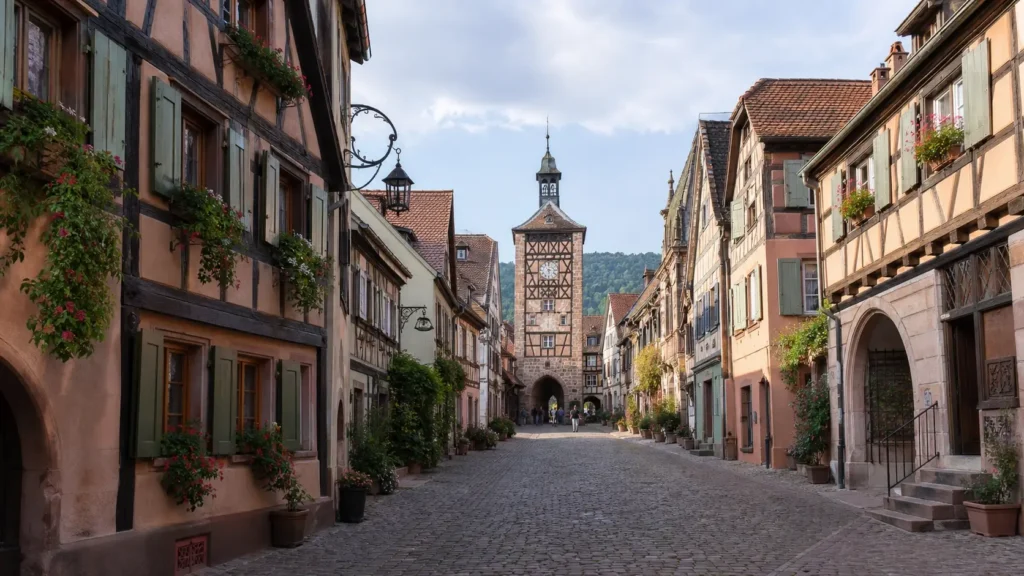
The layout is simple. One long axis — the Grand Rue — climbs gently from the lower gate to the upper town, with the Tour des Bouchers (the Butchers’ Tower) straddling it roughly halfway. Everything worth seeing is on or just off that line, which means you cannot really get lost.
The Tour des Bouchers. The old belfry that once separated two distinct parts of town. It’s the postcard shot, and the arch beneath it is where the street narrows most dramatically.
Place de la Sinne. The main square, with a fountain and cafés spilling out under the half-timbered facades. This is the natural pause point.
Église Saint-Grégoire-le-Grand. The parish church at the upper end of the old town, worth stepping inside for ten minutes if you’re interested in Alsace’s churches and religious architecture.
The upper town. Past the church, the streets thin out and tourists drop away sharply. Walk to the end for vineyard views and a sense of the town’s older, quieter half.
Side alleys off the Grand Rue. Duck into them. The flower displays and courtyard details are often better than on the main drag, and nobody else is looking.
A steady walk end to end takes 20 minutes. Doing it properly, with photo stops and a coffee, takes closer to two hours.
Hiking to the three castles
This is the reason to give Ribeauvillé a full day rather than a quick stop. The three ruins above town — Saint-Ulrich, Girsberg and Haut-Ribeaupierre — belonged to the Ribeaupierre family and can be linked in one circuit.
| Route | Rough duration | Difficulty | Notes |
|---|---|---|---|
| Town to Saint-Ulrich (return) | 1.5–2 hours | Moderate, steady climb | The most impressive of the three; substantial walls and towers still standing |
| Saint-Ulrich to Girsberg | 20–30 minutes extra | Short but steep link | Girsberg is smaller and more precarious; views are the payoff |
| Full three-castle circuit | about 2.5 hours | Intermediate | Signposted from Place de la République via the GR5; the climb is steep in places, so proper hiking shoes are recommended |
| Vineyard loop (no castles) | 1–1.5 hours | Easy | Flatter paths through the slopes for gentler views |
Trails are marked with the standard club vosgien signs. Take water in summer — the lower sections are exposed vineyard, and there’s no reliable refreshment on the ridge. Paths can be slick after rain and in late autumn. If castle ruins are your main interest across the whole region, compare options on our guide to visiting Alsace’s castles, and read up on the history behind them before you climb.
For a shorter, easier walk with a big reward, the vineyard paths on the lower slopes give you the town from above without the ridge climb. More options across the region are in our hiking and outdoors guide.
Wine tasting in Ribeauvillé
The slopes above town include Grand Cru sites, and Riesling is the local strength — dry, mineral, and a very different proposition from the aromatic Gewurztraminer that also does well here. Both are worth tasting side by side, and Ribeauvillé is a good place to do it because the town has several cellar doors within walking distance of each other.
Practical points that catch visitors out: many independent cellars close over the lunch break and on Sundays, and smaller producers may prefer or require an appointment, especially outside July and August. Larger operations tend to keep longer, more predictable hours. Check current opening times directly before you build a day around a specific visit.
If you’re new to Alsace wine, start with the seven Alsatian grape varieties, then focus on Riesling and Gewurztraminer once you’re at the counter. Learning to read an Alsace wine label takes ten minutes and pays off immediately.
Tasting properly and driving afterwards do not mix well. If wine is the point of your day rather than a side note, a driver-led tour removes the problem entirely — and small-group departures from Colmar covering Ribeauvillé and its neighbours fill up quickly in September and October, when harvest brings peak demand.
For a broader picture of how cellar visits work, see our guide to wine cellars and tastings on the Wine Route and, if you want to target the top sites, which Grand Crus are worth visiting.
Where and what to eat
Ribeauvillé has more genuine restaurant choice than most Wine Route villages, including places that stay open through the shoulder seasons. Expect the classic Alsatian repertoire rather than experimental cooking.
- Tarte flambée — thin, cream-and-bacon, traditionally an evening dish. Our full explanation of tarte flambée and how to order it covers the variations.
- Choucroute garnie — the big winter plate. See what’s actually in a choucroute.
- Baeckeoffe — slow-baked meat and potato casserole, often needing to be ordered in advance for two people minimum.
- Munster cheese — pungent, local, and served with cumin. Read about Munster and how to eat it.
- Kougelhopf and other bakery items — best bought in the morning from a proper bakery, not at 4pm from a souvenir shop.
For the atmosphere as much as the food, look for a winstub — the traditional Alsatian wine tavern, wood-panelled and informal. Our guide to eating in a winstub explains the etiquette and the menu. Reserve for dinner in summer and December; walk-in tables get scarce after 7pm.
When to visit
| Period | What it’s like | Worth knowing |
|---|---|---|
| April–May | Vines budding, mild, moderate crowds | Good hiking weather; some cellars still on reduced hours |
| June–August | Warmest, busiest, everything open | Arrive early; parking fills by mid-morning |
| September–October | Harvest activity, golden vines, strong light | Best all-round period; book accommodation well ahead |
| Late November–December | Christmas market weekends, cold, atmospheric | Market operates on a limited schedule, not daily — verify dates |
| January–March | Very quiet, many closures | Castles and walks still accessible; restaurant choice thin |
Ribeauvillé’s Christmas market is smaller and more traditional in feel than the big city events, and it typically runs on selected weekends in December rather than continuously — a crucial difference if you’re planning a trip around it. Confirm the current schedule before committing, and read our overview of Christmas market dates and opening times alongside the wider guide to Alsace Christmas markets.
The town also hosts a well-known medieval-themed festival in late summer, the Pfifferdaj, which transforms the streets and brings large crowds. For the region’s wider calendar, see traditions and festivals in Alsace and Wine Route wine festivals.
Christmas 2026: Important Information
Ribeauvillé’s Medieval Christmas Market will take place on December 5–6 and December 12–13, 2026.
Saturdays: 10 a.m.–7 p.m.
Sundays: 10 a.m.–6 p.m.
The market is held in Ribeauvillé’s historic town centre.
Expect medieval entertainment, local food, crafts and festive activities.
Deciding on your overall travel window? Start with the best time to visit Alsace, or when to do the Wine Route specifically if vineyards and harvest are your priority.
How to get to Ribeauvillé
By car. The most flexible option. Ribeauvillé sits just off the main north–south Wine Route axis, roughly 20 minutes from Colmar and about an hour from Strasbourg. Follow signs to the paid car parks on the edge of the old town; the centre itself is pedestrianised or restricted, and attempting to drive in during busy periods is a waste of your time.
By bus. Regional buses connect Colmar and Ribeauvillé, with onward links to nearby villages. Services are geared to residents rather than tourists, meaning reduced frequency on Sundays and public holidays. Check timetables the day before you travel.
By train. There is no station in Ribeauvillé. The nearest useful railheads are Colmar and Sélestat, both on the main line, from which you continue by bus or taxi. Details on how the network works are in our guide to travelling around Alsace by train.
Without a car at all. It’s doable but limits spontaneity. Our guide to doing the Wine Route without a car sets out the realistic combinations of train, bus and shuttle.
If you want to combine Ribeauvillé with two or three other villages in one day, a car is close to essential — the bus connections between neighbouring villages are the weakest link in the whole network. Vehicles at Basel and Strasbourg airports run short in September and December, so book earlier than you would for a city trip.
Renting a car for the Wine Route
Rates are usually lowest 4–6 weeks ahead, and automatics disappear first — particularly in September and December. Compare pick-ups at Colmar station and Basel-Mulhouse airport before booking; the same dates can differ by half the price between suppliers.
More broadly, see getting around Alsace and how to get to Alsace for the bigger transport picture.
Where to stay in and around Ribeauvillé
Staying overnight changes the town completely. Day visitors leave by early evening, and the Grand Rue after dark, lit and largely empty, is a different place. Ribeauvillé is also a practical base: it’s central on the Wine Route, has enough restaurants to sustain several nights, and puts the castle trails on your doorstep.
Options range from small family-run hotels in the old town to guesthouses on the vineyard edge. The town is also known for its thermal spa facilities, which makes it a candidate if you want walking by day and something restorative afterwards.
Village accommodation stock is genuinely limited — a handful of properties rather than dozens — and it sells out first for September weekends and December. If Ribeauvillé is your target, secure the room before you finalise anything else.
Where to stay in Ribeauvillé
Staying overnight is the single best upgrade to a Ribeauvillé visit — the Grand Rue after the day-trippers leave is a different town entirely. Options run from small family-run hotels inside the old town to vineyard guesthouses and spa hotels on the edge.
The catch is supply: this is a village, not a city, and the stock is measured in dozens of rooms rather than hundreds. September weekends, the Pfifferdaj festival and December market weekends sell out months ahead.
Comparing bases across the region? Our guide to where to base yourself in Alsace weighs Strasbourg against Colmar against a village, and where to stay on the Wine Route goes village by village. For something with vines outside the window, see vineyard hotels, and for a spa-focused stay, spa and wellness hotels in Alsace.
Combining Ribeauvillé with nearby villages
Ribeauvillé’s greatest practical asset is its neighbours. Distances are tiny.
| From Ribeauvillé | Approximate driving time | Why go |
|---|---|---|
| Riquewihr | 5–10 minutes | The most photographed village in Alsace; walled and compact |
| Hunawihr | 5 minutes | Fortified hilltop church; stork and butterfly centres nearby |
| Bergheim | 10 minutes | Intact medieval walls, far fewer visitors |
| Kaysersberg | 15 minutes | Ruined castle above town, river through the centre |
| Haut-Kœnigsbourg | 25–30 minutes | The region’s headline castle, high above the plain |
| Colmar | 20 minutes | Old town, museums, restaurants, transport links |
A sensible full day: Ribeauvillé in the morning, Riquewihr late morning, lunch, then either Haut-Kœnigsbourg or Kaysersberg in the afternoon. Ready-made versions of this kind of day are in our Wine Route itineraries, and if you’re basing in the city, see day trips from Colmar.
Common mistakes to avoid
- Driving into the old town. The centre is pedestrianised or heavily restricted. Use the signed paid car parks on the perimeter and walk in — it takes three minutes.
- Arriving between 11am and 3pm in high summer. That’s when coaches and day-trippers coincide. Early morning or late afternoon gives you the same town with a fraction of the people.
- Assuming cellars are open all day. Many independent producers close for lunch, shut on Sundays, and prefer appointments outside peak season. Verify before you build a plan around one.
- Turning up for the Christmas market on the wrong day. It typically runs on selected December weekends, not daily. Check the current dates.
- Underestimating the castle climb. It’s a real hill with uneven ground. Trainers are the minimum; sandals are not.
- Tasting wine then driving on to the next village. French drink-driving limits are strict. Nominate a driver or take a tour.
- Trying to fit five villages into one day. Three is comfortable, four is rushed. See how many days you need in Alsace before over-planning.
Frequently asked questions
How long do you need in Ribeauvillé?
Two to three hours covers the old town properly — walking the Grand Rue, the Tour des Bouchers, Place de la Sinne and the upper streets, with time for a coffee. Add a wine tasting and you’re at half a day. If you hike to the three castles above town, plan a full day, since the circuit alone takes three to four hours.
Is Ribeauvillé better than Riquewihr?
They’re different rather than ranked. Riquewihr is smaller, more perfectly preserved and far busier. Ribeauvillé is a working town with better restaurant choice, more space, and three castles you can walk to. Most visitors see both — they’re barely 5 kilometres apart, so choosing between them is unnecessary.
Can you visit Ribeauvillé without a car?
Yes, via regional bus from Colmar, but with reduced services on Sundays and public holidays. There’s no train station in Ribeauvillé; the nearest stations are Colmar and Sélestat. Connecting onward to other villages by public transport is the weak point, so if you want to see several villages in a day, consider a car or a guided tour.
Where do you park in Ribeauvillé?
In the signed paid car parks around the edge of the old town, since the centre is pedestrianised or access-restricted. Spaces fill by mid-morning in summer, during the Pfifferdaj festival, and on Christmas market weekends. Arriving before 10am makes parking straightforward almost year-round.
Does Ribeauvillé have a Christmas market?
Yes, and it has a strongly traditional, medieval-flavoured character that differs from the larger city markets. Importantly, it typically operates on selected weekends in December rather than every day, so confirm the current schedule before planning a trip around it. Our Christmas markets guide covers the regional picture.
What wine is Ribeauvillé known for?
Riesling above all — the slopes above town include Grand Cru sites well suited to it — with Gewurztraminer a close second. Tasting the two side by side is the most instructive thing you can do here: one dry and mineral, the other aromatic and fuller. Pinot Gris and Crémant d’Alsace are also widely available.
Is Ribeauvillé worth visiting in winter?
Yes if you accept the trade-offs. December brings market weekends and atmosphere; January to March is very quiet, with limited restaurant choice and some closures, but the castle trails and vineyard paths stay walkable. Cold, clear winter days give the sharpest views from the ridge.
Can you walk from Ribeauvillé to Riquewihr?
Yes. Marked vineyard paths link the two, typically taking a little over an hour each way at a relaxed pace, with gentle gradients and open views. It’s one of the most rewarding short walks on the Wine Route. Wear proper shoes and take water in summer, as there’s no shade on the vineyard sections.
Keep planning your Alsace trip
- Alsace destinations: every town and village worth your time — the full overview
- The Alsace Wine Route: complete guide — routes, villages, cellars and logistics
- The most beautiful villages on the Wine Route — pick your shortlist
- Alsace itineraries from 1 to 7 days — ready-made plans
- Where to stay in Alsace — bases, hotels and guesthouses
- Colmar travel guide — the nearest city base