
Some links on this page are affiliate links. If you book or buy through them, I earn a small commission — at no extra cost to you. How this site is funded →
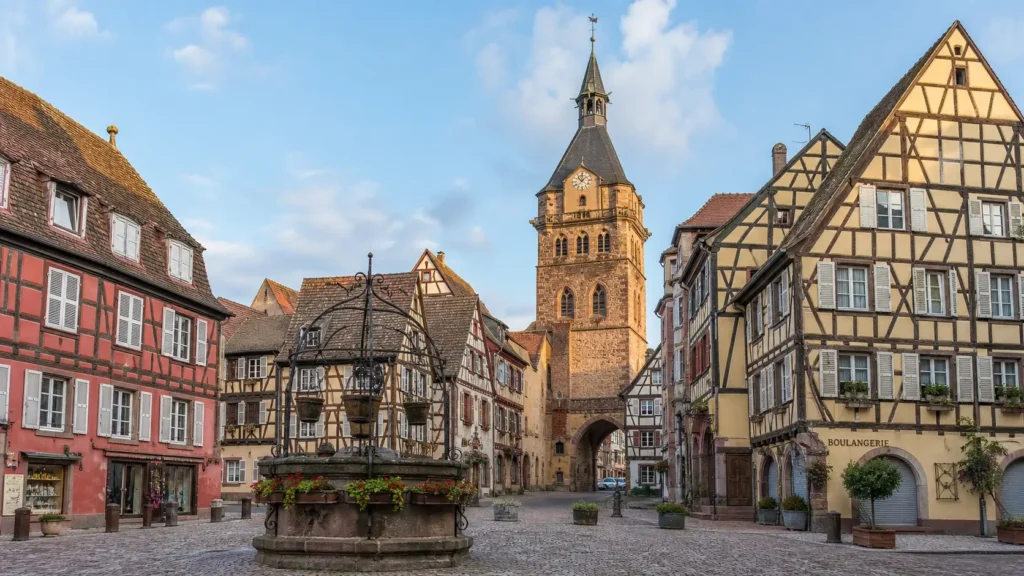
Obernai is the largest and liveliest town on the northern stretch of the Alsace Wine Route, sitting at the foot of Mont Sainte-Odile about 30 kilometres south of Strasbourg. It has the half-timbered old town and vineyard setting you came to Alsace for, plus something most wine villages lack: enough shops, restaurants and hotels to function as a genuine base. This guide covers what to see, how long to stay, how to get here, and whether Obernai should be your home for a few nights or a two-hour stop.
In short
- Time needed: 2 to 3 hours for the old town on foot; a half-day if you add a tasting or the ramparts walk.
- Getting here: Direct TER trains from Strasbourg take roughly 30 minutes; by car it’s about 40 minutes via the A35.
- Best for: Travellers who want a walkable Alsatian town with real amenities, and a base for the Bas-Rhin section of the Wine Route.
- Highlights: Place du Marché, the Six-Bucket Well, the Kapellturm belfry, the town ramparts, and Mont Sainte-Odile just above.
- Busiest: December (Christmas market) and September to mid-October (harvest). Book accommodation well ahead for both.
- Skip it if: You only have one day in Alsace and are chasing the postcard villages of the Haut-Rhin, in which case head for Riquewihr or Eguisheim instead.
Why visit Obernai rather than another Alsace town?
Obernai occupies a useful middle ground. It is far bigger than Riquewihr or Kaysersberg — a working town of several thousand residents rather than a village that empties after 6pm — but it kept its medieval street plan, its ring of ramparts and a dense core of half-timbered houses. That combination matters if you want to walk to dinner rather than drive to it.
The practical case for Obernai comes down to three things:
- Access from Strasbourg. It is one of the few Wine Route towns on a direct rail line, which makes it the obvious choice if you are travelling around Alsace without a car.
- Amenities. Pharmacies, bakeries, supermarkets, a real choice of restaurants and a spread of accommodation from guesthouses to spa hotels.
- Position. You are at the northern end of the vineyards, within easy reach of Mont Sainte-Odile, Barr and the villages of the northern Wine Route, while Strasbourg is a short hop away.
What Obernai is not: it is not the most photogenic place in Alsace. The old town is handsome and cohesive rather than jaw-dropping, and the outskirts are ordinary. If you want concentrated prettiness, compare it against the shortlist on our page of the prettiest villages in Alsace.
What to see in Obernai
Everything worth seeing sits inside the ramparts, in an area you can cross on foot in ten minutes. Start at the main square and work outwards.
Place du Marché
The central square is the reason most people come. It is framed by the Halle aux Blés (the old corn exchange, with its distinctive stepped gable), the town hall, and rows of painted half-timbered façades. Market days bring stalls of Munster, charcuterie, bread and seasonal produce to the square — a good moment to shop for a picnic. Check the current market day with the tourist office when you arrive, as timings shift.
The Six-Bucket Well
In the corner of the square stands the Puits aux Six Seaux, a Renaissance-era well with three wheels and six buckets. It is small, and you will spend two minutes on it, but it is the town’s signature image and a fixture in Alsatian ornament and traditional symbolism.
The Kapellturm belfry
The 13th-century chapel tower rises above the square, topped by a later Gothic spire and corner turrets. It is the tallest structure in the old town and your orientation point for wandering.
The ramparts
Obernai retains a substantial double ring of medieval walls with towers. A signed circuit runs around much of the perimeter — an easy flat walk of well under an hour that gives you the town’s shape and a look at gardens and back streets you would otherwise miss. Do this if you have more than a couple of hours.
Église Saints-Pierre-et-Paul
The 19th-century neo-Gothic parish church is unusually large for a town this size and holds a Holy Sepulchre group and stained glass worth a look. If church architecture interests you, see our overview of Alsace’s churches and cathedrals.
Mont Sainte-Odile
The abbey on Mont Sainte-Odile sits on a wooded plateau above Obernai and is the region’s most important pilgrimage site, dedicated to the patron saint of Alsace. The terrace gives long views across the Rhine plain toward the Black Forest. It is roughly a 20-minute drive up from town on winding roads, or a serious uphill hike. The surrounding forest holds the enigmatic Mur Païen, a prehistoric dry-stone wall, and marked trails run through it — details on our guide to hiking and the outdoors in Alsace.
How long to spend in Obernai
| Time available | What you can realistically do |
|---|---|
| 1–2 hours | Place du Marché, the well, the Kapellturm, a coffee, a quick browse of the shops |
| Half a day | The above plus the ramparts circuit, the church, and a cellar tasting or lunch |
| Full day | Add Mont Sainte-Odile in the morning and the old town in the afternoon |
| 2–3 nights | Use Obernai as a base for the northern Wine Route, Strasbourg and the castles |
Most day visitors are done in two to three hours. The town rewards an overnight stay more than a rushed stop, mainly because the streets empty of coach groups by early evening and the winstubs come into their own. If you are still working out your overall schedule, our page on how many days you need in Alsace sets out the trade-offs.
Getting to Obernai
From Strasbourg
Obernai is one of the easiest Wine Route towns to reach without a car. Regional TER trains run from Strasbourg station on the Sélestat–Obernai–Barr line, with a journey time of around 30 minutes. Services are frequent on weekdays and thinner at weekends and on public holidays, so check the timetable the evening before rather than turning up on spec. The station sits a short walk from the old town.
By car, allow around 40 minutes from central Strasbourg via the A35 and the D426. There are car parks around the edge of the ramparts; the historic centre itself is largely pedestrianised or restricted, so plan to park outside and walk in.
From Colmar and the south
There is no simple direct train from Colmar. Driving takes roughly an hour up the A35, or a little longer and far more enjoyable on the Route des Vins itself through Barr, Andlau and Dambach-la-Ville. For the rail alternative and connection logic, see our comparison of options between Strasbourg and Colmar.
Arriving from abroad
Strasbourg airport and EuroAirport Basel-Mulhouse-Freiburg are the two realistic entry points, with Frankfurt and Paris CDG as long-haul alternatives feeding into the TGV network. The full breakdown sits on our Alsace airports guide, and the routes into the region generally are covered in how to get to Alsace.
If you intend to explore the surrounding villages, vineyards and castles properly, a car changes what is possible — the northern Wine Route has stretches with no useful public transport at all. Demand at Strasbourg and Basel pick-up points tightens sharply in September, October and December, and automatic transmissions are a minority of the fleet in France, so book early if you need one.
Renting a car for the Wine Route
Rates are usually lowest 4–6 weeks ahead, and automatics disappear first — particularly in September and December. Compare pick-ups at Colmar station and Basel-Mulhouse airport before booking; the same dates can differ by half the price between suppliers.
Obernai as a base: is it the right call?
Obernai works well as a base if your priorities are Strasbourg, the northern vineyards, Mont Sainte-Odile and the Bas-Rhin castles. It works poorly if your heart is set on Colmar, Riquewihr, Kaysersberg and Eguisheim, which all sit 45 to 70 minutes further south.
| Obernai | Strasbourg | Colmar | |
|---|---|---|---|
| Size and atmosphere | Small town, quiet evenings | City, full nightlife | Mid-size, tourist-focused |
| Rail links | Regional only | Excellent, TGV hub | Very good |
| Distance to Wine Route | In it | 25–30 km | In it |
| Best for | Northern vineyards, Mont Sainte-Odile | City breaks, no-car trips | Southern villages |
| Evening choice | Limited but adequate | Extensive | Good |
The town has a reasonable spread of options: family-run hotels inside the walls, guesthouses in the surrounding vineyards, and a couple of larger properties with spa facilities on the edge of town. Rooms inside the ramparts are the ones to target if you want to walk everywhere; they are also the first to disappear in December and during harvest. If you want to weigh the alternatives properly, read where to base yourself in Alsace before booking, and see the vineyard-side options in where to stay on the Wine Route.
Where to stay inside the walls
Rooms within the ramparts are the ones worth targeting — you’ll walk to dinner instead of driving. There are perhaps a dozen properties in that footprint, from family-run hotels on Place du Marché to guesthouses on the quieter side streets, plus two larger spa hotels just outside. They go first for the December market weekends and during harvest.
Eating and drinking in Obernai
Obernai has more restaurants than a village of its size would, and enough variety that you are not eating the same tasting menu three nights running. Look for a winstub — the traditional Alsatian tavern, wood-panelled and informal — for the classic repertoire. Reserve for dinner at weekends and throughout December; the good places fill.
What to order:
- Choucroute garnie — fermented cabbage with a spread of pork cuts and sausages. Substantial; share if you are not hungry. Background on choucroute.
- Tarte flambée — thin, crisp, cream, onion and bacon, usually served in the evening and priced per person. See tarte flambée explained.
- Baeckeoffe — a slow-baked meat and potato casserole, often needing to be ordered ahead. More on baeckeoffe.
- Munster cheese — pungent, local, and best with cumin seeds and a glass of Gewurztraminer. Details on Munster.
- Kougelhopf and other bakes — for the morning, from any decent bakery. See Alsatian pastries and desserts.
For an idea of what a winstub evening actually involves and how to read a menu, our page on the Alsatian winstub covers the etiquette.
Wine in and around Obernai
Obernai sits within a productive vineyard zone, particularly around the Schenkenberg hill, but the town does not have its own Alsace Grand Cru vineyard. Several recognised Grand Crus can be found in nearby wine villages such as Barr, Andlau, Mittelbergheim and Dambach-la-Ville. The town and its immediate neighbours produce the full Alsatian range — dry Riesling, aromatic Gewurztraminer, Pinot Gris, Sylvaner and a growing amount of Crémant d’Alsace.
A few practical points about tasting here:
- Most independent cellars operate Monday to Saturday, frequently closing over the middle of the day and often shut on Sundays. Ring ahead for anything other than a walk-in tasting.
- Tastings at family domaines are typically informal and low-cost or free, with an unspoken expectation that you will buy a bottle or two if you enjoyed it.
- Harvest, generally from around September into October depending on the year, is the busiest and most atmospheric period, but cellars are working flat out and may have limited time for visitors. Our harvest season guide explains what to expect.
If you would rather not drive between cellars, guided small-group tours run from Strasbourg and cover the northern villages, letting everyone taste. This is worth considering for a first visit, as tour operators get you into domaines that do not routinely take walk-ins. Availability tightens considerably in autumn and December.
For the full picture of how tastings work across the region, see our guide to Alsace wine cellars and tastings, and for the route itself, the Alsace Wine Route complete guide.
Obernai at Christmas
Obernai runs a Christmas market in the old town during Advent, with chalets on and around Place du Marché, decorated façades and a programme of concerts and events. It is markedly calmer than Strasbourg and Colmar, and easier to actually enjoy — you can move through the stalls without being carried along by the crowd.
Practical expectations:
- Alsatian Christmas markets typically run from around late November to just before or just after Christmas Day, with a few extending into early January. Exact dates shift each year and are published in the autumn.
- Weekends and the two weeks before Christmas are the peak. Weekday afternoons are far more comfortable.
- Evenings are cold and often damp; layered clothing and waterproof footwear make the difference between a pleasant two hours and a miserable one.
Christmas 2026: Important Information
27 November–27 December. Open daily from 10am to 7pm, until 8pm on Fridays, Saturdays and Sundays. Closed on 25 December; open until 4pm on 24 December.
Because Obernai is on the Strasbourg rail line, it makes a very manageable market day trip without a car — one of the few Wine Route towns where this is genuinely straightforward. See Christmas markets without a car for the timetable logic, and our Alsace Christmas markets guide for the overall picture.
Day trips from Obernai
| Destination | Approx. driving time | Why go |
|---|---|---|
| Strasbourg | 35–40 min | Cathedral, Petite France, museums |
| Mont Sainte-Odile | 20–25 min | Abbey, views, Mur Païen, forest walks |
| Barr and Andlau | 15–20 min | Quieter wine villages, good cellars |
| Château du Haut-Kœnigsbourg | 45–55 min | The region’s flagship castle |
| Sélestat | 35–40 min | Humanist Library, old town |
| Colmar | 55–65 min | Old town, Unterlinden, southern villages |
Haut-Kœnigsbourg is the single most rewarding excursion from Obernai if you have a car and half a day — the restored hilltop fortress dominates the plain and the interior is unusually complete. Practical visiting detail is on our Haut-Kœnigsbourg page, and the wider picture on visiting Alsace’s castles. If Strasbourg is on your list, our page on day trips from Strasbourg works equally well in reverse.
Good to know before you go
- Do not drive into the old town. The centre is pedestrianised or heavily restricted. Park outside the ramparts and walk; the whole core is a ten-minute stroll across.
- Lunch closes early. Many kitchens stop serving around 2pm and do not reopen until evening. If you arrive at 1.45pm expecting a leisurely meal, you may be disappointed.
- Sundays and Mondays are quiet. A meaningful number of shops and some restaurants close. Plan Sunday around walking, the market square and whatever is open, not shopping.
- Cellars close at lunchtime. Independent domaines commonly shut for a couple of hours in the middle of the day. Aim for late morning or mid-afternoon.
- The station is not in the old town. It is a short but not instant walk. Fine with a day bag, less fine with large suitcases on cobbles.
- Weekend train services are reduced. Check return times before you set out from Strasbourg, especially on Sundays and public holidays.
- December accommodation goes early. Rooms inside the walls are booked months ahead for the market weekends.
Frequently asked questions
Is Obernai worth visiting?
Yes, particularly if you are basing yourself in the northern half of Alsace or travelling without a car. It gives you a genuine half-timbered old town, ramparts, vineyards and Mont Sainte-Odile within reach, plus enough restaurants and shops to sustain a stay. If you only have one day in Alsace and want the most concentrated village scenery, the Haut-Rhin villages have the edge.
How do I get from Strasbourg to Obernai?
Take a regional TER train from Strasbourg station on the Sélestat line; the journey takes roughly 30 minutes and services are frequent on weekdays. By car, allow about 40 minutes via the A35. Weekend and public holiday timetables are reduced, so check departure and return times in advance rather than assuming an hourly service.
How long do you need in Obernai?
Two to three hours covers the old town: Place du Marché, the Six-Bucket Well, the Kapellturm and the main streets. Add the ramparts circuit and lunch and you have a comfortable half-day. A full day makes sense if you also drive up to Mont Sainte-Odile. Staying two or three nights works well if you are using Obernai as a Wine Route base.
Is Obernai better than Riquewihr or Eguisheim?
They serve different purposes. Riquewihr and Eguisheim are smaller, denser and more visually striking, but they are villages with limited services and heavy daytime crowds. Obernai is a real town with better transport, more restaurants and a wider choice of accommodation. For a base, Obernai often wins; for pure scenery, the southern villages do.
Can you visit Obernai without a car?
Yes. The direct rail link from Strasbourg makes Obernai one of the most accessible Wine Route towns, and the old town is entirely walkable. Mont Sainte-Odile and the smaller neighbouring villages are much harder without a car, though seasonal shuttles and organised tours cover some of the gap during the main season.
Does Obernai have a Christmas market?
Yes, in the old town during Advent, centred on Place du Marché and the surrounding streets. It is considerably smaller and calmer than Strasbourg’s, which many visitors prefer. Dates vary each year and are typically confirmed in the autumn — verify them before booking travel, and expect the weekends before Christmas to be the busiest.
Is there parking in Obernai?
Yes, in car parks and marked areas around the outside of the ramparts. The historic centre itself is largely closed to through traffic. Spaces are tight on market days and throughout the Christmas market period, so arrive early or park a little further out and walk in.
What is Mont Sainte-Odile and how do you get there?
It is a hilltop abbey above Obernai, dedicated to the patron saint of Alsace and the region’s principal pilgrimage site, with wide views over the Rhine plain. Access is by car on winding forest roads, roughly 20 to 25 minutes up from town, or on foot via marked hiking trails for those wanting a substantial climb.
Keep planning your trip
- Alsace destinations: towns and villages — the full overview of where to go
- Northern Wine Route guide — the vineyards and villages around Obernai
- Barr — the quieter wine town 15 minutes south
- Where to stay in Alsace — bases compared, from cities to vineyard villages
- Best time to visit Alsace — season by season
- Alsace itineraries — ready-made routes from one day to a week