Some links on this page are affiliate links. If you book or buy through them, I earn a small commission — at no extra cost to you. How this site is funded →
Barr is one of the larger wine towns on the northern Wine Route, roughly 30 kilometres south-west of Strasbourg, and it works best as a base or a half-day stop rather than a quick photo detour. It has real working cellars, a town hall with a Renaissance-style façade, and forest trails leading from the edge of town towards Mont Sainte-Odile. This guide covers what to actually do there, how long to allow, and whether Barr suits your trip better than Obernai or Riquewihr.
In short
- Allow 2–4 hours for the old centre plus a tasting; a full day if you add a vineyard walk or hike.
- Best for: wine tasting without crowds, walkers, and travellers wanting a quieter base near Strasbourg.
- Getting there: direct regional train from Strasbourg in around 35–45 minutes, or roughly 40 minutes by car.
- Wine focus: Barr sits below the Kirchberg de Barr Grand Cru; Riesling, Pinot Gris and Sylvaner are strong here.
- Skip Barr if you want maximum half-timbered density in a small space — Riquewihr or Eguisheim deliver that better.
- Time it well: the wine harvest weeks and the town’s traditional wine fair in July make Barr far livelier than a wet Tuesday in February.
Why visit Barr rather than another Wine Route town?
Barr is a town, not a village showpiece. It has around 7,000 residents, a working high street, schools and shops, which means life continues regardless of tourism. For some travellers that’s the appeal: you taste wine in cellars where the person pouring is the person who made it, and you eat in restaurants that serve locals on a Wednesday lunchtime.
The historic core is compact and pleasant, with the Hôtel de Ville and its Renaissance façade at the centre, timber-framed houses along the surrounding lanes, and vineyards rising immediately on the western edge. Barr also marks a natural junction: the Wine Route runs through it, and the wooded slopes of the Vosges begin right behind, with Mont Sainte-Odile above.
What Barr doesn’t offer is the tight, camera-ready density of the small central villages. If your priority is postcard streets, plan Barr as a stop rather than a destination and put your main hours into the prettiest villages in Alsace.
How long do you need in Barr?
Two to three hours covers the centre and one cellar visit at a relaxed pace. Half a day is more comfortable if you want a proper tasting sit-down and lunch. A full day makes sense only if you’re walking into the vineyards or up towards Mont Sainte-Odile.
| Time available | Realistic plan |
|---|---|
| 1 hour | Town hall square, main lanes, a bakery stop |
| 2–3 hours | Above plus one cellar tasting or the local museum |
| Half day | Tasting, lunch in town, short vineyard loop |
| Full day | Add a hike towards Mont Sainte-Odile or a second cellar |
| Overnight | Barr as a base for the northern Wine Route and Strasbourg |
If you’re still deciding how to divide your days across the region, the breakdown in how many days to spend in Alsace will help you decide whether Barr earns a slot at all.
Things to do in Barr
Walk the historic centre
Start at the Hôtel de Ville. Its Renaissance-style façade and open loggia are the town’s architectural set piece, and the square around it is where markets and civic events take place. From there, the lanes running off towards the church and the old wine-growers’ quarter give you timber frames, carved doorways and courtyard gateways within a short loop. It’s a 30–45 minute wander, no ticket needed.
Visit a wine cellar
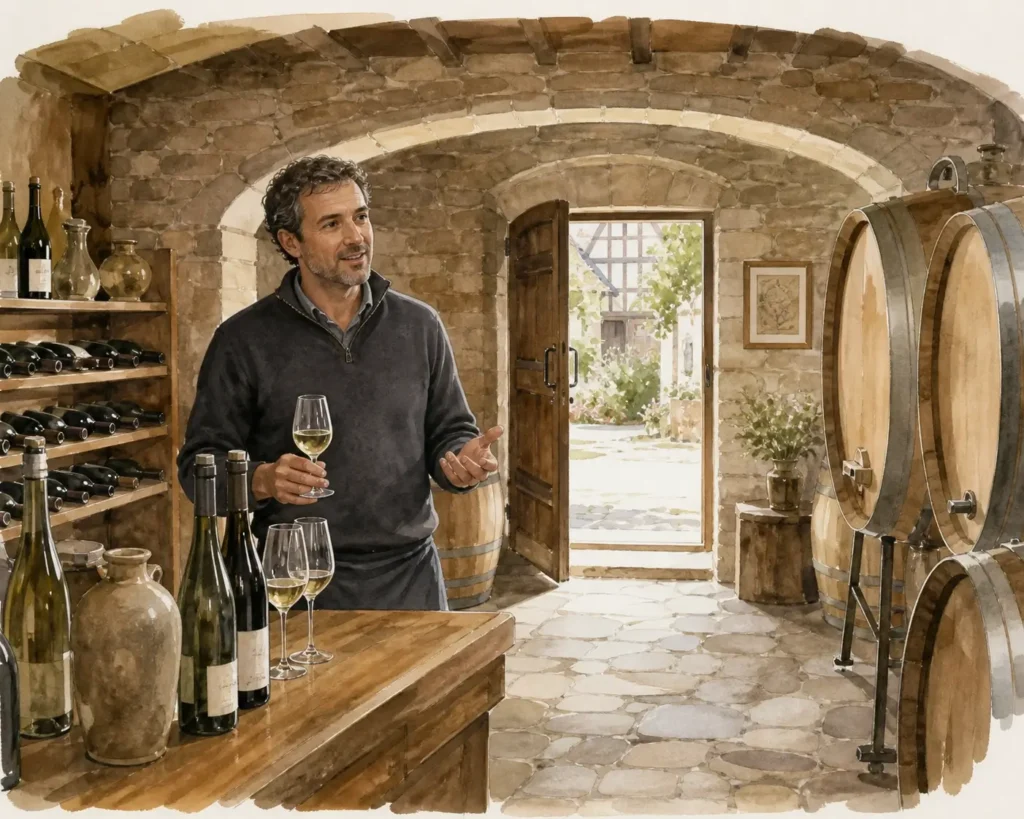
This is the main reason to come. Barr has a solid concentration of independent growers, and the town’s own hillside, the Kirchberg de Barr, is a classified Grand Cru site producing Riesling and Gewurztraminer of real weight. Tastings are usually free or low-cost with the understanding that you may buy a bottle or two. Most cellars open Monday to Saturday, often with a lunchtime closure, and smaller family estates frequently prefer a phone call or email ahead — especially outside summer.
If you want the wider context before you taste, read up on Alsace grape varieties and how to make sense of a label in reading Alsace wine labels. For the practical side of cellar visits across the region, see wine cellars and tastings on the Wine Route.
Explore the vineyards on foot
Marked vineyard trails leave from the edge of town and climb through the parcels above. These are gentle, well-signed walks of one to two hours, with views back over the plain towards the Rhine on clear days. Signage is generally in French and sometimes German; a downloaded map is a sensible precaution.
Hike towards Mont Sainte-Odile
Above Barr, the Vosges foothills carry a dense network of waymarked paths managed by the Club Vosgien. Mont Sainte-Odile, the hilltop monastery site that is one of Alsace’s most important pilgrimage places, is reachable on foot from the Barr area, though it’s a serious half-day walk with real ascent, not a stroll. Many visitors drive up instead and use Barr as the valley base. Either way, check conditions in winter, when upper paths can be icy.
More options across the range are covered in hiking and outdoor activities in Alsace.
See the local museum
Barr has a small municipal museum housed in a historic townhouse, with collections covering local furniture, ceramics and regional decorative arts. Opening is seasonal and limited, so treat it as a bonus rather than a fixed plan and confirm before you build your afternoon around it.
When is the best time to visit Barr?
September and early October are the strongest weeks: grapes coming in, cellars busy in the good sense, vine leaves turning. July brings Barr’s long-standing wine fair, held in and around the town hall, which is a genuinely local event rather than a tourist production. December is quiet compared with the big Christmas market towns, which suits some travellers and disappoints others.
| Season | What Barr is like | Watch out for |
|---|---|---|
| Spring | Vines waking up, mild walking weather | Some cellars still on reduced hours |
| Summer | Wine fair season, long evenings, all cellars open | Warm afternoons, busier weekends |
| Early autumn | Harvest, colour, best atmosphere | Growers working flat out; book tastings ahead |
| Late autumn | Bare vines, few visitors, low prices | Short days, more closures |
| Winter | Quiet town, cosy restaurants | Limited Christmas market scale; icy trails |
For a region-wide view of the trade-offs, see the best time to visit Alsace, and for the vineyard-specific calendar, when to visit the Wine Route and the Alsace harvest season.
Where to eat and what to order
Barr’s restaurants lean traditional, and that’s the point. Look for a winstub — the Alsatian wine tavern format — for the regional standards: tarte flambée cooked thin and blistered, choucroute garnie, baeckeoffe if the kitchen still makes it, and Munster cheese to finish. Portions are large, and lunch service in smaller places typically ends early, often by around 1.30pm, with kitchens closed between services.
Useful background before you order: traditional Alsatian dishes, what a winstub actually is, and how to match glass to plate with Alsace food and wine pairing.
Where to stay in and around Barr
Barr works well as a base if you want vineyard quiet with fast access to Strasbourg. Accommodation here is mostly small: guesthouses, family-run hotels, and rooms attached to wine estates. That scale is the attraction and the constraint — inventory is limited, so September weekends and the July fair period fill early, and last-minute searches often come back empty.
Choose Barr if you’re driving and want a rural base within 40 minutes of Strasbourg. Choose Obernai a few kilometres north if you want more hotels and evening options. Choose Strasbourg or Colmar if you’d rather have city dining and no driving after dinner. Pin down your dates before your accommodation, then book the room.
Where to stay in Barr
Barr has few beds and the rooms attached to wine estates go first — the format that lets you taste in the evening and walk upstairs afterwards. Look at Barr itself for train access on foot, or Mittelbergheim and Andlau (2–4 km) for gîtes and winegrower B&Bs, often cheaper. Obernai is the fallback when Barr is full. September weekends and the July wine fair fill months ahead.
For a full comparison of bases, read where to base yourself in Alsace and the options in where to stay along the Wine Route. If you’d rather sleep among the vines, vineyard hotels in Alsace covers that angle, and bed and breakfast stays suit Barr’s scale particularly well.
How to get to Barr
By train
Barr has its own station on the regional line linking Strasbourg, Molsheim, Obernai, Barr and Sélestat. Travellers continuing to Colmar generally need to change at Sélestat. Journey time from Strasbourg is typically 35–45 minutes depending on the service, with several departures a day. The station is a short walk from the centre, which makes Barr one of the more accessible Wine Route towns without a car.
Regional tickets are inexpensive and don’t require advance booking, but timetables thin out on Sundays and public holidays. Check the day’s schedule before you commit to a late return.
Details on the network are in travelling around Alsace by train, and exploring the Wine Route without a car explains which villages connect and which don’t.
By car
From Strasbourg, allow roughly 40 minutes via the A35 and then the local roads through Obernai. From Colmar, budget around 45–55 minutes depending on whether you take the motorway or the slower, prettier Wine Route itself. Barr has public parking near the centre, and streets in the old core are narrow.
A car remains the most flexible way to link Barr with the smaller villages, hilltop castles and Mont Sainte-Odile in a single day, and demand for hire cars peaks sharply in September and December. Decide your pick-up point first — Strasbourg station, Strasbourg airport or Basel — then reserve, because automatic transmissions in particular are scarce in Alsace.
Renting a car for the Wine Route
Rates are usually lowest 4–6 weeks ahead, and automatics disappear first — particularly in September and December. Compare pick-ups at Colmar station and Basel-Mulhouse airport before booking; the same dates can differ by half the price between suppliers.
See car hire in Alsace for practicalities, and driving the Alsace Wine Route for the route itself.
From further afield
Coming from outside France, your realistic entry points are Strasbourg by TGV or the airports at Basel-Mulhouse-Freiburg and Strasbourg. Both are covered in Alsace airports and how to get to Alsace.
Barr as part of a wider route
Barr sits on the northern stretch of the Wine Route, which means it pairs naturally with a chain of stops rather than standing alone. A satisfying day: Barr in the morning for a tasting, Obernai for lunch and its market square, then the climb to Mont Sainte-Odile in the afternoon. Alternatively, run south towards Sélestat and up to Château du Haut-Kœnigsbourg, which is the single most impressive castle visit in Alsace.
Guided options exist if you’d rather taste properly and not drive at all. Small-group tours leaving Strasbourg cover several villages and two or three estates in a day, with the driving handled; groups are capped, so popular autumn dates go early.
Build your own version with Wine Route itineraries, the northern Wine Route section guide, or day trips from Strasbourg.
Good to know before you go
- Cellars close at lunchtime. Many independent growers shut for one to two hours in the middle of the day and all day Sunday. Plan your tasting for late morning or mid-afternoon.
- Ring ahead for small estates. A short call or email the day before turns a locked door into a proper tasting, particularly outside July and August.
- Don’t rely on the museum. Its opening is seasonal and reduced; confirm before making it the centre of your visit.
- The Mont Sainte-Odile hike is real hiking. Proper footwear, water and a checked forecast. If in doubt, drive up.
- Sunday transport is thin. Regional trains and buses run reduced timetables, and returning to Strasbourg late on a Sunday can be awkward without a car.
- Nominate a driver. Tasting rooms pour generously and French drink-driving limits are strict. One person tastes and spits, or you take a tour.
- Barr is not a Christmas market destination. For that scale, look at the best Alsace Christmas markets.
Frequently asked questions
Is Barr worth visiting?
Yes, if you want wine tasting with few other visitors, easy train access from Strasbourg and a walkable town that still functions as a town. It’s less immediately photogenic than Riquewihr or Eguisheim, so treat it as a tasting and walking stop rather than a scenic highlight. Two to four hours is usually enough.
How do you get from Strasbourg to Barr?
Take a regional TER train from Strasbourg station towards Sélestat or Colmar; the journey is generally 35–45 minutes and the station sits a short walk from Barr’s centre. By car, allow around 40 minutes via the A35. Check the return timetable in advance, as Sunday and holiday services are reduced.
What wine is Barr known for?
Barr lies below the Kirchberg de Barr, a classified Grand Cru hillside best known for Riesling and Gewurztraminer with good structure and ageing potential. Around it you’ll also find Pinot Gris, Sylvaner and Pinot Blanc from independent growers. Tastings in town let you compare Grand Cru bottlings against village-level wines side by side.
Can you visit Barr without a car?
Yes. Barr is one of the easier Wine Route towns to reach by public transport thanks to its own railway station on the Strasbourg–Colmar regional line. Once there, the centre and the vineyard trails are walkable. Reaching neighbouring villages, however, becomes difficult without a car or an organised tour.
Is Barr better than Obernai?
They serve different purposes. Obernai is larger, prettier in its central square, and has more hotels and restaurants. Barr is quieter, more focused on wine production, and better placed for walking into the Vosges. Many visitors do both in a single day, as they’re only a few kilometres apart.
When is Barr’s wine festival?
Barr holds a long-established wine fair in July, centred on the town hall and its surroundings, with tastings from local growers and a distinctly local atmosphere. Exact dates shift each year, so confirm with the tourist office before planning around it. Accommodation nearby fills quickly during that weekend.
Can you walk to Mont Sainte-Odile from Barr?
Yes, via waymarked Club Vosgien paths, but it’s a demanding half-day ascent through forest rather than a casual walk. Allow a full day for the round trip on foot, or drive up and combine the site with Barr in one afternoon. Avoid the upper trails in icy conditions.
Keep planning your trip
- Alsace destinations overview — see how Barr fits among the region’s towns and villages
- The Alsace Wine Route: complete guide — the full picture of the route Barr sits on
- Most beautiful villages on the Wine Route — the classic stops to pair with Barr
- Alsace map and geography — distances and orientation between Bas-Rhin and Haut-Rhin
- Alsace itineraries — ready-made plans from one day to a week
- Alsace food and wine guide — what to order and what to drink with it