
Some links on this page are affiliate links. If you book or buy through them, I earn a small commission — at no extra cost to you. How this site is funded →
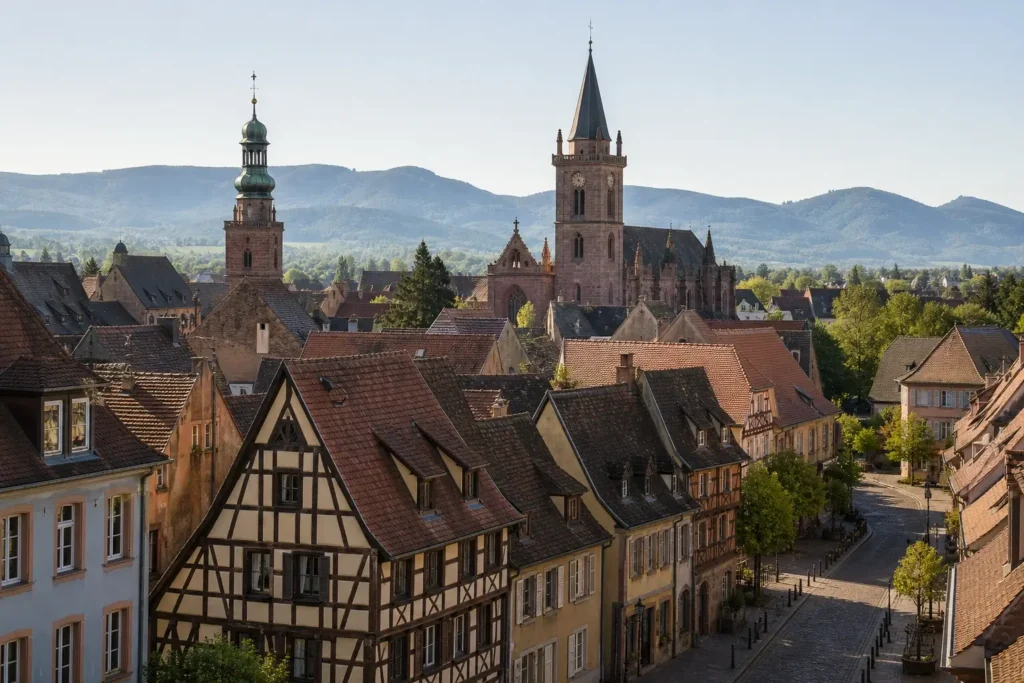
Sélestat sits almost exactly halfway between Strasbourg and Colmar, on the main rail line and beside the A35 motorway. It is not a postcard village and it does not try to be. What It offers a library whose collections are inscribed on UNESCO’s Memory of the World Register, including the library of Renaissance scholar Beatus Rhenanus, two of the finest churches in Alsace, a working town centre with normal prices, and the best transport position in the region. This guide tells you what to see, how long to give it, and when Sélestat is the right call versus when it is not.
In short
- Give it 2 to 4 hours. The old town is compact; the Humanist Library plus both churches is a comfortable half day.
- The Humanist Library (Bibliothèque Humaniste) is the reason to come. It holds a UNESCO Memory of the World collection and is unlike anything else in Alsace.
- Best used as a base or a stop, not usually as your only destination. It is the natural jumping-off point for Haut-Kœnigsbourg and the central Wine Route villages.
- Trains from both Strasbourg and Colmar take roughly 20 minutes, making it one of the easiest car-free stops in Alsace.
- Cheaper than Colmar for food and accommodation, with a genuine local atmosphere rather than a tourist one.
- Skip it if you have only two days in Alsace and want classic half-timbered scenery — go to Riquewihr or Eguisheim instead.
Where Sélestat is and why its position matters
Sélestat lies in the Bas-Rhin, on the Ill river, at the point where the Alsace plain meets the foothills of the Vosges. Strasbourg is about 45 kilometres north; Colmar is about 22 kilometres south. The Haut-Kœnigsbourg castle sits on the ridge directly west, roughly 25 minutes away by road.
That geography is the practical argument for Sélestat. Almost every major Alsace attraction is within a 30-minute drive: the castle, the central Wine Route villages of Ribeauvillé and Riquewihr, the Montagne des Singes and Volerie des Aigles, and the vineyards around Bergheim and Dambach-la-Ville. If you want to understand how the region fits together before you build an itinerary, the Alsace map and geography guide lays out the distances.
For rail travellers, Sélestat is on the Strasbourg–Colmar–Basel line, served by frequent regional TER trains. That makes it one of the few places in Alsace where you can reasonably plan a trip without a car and still reach the countryside — the bus and shuttle options are covered in visiting the Wine Route without a car.
What to see in Sélestat
The Humanist Library
This is the headline. The Bibliothèque Humaniste holds the personal library of Beatus Rhenanus, a Sélestat-born scholar and friend of Erasmus, alongside the town’s medieval school library. The library of Beatus Rhenanus is inscribed on UNESCO’s Memory of the World Register.
The building was renovated and reopened in recent years, and the display is genuinely modern: manuscripts, incunabula and early printed books are shown with English-language context rather than dumped in glass cases. Allow 60 to 90 minutes. Opening hours vary by season and the library typically closes one day a week, so check the current schedule before you build your day around it.
Worth knowing: this is a museum for people who enjoy books, printing, and the intellectual history of the Rhine valley. If that is not you, an hour here will feel long. If it is you, it is the single most interesting indoor attraction between Strasbourg and Colmar.
Église Sainte-Foy
A Romanesque church from the 12th century, built in pink and grey Vosges sandstone, with a heavy west front and three towers. It is one of the best-preserved Romanesque buildings in Alsace and takes about 20 minutes to look around properly. Entry to the church itself is free, as with most Alsatian parish churches.
Église Saint-Georges
Two minutes’ walk from Sainte-Foy, and a complete contrast: a large Gothic church with substantial stained glass, some of it medieval. Seeing the two side by side is the clearest lesson in Alsatian church architecture you will get anywhere in the region without paying for a guide. If churches interest you more broadly, the guide to Alsace’s churches and cathedrals sets them in order.
The old town, the ramparts and the Tour des Sorcières
Sélestat kept fragments of its medieval and Vauban-era fortifications, including the Witches’ Tower and the Tour de l’Horloge. The old town is a loop of maybe 30 to 40 minutes at a slow pace. You will see half-timbered houses, a handsome corn exchange, and courtyards — but fewer, and less concentrated, than in the Wine Route villages. Treat it as pleasant walking between the churches, not as the main event.
Maison du Pain d’Alsace
A small museum devoted to bread, housed in the old bakers’ guild house, with a working bakery. It is a good stop with children and a fair rainy-hour filler. Hours and demonstration times vary, so confirm before making a special trip.
How long to spend, and how Sélestat fits your trip
| Your plan | Time to give Sélestat | What to do |
|---|---|---|
| Driving Strasbourg to Colmar | 2 hours | Humanist Library, both churches, coffee |
| Day trip from Strasbourg by train | Half day | Library, old town, lunch, back by mid-afternoon |
| Combining with Haut-Kœnigsbourg | 2–3 hours | Morning at the castle, afternoon in town |
| Using it as a base | 1 evening + 1 half day | Sights at your own pace, day trips elsewhere |
| Two days in Alsace total | Skip | Prioritise Colmar and one or two villages |
If you are still working out the overall shape of your trip, start with how many days you need in Alsace, then match Sélestat to the slot it actually deserves.
Getting to Sélestat
By train. Sélestat is on the main Strasbourg–Basel line. Journeys from Strasbourg and from Colmar are both in the region of 20 minutes on regional trains, with services running throughout the day. The station is a short walk from the old town — under 10 minutes. Fares on regional services are modest; expect single tickets in the low single-digit euros for the short hops. Details on ticket types and how the network works are in the Alsace by train guide, and the specific Strasbourg–Colmar corridor is covered in travelling between Strasbourg and Colmar.
By car. Sélestat sits directly on the A35 between Strasbourg and Colmar, with clear exits. Drive time is roughly 40 minutes from Strasbourg and 25 from Colmar in normal conditions.
Parking. There is paid parking around the old town perimeter and some free options a little further out. Do not attempt to drive into the pedestrianised core. Arrive before mid-morning on market days and you will have far less trouble.
A car transforms what Sélestat can do for you, because the castle, the monkey park, the bird-of-prey centre and the central Wine Route villages all sit within half an hour. Book an automatic if you cannot drive a manual — automatics are a minority of the French rental fleet and go quickly in high season. Pick-up at Strasbourg station or the airport is usually more convenient than Sélestat itself.
🚗 Renting a car for Sélestat
Automatics make up a small share of the French rental fleet and sell out fast in high season. If you’re planning a Sélestat-based trip, pick up your car at Strasbourg station or Strasbourg airport — both are more convenient than renting in Sélestat itself, and give you flexibility to drop off in Colmar if your route is one-way.
Compare automatic car rentals at Strasbourg station
Book early for July–September and the December market season — availability drops quickly.
Our full breakdown of vehicle types, insurance and cross-border rules is in the Alsace car rental guide.
Day trips from Sélestat
This is where Sélestat earns its place. Everything below is within about 30 minutes’ drive.
- Château du Haut-Kœnigsbourg — the restored hilltop fortress above Orschwiller, and the most visited monument in Alsace outside Strasbourg. Roughly 25 minutes by road, with a seasonal shuttle from Sélestat station in the warmer months. Practical detail in the Haut-Kœnigsbourg visiting guide.
- Montagne des Singes and Volerie des Aigles — a Barbary macaque park and a bird-of-prey centre, both near Kintzheim on the road to the castle. The strongest family combination in the area; see family attractions in Alsace.
- Ribeauvillé and Riquewihr — the heart of the central Wine Route, 15 to 20 minutes south-west. Covered in the central Wine Route guide.
- Dambach-la-Ville and Bergheim — walled wine villages with far fewer coach parties, both under 20 minutes away.
- Colmar — 20 minutes by train or car, easily done as a half day from a Sélestat base. See the Colmar destination guide.
If you would rather not drive at all, guided day tours generally depart from Colmar or Strasbourg rather than Sélestat, and small-group departures for the castle-and-villages loop fill early in September and December. Compare the options in Alsace wine tours and guided versus self-guided touring.
Eating and drinking in Sélestat
Sélestat is a real town, which means restaurants price for locals rather than for coach traffic. You will find winstubs, brasseries and bakeries around the old town and along the main streets. Expect a two-course lunch in the middle of the standard Alsatian range — usually noticeably less than the equivalent in central Colmar.
What to order: tarte flambée in the evening (many places serve it only after 6pm), baeckeoffe if it appears on a weekend menu, and a glass of dry Riesling rather than a sweet aperitif wine with anything savoury. The wider picture of what to eat and when is in the Alsatian traditional dishes guide, and the winstub explainer tells you what to expect from the format.
Note the usual French service pattern: lunch generally runs roughly midday to 2pm, dinner from around 7pm, and many kitchens close entirely on Sunday evening and Monday. Plan around it rather than being caught out.
Where to stay: is Sélestat a good base?
Yes, with one caveat.
The case for it. You get rail access to both Strasbourg and Colmar in about 20 minutes each, road access to the castle and the central Wine Route in under half an hour, lower room rates than either big city, and easy parking. For a road trip built around the countryside rather than the cities, it is one of the most efficient bases in Alsace.
The caveat. Evening atmosphere is limited. Sélestat is quiet after dinner. If you want to stroll a lit-up old town after dark, or you are travelling as a couple looking for evening charm, you will be happier in Colmar or in a Wine Route village.
Accommodation stock in Sélestat is modest — a handful of hotels plus guesthouses in the surrounding villages — and it books out fast when Haut-Kœnigsbourg is busy and during the Christmas market season, when the whole corridor between Strasbourg and Colmar fills up. If your dates fall in September, October or December, secure a room well ahead.
🏨 Where to book
Sélestat’s hotel and guesthouse stock is modest, and it fills up fast around Haut-Kœnigsbourg’s busy periods and the Christmas market season. If your dates fall in September, October, or December, book well ahead.
See hotels and guesthouses in Sélestat and nearby villages
Prefer more evening atmosphere? Browse hotels in Colmar
To compare Sélestat against the alternatives properly, read choosing where to base yourself in Alsace and the options for staying on the Wine Route. For the full picture across the region, the where to stay in Alsace guide is the place to start.
When to visit Sélestat
| Season | What it’s like | Verdict |
|---|---|---|
| Spring | Quiet, mild, everything open, vines greening | Excellent value |
| Summer | Busiest, castle and parks crowded, warm plain | Book ahead, start early |
| September–October | Harvest, vineyard colour, strong demand | Best all-round period |
| November | Grey and quiet, some closures | Only for the library |
| December | Christmas market season, regional crowds | Good, but book far ahead |
| January–February | Very quiet, short days | Skip unless passing through |
Sélestat holds its own Christmas market, smaller and less commercial than Strasbourg’s, and it is also known for a summer flower festival — dates for both shift year to year, so verify before planning around them. The seasonal picture across the region is set out in the best time to visit Alsace, and the December logistics in Christmas market dates and opening times.
Common mistakes to avoid
- Turning up expecting Riquewihr. Sélestat is a town, not a village showpiece. Come for the library, the churches and the position — not for wall-to-wall half-timbering.
- Not checking the Humanist Library’s opening day. It closes at least one day a week and hours change seasonally. If it is the reason you came, confirm first.
- Arriving on a Monday. Museums, and many restaurants, commonly close. Monday is the worst day of the week to visit almost anywhere in Alsace.
- Assuming the castle shuttle runs year-round. The seasonal bus link from Sélestat station to Haut-Kœnigsbourg operates daily from 30 May to 30 August 2026, and on weekends and public holidays from 28 February 2026 to 3 January 2027. Outside the daily summer period, the shuttle still operates on weekends and public holidays. On other days, you will need a car, a taxi or a guided tour.
- Driving into the pedestrian zone. Park on the ring and walk. The centre is small enough that it makes no difference.
- Missing Église Saint-Georges. Visitors do Sainte-Foy and leave. The two together are the point.
- Budgeting a full day. Unless you are pairing it with a day trip, you will run out of things to do by mid-afternoon.
Sélestat FAQ
Is Sélestat worth visiting?
Yes, if you want the Humanist Library, two outstanding churches, or a well-placed base for the castle and the central Wine Route. Give it two to four hours as a stop. It is not the right choice if you only have a couple of days in Alsace and want classic village scenery — in that case prioritise Colmar and one or two Wine Route villages.
How long does it take to get from Strasbourg to Sélestat?
Around 20 minutes by regional TER train, with services running frequently throughout the day. By car it is roughly 40 minutes on the A35. From Colmar the train also takes around 20 minutes. That symmetry is what makes Sélestat such a practical stop between the two cities.
Can you visit Haut-Kœnigsbourg from Sélestat without a car?
In the warmer months, yes — a seasonal shuttle bus links Sélestat station with the castle. Outside the shuttle’s operating days, you will need a car, a taxi, or a guided tour departing from Colmar or Strasbourg. Always confirm the current shuttle timetable before travelling, as it changes from year to year.
What is the Humanist Library and do I need to book?
It is a museum built around the Renaissance book collection of scholar Beatus Rhenanus, inscribed on the UNESCO Memory of the World register. Advance booking is not usually necessary for individuals, but hours vary by season and it closes at least one day a week. Check the current schedule before you go. Allow 60 to 90 minutes.
Is Sélestat a good base for exploring Alsace?
It is one of the most efficient bases in the region for a car-based trip: 20 minutes to Colmar, 40 to Strasbourg, under 30 to Haut-Kœnigsbourg and the central Wine Route villages, with cheaper rooms and easier parking than either city. The trade-off is a quiet evening atmosphere.
Does Sélestat have a Christmas market?
Yes, a modest one, generally running through the weeks before Christmas like most Alsatian markets. It draws a mainly regional crowd rather than international visitors, which many people prefer. Dates and opening hours change each year, so verify before planning a trip around it.
Do people speak English in Sélestat?
Less consistently than in Strasbourg or Colmar, since Sélestat sees fewer international visitors. Museum staff and hotel receptions generally manage well; small shops and some restaurants may not. A few polite French phrases go a long way here.
Keep planning your Alsace trip
- Alsace destinations: towns and villages compared — where Sélestat sits among the alternatives
- The prettiest villages in Alsace — for the half-timbered scenery Sélestat doesn’t have
- The Alsace Wine Route: complete guide — the vineyards on Sélestat’s doorstep
- Alsace itineraries by length — fitting Sélestat into 3, 5 or 7 days
- Day trips from Strasbourg — including the Sélestat and castle route
- How to plan a trip to Alsace — transport, timing and budget from scratch