
Some links on this page are affiliate links. If you book or buy through them, I earn a small commission — at no extra cost to you. How this site is funded →
Neuf-Brisach is the most complete Vauban fortress town in Alsace, and one of the twelve French sites listed by UNESCO as part of the Fortifications of Vauban. It sits on the flat Rhine plain about 15 kilometres east of Colmar, and it looks nothing like the half-timbered wine villages nearby. This page explains what there is to see, how much time to give it, how to get there without wasting half a day, and whether it deserves a slot in your itinerary at all.
In short
- What it is: a purpose-built garrison town from around 1700, laid out as a perfect octagon inside star-shaped ramparts, designed by Vauban for Louis XIV.
- Why it matters: UNESCO World Heritage since 2008, as part of the Fortifications of Vauban network.
- How long to spend: 1.5 to 2.5 hours is plenty for the ramparts, the central square and the museum.
- Best paired with: Colmar, the Écomusée d’Alsace, or a Rhine crossing into Germany at Breisach am Rhein.
- Getting there: easiest by car (roughly 20–25 minutes from Colmar). Bus links exist but are infrequent, especially at weekends.
- Who should skip it: first-timers with only two or three days who came for vineyards and Christmas markets.
Why visit Neuf-Brisach at all?
Because it is the clearest example in France of a town designed entirely on paper and then built from nothing. The name means « New Breisach ». After France lost the Rhine-side fortress of Breisach in the late 17th century, Louis XIV ordered a replacement on the French bank. Vauban delivered a fortified town in the shape of an octagon, with a grid of streets inside and a central parade square, ringed by bastions, ravelins and dry ditches.
Walk it today and the geometry is still legible from the ground. Streets meet at right angles, the blocks are almost identical in size, and every road eventually runs into the ramparts. There is no organic medieval tangle here, and that is precisely the point.
What Neuf-Brisach is not: pretty in the postcard sense. If you are expecting flower-hung timber façades, you will be disappointed. For that, head to Riquewihr or Eguisheim. Come to Neuf-Brisach for architecture, military engineering and a genuinely different chapter of the region’s story.
What to see and do
Walk the ramparts
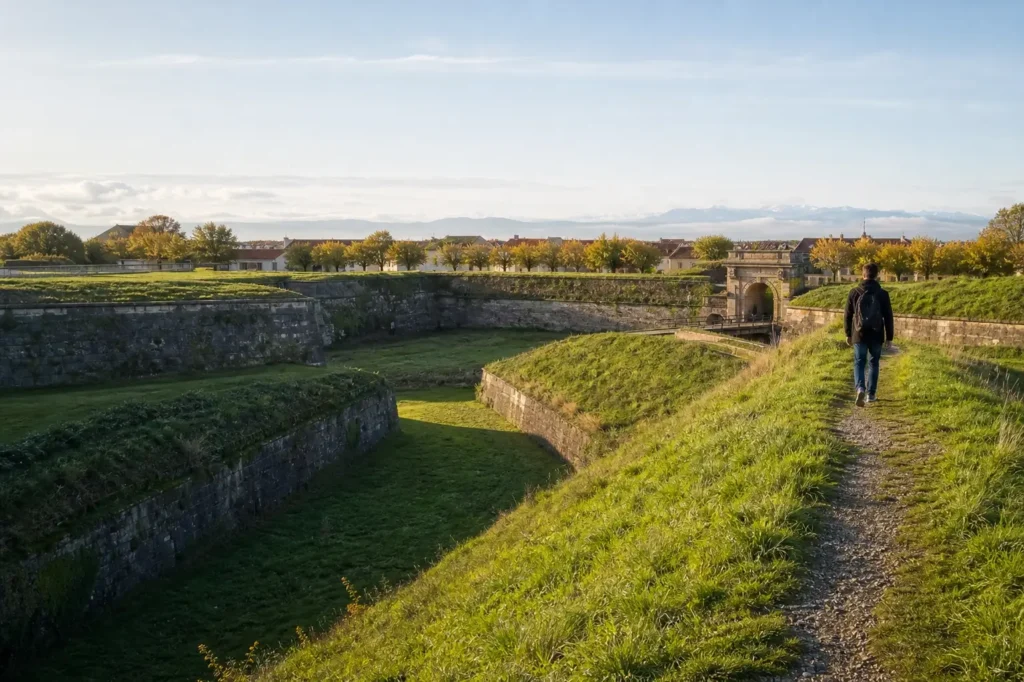
This is the main event, and it is free. The defensive belt survives more completely than at most Vauban sites: you can follow long stretches of the earthworks, look down into the dry ditches, and get a feel for how deep the defensive system ran before an attacker reached the town wall. Grass covers much of it, so it functions locally as a park as well as a monument.
Practical points: the full circuit is a walk of a couple of kilometres, longer if you detour onto the outer works. Surfaces are uneven grass and gravel in places, and there is very little shade. Wear proper shoes rather than city footwear.
The historic gates
Monumental stone gateways pierce the ramparts, and they are the best single spot to understand the thickness of the defences. One of them houses the town’s Vauban museum, dedicated to the fortifications and the history of the site. As with all small municipal museums in Alsace, opening days and hours vary with the season and can be reduced outside summer, so check with the local tourist office before you plan your day around it.
The central square and the church
The Place d’Armes at the centre of the grid was the parade ground, and it remains the town’s focal point, with the church of Saint-Louis on one side. It takes ten minutes to see, but stand in the middle and look down the four axes: the whole logic of the town becomes obvious in a single glance.
Cross the Rhine to Breisach am Rhein
Neuf-Brisach sits close to the German border, and its historic counterpart, Breisach am Rhein, is a short drive across the river. The hilltop minster and the views back over the plain make an easy add-on, and it turns a 90-minute stop into a satisfying half day. Bring ID for the crossing even though checks are usually absent.
How long do you need?
| Plan | Time needed | What you get |
|---|---|---|
| Quick stop | 45–60 min | Central square, one gate, a short section of rampart |
| Standard visit | 1.5–2.5 hrs | Full or near-full rampart circuit, museum, central square |
| Half day | 3–4 hrs | Neuf-Brisach plus Breisach am Rhein across the Rhine |
| Full day | 6+ hrs | Combined with the Écomusée or a Rhine-plain loop |
Our advice: treat it as a 2-hour stop on a driving day, not a destination in its own right. If you are working out how to distribute your days across the region, the how many days in Alsace breakdown will help you decide whether a stop like this fits.
How to get to Neuf-Brisach
By car
The simplest option by a wide margin. From Colmar it is a straightforward run east across the plain, roughly 20–25 minutes in normal traffic. From Strasbourg allow around an hour and a quarter; from Basel and the EuroAirport, a similar order of time going north. Parking is generally available around the ramparts and outside the gates rather than in the tight central grid, which is not designed for modern traffic.
Because the Rhine plain has few useful public transport links between minor towns, a car transforms what you can string together in a day: Neuf-Brisach, a wine village or two, a castle and dinner in Colmar all become realistic. Demand for hire cars peaks in September and December, and automatic transmissions in particular sell out early in Alsace, so lock in the vehicle class you actually want rather than gambling on availability at the desk. Full comparison of pick-up points and paperwork is in our car hire guide for Alsace.
Renting a car for the Wine Route
Rates are usually lowest 4–6 weeks ahead, and automatics disappear first — particularly in September and December. Compare pick-ups at Colmar station and Basel-Mulhouse airport before booking; the same dates can differ by half the price between suppliers.
By public transport
There is no useful passenger rail service into the town itself for visitors, so you are relying on regional buses from Colmar. Services run on a weekday-oriented timetable built around commuters and schools, which means limited frequency in the middle of the day and thin or non-existent options on Sundays and public holidays. Check the current timetable the day before you travel, and plan the return leg first.
If you are travelling car-free across the region generally, read the getting around Alsace overview and the dedicated car-free Alsace itineraries, which concentrate on places with genuinely reliable connections. Neuf-Brisach is not one of them.
On a tour
Neuf-Brisach appears occasionally on Rhine-plain or heritage-themed excursions rather than on the standard villages circuit. If you want it covered without driving, a private or custom arrangement is the realistic route, as described in our private and custom tours guide. Guides based in Colmar are the ones most likely to know the site well.
Combining Neuf-Brisach with the rest of your trip
The town’s biggest asset for planners is its position: east of Colmar, on the flat plain, close to the German border. That makes it a natural add-on rather than a detour.
- With Colmar. Base yourself in the city, and Neuf-Brisach becomes a half-morning outing before lunch back in the old town. See what to do in Colmar for the return leg.
- With the Écomusée d’Alsace. Neuf-Brisach lies east of Colmar, while the Écomusée is farther south, near Ungersheim. They are therefore not immediate neighbours, but they can be combined in a longer Rhine-plain itinerary if you are driving.
- With the Wine Route. The vineyards run along the hills to the west. Combine the two in one day and you get a striking contrast: engineered flatland fortress in the morning, terraced slopes in the afternoon. Plot it using the Wine Route map and the central Wine Route section.
- With Germany. Breisach, and beyond it the Black Forest. If you are considering a cross-border loop, our Alsace, Black Forest and Switzerland planner covers the sensible routings.
- With other fortifications. Pair it with the hill castles for a broader defensive story: Haut-Kœnigsbourg is the obvious choice, and the castles of Alsace page lists the practical alternatives.
For readers who like the engineering angle, the history of Alsatian castles and fortifications explains why this corner of Europe ended up so heavily defended.
Where to stay nearby
Neuf-Brisach itself has only a small amount of accommodation, and most visitors sleep elsewhere. The two workable strategies:
- Colmar. Best for restaurants, evening atmosphere, rail connections and day-trip range. Compare districts in our Colmar accommodation guide.
- A wine village on the hills west of Colmar. Quieter, better value in shoulder season, and you wake up among vines. Downsides: fewer dinner options and you will drive everywhere.
Village stays are the tightest supply in the whole region. Inventory is genuinely small, and September harvest weekends and December market weekends sell out months ahead, so decide your base early rather than late. Our comparison of Strasbourg versus Colmar versus a village base sets out the trade-offs, and the vineyard hotel selection covers the vines-outside-the-window option.
When to visit
Neuf-Brisach is an outdoor site, so weather matters more here than in a museum town.
| Season | What it is like | Verdict |
|---|---|---|
| Spring | Green ramparts, mild walking conditions, low crowds | Very good |
| Summer | Long daylight, but the earthworks are exposed with little shade | Good early or late in the day |
| Autumn | Clear light, comfortable temperatures, harvest activity in nearby vineyards | Best overall |
| Winter | Bare, often grey and damp on the plain; the geometry still reads well | Only worth it if you are nearby |
The town is not part of the classic Christmas market circuit. If December is your travel month, put your energy into the markets themselves and read the Alsace Christmas markets guide instead. For seasonal weather patterns across the region, see Alsace weather by season and the broader best time to visit Alsace advice.
Christmas 2026: Important Information
Christmas market: 11–13 December 2026, at the Town Hall Square and village hall. Admission is free.
Opening hours: Friday 2–8 pm; Saturday 10 am–9 pm; Sunday 10 am–6:30 pm.
Good to know before you go
- Do not expect a wine village. Neuf-Brisach is military architecture on flat ground. Setting your expectations correctly is the single biggest factor in enjoying it.
- Check museum opening before travelling. Small-town museums in Alsace often close for lunch, shut one or two days a week, and reduce hours out of season. Confirm with the tourist office.
- The ramparts read best from above. Aerial views make the octagon obvious; from ground level you need to walk a full stretch of the earthworks to appreciate the layout. Give the circuit proper time.
- Sunday and holiday transport is the trap. Bus frequency drops sharply. If you have no car, verify both directions before committing to the day.
- Shops and restaurants are limited. Plan lunch in Colmar or across the river in Breisach rather than assuming choice on site.
- Bring ID if crossing into Germany. Border checks are usually absent, but carry your passport or national ID card regardless.
- Wear walking shoes. Grass, gravel and uneven earthworks, not paved lanes.
Frequently asked questions
Is Neuf-Brisach worth visiting?
Yes, if you have a car, four or more days in Alsace, and an interest in architecture or military history. It is the region’s most complete Vauban fortress town and takes only about two hours. If you have a short trip focused on wine villages and Colmar, skip it — see is Alsace worth visiting for how to prioritise.
How far is Neuf-Brisach from Colmar?
About 15 kilometres east, which is roughly 20 to 25 minutes by car across the Rhine plain. Regional buses connect the two but run on a limited, commuter-shaped timetable, so always check the return service before you set out.
Why is Neuf-Brisach a UNESCO site?
It was inscribed in 2008 as one of twelve French locations forming the Fortifications of Vauban World Heritage listing. Neuf-Brisach is included because it is an exceptionally intact example of Vauban’s late fortification style: a planned octagonal town with a complete, purpose-built defensive belt.
Can you walk on the ramparts?
Yes. Long sections of the earthworks and defensive works are freely accessible on foot, and walking them is the main reason to come. The full circuit is a couple of kilometres over grass and gravel with little shade, so allow at least an hour and wear suitable shoes.
Is Neuf-Brisach good with children?
It works as an open-air space to run around in, and the sheer scale of the ditches and gateways tends to impress. There is no interactive attraction, though. For a more child-focused day on the same side of the region, look at family attractions in Alsace.
Does Neuf-Brisach have a Christmas market?
It is not one of the region’s recognised Christmas market towns. For December, concentrate on Strasbourg, Colmar and the wine villages; the best Christmas markets in Alsace comparison ranks them by size, atmosphere and ease of access.
Can you visit Neuf-Brisach without a car?
It is possible using regional buses from Colmar, but frequency is low and weekend service is unreliable. Unless you enjoy building your day around a bus timetable, either hire a car for the day or choose a different destination from the Alsace destinations overview.
Keep planning
- Alsace destinations: where to go — the full list of towns and villages worth your time
- Prettiest villages in Alsace — the counterpoint to Neuf-Brisach’s geometry
- Map and geography of Alsace — how the plain, the hills and the two departments fit together
- Day trips from Colmar — what else is within easy reach
- Alsace itineraries by length — 1 to 7 days, ready to adapt
- How to plan a trip to Alsace — transport, timing, budget and bases in one place